By Jetson, Head of CRO at ThriveX
Reading time: 6 minutes. Last updated: May 2026.

Author's Note:
AI marketing is worth it when it changes how fast you learn from your own funnel, and far less so when it only produces more ads. The brands pulling ahead in 2026 use AI to shorten the insight loop, to assess the funnel objectively, and to iterate on campaigns faster. Brands that bolt AI tools onto a manual process mostly get more output at the same results. If your cost per acquisition keeps climbing despite rising investment, the constraint is usually operational rather than creative, and that is where the return on AI sits. If you have already invested and results haven't moved, start with why your AI marketing is not working.
Lock in early access to the ThriveX AI Audit with Jetson for $49 before it goes to $99 at full launch.
Is AI Marketing Worth It? Where the Return Actually Comes From
Global digital ad spend continues to climb. Platforms have better algorithms. AI targeting features have improved. And yet, for a significant portion of founders and marketing leads, 2025 delivered a frustrating result: more spend, higher cost per acquisition, and flat revenue growth.
That frustration has a name: the Efficiency Gap.
The Efficiency Gap is the distance between what you invest in marketing and what you get back in terms of revenue, learning, and leverage. For brands that have operationalized AI across their marketing functions, that gap is closing. For those still relying on manual reporting, gut-feel copy testing, and monthly retrospective audits, it is growing.
This is not a technology story. It is a systems story. And in 2026, it is the defining divide in performance marketing.
What the Data Actually Shows
This is not anecdotal. The evidence from major research institutions points clearly in one direction.
McKinsey's State of AI 2024 found that 65% of organizations are now regularly using generative AI, nearly double the figure from the prior year. The biggest single-year adoption jump occurred in marketing and sales. Yet adoption and operationalization are two different things. Most organizations remain in the experimentation phase, while a small group of AI high performers, those attributing more than 10% of EBIT to AI, are pulling meaningfully ahead.
BCG's Future of Marketing with GenAI report put a number to the divergence: AI-mature marketing organizations are achieving 3 to 6 times the ROI on their total marketing spend compared to traditional operations. Campaign go-live time is collapsing from months to weeks. ROAS is improving by 50 to 100% through AI-powered audience analytics and execution control.
Meanwhile, BCG's AI adoption research found that 74% of companies still struggle to scale AI beyond proof-of-concept. Those organizations are not just missing out on efficiency gains; they are actively falling behind competitors who have restructured their marketing workflows around AI.
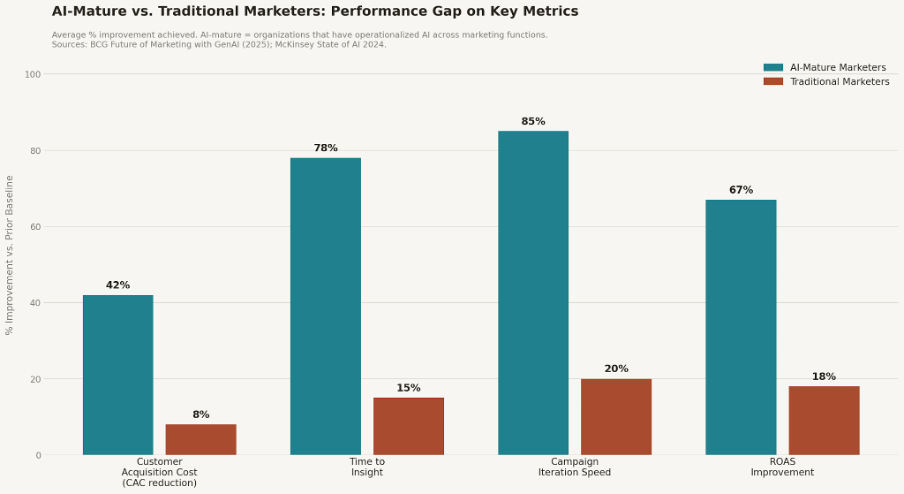
Figure 1 AI-mature marketers vs. traditional marketers across four key metrics: CAC reduction, time to insight, campaign iteration speed, and ROAS improvement.
Sources: BCG Future of Marketing with GenAI (2025); McKinsey State of AI 2024.
Why Manual Ad Management Is a Structural Disadvantage in 2026
It is worth being precise about what "manual ad management" actually means in this context. It does not simply mean running ads without automation. It means operating a marketing function where:
Performance data is reviewed weekly or monthly, not in near real-time
Creative iteration cycles run on human bandwidth rather than automated testing loops
Attribution analysis depends on a single analyst pulling reports rather than AI synthesizing signals across touchpoints
Funnel diagnostics happen as a quarterly or annual exercise, not a continuous monitoring function
Each of these represents a lag. And in a competitive paid media environment, lags cost money.
The platforms themselves are not the problem. Google and Meta have built increasingly sophisticated targeting infrastructure. The algorithms are very good at finding people who will click. The structural leak is almost always on the receiving end: the funnel, the landing page, the checkout, the pricing page clarity.
When a traditional marketer sees rising CAC, the instinct is to test more ad creatives or adjust bidding strategies. An AI-mature marketer runs a diagnostic first. Where is the drop-off? At which step? On which device? For which audience segment? Those answers determine whether the problem is the ad, the landing page, the offer, or the checkout. Without that diagnostic layer, you are adjusting the wrong variable.
For more on why fixing your funnel before scaling spend is the foundational move, the CRO Before Ads framework lays out exactly why conversion optimization must precede paid media at any meaningful scale.
The Three Operational Gaps That Define AI Maturity
Based on BCG's research framework and what we see directly with the brands ThriveX works with, AI maturity in marketing comes down to three operational capabilities.
1. Speed of the Insight Loop
Scenario 1, Traditional. A campaign runs for two weeks. The marketing manager pulls a performance report on Friday. The team meets Monday to review. Decisions are made the following week. By the time a new creative is live, three weeks have passed and $18,000 of budget has run.
Scenario 2, AI-Mature. Automated anomaly detection flags a conversion drop within hours of a campaign going live. A diagnostic surfaces the issue as a landing page load speed problem on Android. The team fixes it the same day. Budget efficiency is preserved.
BCG data shows AI-mature marketing teams achieve up to 60% reduction in time spent on post-campaign analysis, freeing strategic bandwidth for higher-value decisions.
2. Objectivity of Funnel Assessment
Manual audits carry the bias of whoever is doing the work. If the reviewer comes from a copy background, they focus on headlines. If they have a design orientation, they look at visual hierarchy. The result is an opinion, not a diagnosis.
AI-powered diagnostics score friction across the entire funnel, from ad click to post-purchase, using behavioral data, technical performance signals, and messaging continuity analysis. The output is a prioritized list of leaks ranked by revenue impact, not ranked by the reviewer's strongest opinion.
3. Iteration Velocity on Campaigns
McKinsey's research on AI high performers consistently shows that these organizations are redesigning their workflows, not just layering AI tools on top of existing processes. The result is campaign iteration cycles that compress from weeks to days.
In mobile-first markets across Southeast Asia, where user behavior shifts rapidly across platforms and devices, this iteration speed advantage compounds quickly. A team that can run ten creative tests per month will outlearn a team running two, regardless of how much either spends per test.
Why Diagnostics Are Now the Highest-ROI Investment in Marketing
The strategic implication of the Efficiency Gap is straightforward, even if it is counterintuitive to most founders.
Adding $10,000 per month to your ad spend into an undiagnosed funnel might generate a 10 to 15% lift in raw traffic. Investing that same $10,000 into identifying and fixing your two or three highest-friction points will often reduce CAC by 20 to 40% permanently, meaning every future dollar you spend works harder.
Diagnostics are not a cost center. They are an insurance policy on your paid media investment.
This is why the most sophisticated marketing leaders are shifting diagnostics from an annual exercise to a continuous operating layer. The AI Marketing Strategy framework for SMEs covers how to structure this thinking across an entire marketing function, not just at the campaign level.
The shift also changes how you think about your tech stack. The question is no longer "which ad platform should I allocate more budget to?" The question is "which part of my funnel is bleeding, and how quickly can I see it?"
Related: AI Marketing Trends for 2025 covers the broader platform and technology shifts that are reshaping where AI maturity creates competitive advantage.
The Real Cost of Waiting
There is a compounding cost to operating with a closed efficiency gap that is easy to underestimate.
Every month you run paid media into an underdiagnosed funnel, you are paying premium CPCs and CPMs to expose more of your target market to a suboptimal experience. That does not just waste budget in the short term. It erodes brand equity with potential customers who clicked, hit friction, and left.
The brands that close their efficiency gaps early in 2026 will not just have better unit economics this quarter. They will have cleaner retargeting pools, better lookalike audiences trained on higher-quality converters, and stronger Quality Scores on paid search, all of which compound into structural cost advantages.
The Invisible Friction AI Audit article goes deeper on the specific friction patterns that AI diagnostics are uniquely positioned to surface, particularly the ones that do not show up in standard analytics.
Understanding how AI-powered search is changing buyer intent signals is also critical context. AEO and Google AI Overviews explains how search behavior shifts affect the top of your funnel, and why diagnostic thinking extends beyond on-site conversion.
The Thesis for 2026
The 2026 efficiency thesis is this: the gap between AI-mature marketing organizations and those still running on manual processes will not stabilize. It will widen.
The leaders who invest now in diagnostic infrastructure, whether that means internal AI tooling, a structured audit process, or a dedicated audit engagement, are not just optimizing today's campaigns. They are building an operating advantage that compounds.
The leaders who respond to rising CAC by pushing harder on ad spend, without first understanding why the CAC is rising, will continue to fund the efficiency gap rather than close it.
The choice between those two paths is the defining strategic question for every marketing leader in 2026.
Get a CRO Audit with Jetson for $49
What you get. A full AI-powered audit and 1:1 recommendation session with Jetson. We analyze your funnel end-to-end, identify your highest-impact friction points, and give you a prioritized fix list built around your specific growth goals.
Why now. Early access is $49. At full launch, it goes to $99.
Who it is for. DTC, B2B, and SaaS founders or marketing leads spending at least $5K per month on paid media, or planning to scale.
Book it here.Lock in early access at $49 before it goes to $99.
Further Reading in the ThriveX Knowledge Hub
AI Marketing Strategy for SMEs - The pillar framework for building an AI-powered marketing strategy from the ground up.
AI Marketing Trends 2025 - The platform and technology shifts every performance marketer needs to track this year.
CRO Before Ads - Why conversion optimization must come before you scale paid media, and how to sequence it correctly.
Invisible Friction AI Audit - The specific friction patterns that AI diagnostics find, and that manual audits miss.
AEO and Google AI Overviews - How AI-powered search is reshaping buyer intent signals at the top of your funnel.