By Jetson, Head of CRO at ThriveX
Reading time: 6 minutes. Last updated: May 2026.
Author's Note:
Six AI marketing shifts are separating high-growth teams from everyone else in 2025-2026: AI agents replacing manual media buying, generative content at scale, AI-driven personalization, predictive CRO, AI customer service, and AEO citation optimization. Practical execution beats the hype in every one of these.
Lock in early access to the ThriveX AI Audit with Jetson for $49 before it goes to $99 at full launch. Book your audit here.
Why This Year Is Different
For three years, the dominant AI marketing story was experimentation. Teams installed tools, ran pilots, and wrote case studies about ChatGPT generating blog drafts. That era is over.
According to the HubSpot State of Marketing 2026 report, 80% of marketers now use AI for content creation, and adoption across functions is accelerating. The teams generating real lift are not running experiments. They have replaced manual workflows entirely.
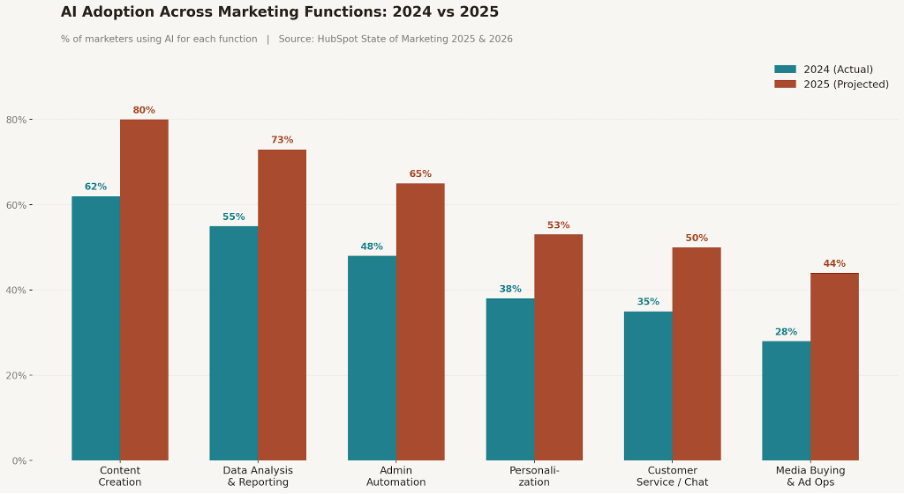
AI adoption by marketing function, 2024 actual vs 2025 projected.
Source: HubSpot State of Marketing 2025 and 2026 reports.
The question for 2025-2026 is not whether to use AI. It is which six shifts to move on first.
Trend 1: AI Agents Are Replacing Manual Media Buying Tasks
AI agents are beginning to handle end-to-end campaign management tasks that previously required a media buyer's daily attention. New standards like the Ad Context Protocol (AdCP), launched by Yahoo and PubMatic, allow AI agents to negotiate and purchase ad placements directly, bypassing traditional programmatic auction systems. Early data shows up to 15% lift in campaign ROI through cleaner auctions and faster launches.
Traditional programmatic loses an estimated 15-20% of advertiser spend to fees, duplication, and opaque supply chains. 60% of US ad buyers have already used or plan to use AI-powered buying products, according to eMarketer.
What this means practically: restructure campaigns to give AI agents more signal (first-party data, broad match, value-based bidding) and reduce manual bid adjustment workflows.
Trend 2: Generative Content at Scale (With Brand Guardrails)
63% of marketers are currently using generative AI, per Salesforce's State of Marketing. The distinction separating high performers is the brand voice layer. Generic AI content underperforms because it lacks the expertise signal and proprietary perspective that earns trust.
The working system: build a brand voice document from your 15-20 best-performing posts, use it as context in every generation prompt, and let AI handle drafts and repurposing while humans own strategy and final edit. Target benchmark: 3x your current content output without adding headcount.
Trend 3: AI-Driven Personalization Beyond Email Tokens
53% of marketers now incorporate AI personalization, up from under 40% the prior year, according to HubSpot's State of Marketing 2026. The leap is being driven by tools that make behavioral targeting accessible without a data science team.
Scenario 1, Static site. Every visitor sees the same hero, same descriptions, same CTA regardless of intent. Conversion rates reflect the average.
Scenario 2, AI-personalized. Visitors from a specific search ad see a matched hero. Return visitors see previously viewed items surfaced higher. Email subscribers see loyalty pricing flags.
AI-driven personalization increases customer engagement by an average of 30% and drives a 20% increase in sales at the platform level. This connects directly to the foundation covered in the AI Marketing Strategy guide for SMEs: personalization at scale requires clean data first.
Trend 4: Predictive CRO
Traditional A/B testing splits traffic equally and waits weeks for significance. Predictive CRO replaces the static model with continuous optimization. Multi-armed bandit testing dynamically shifts traffic toward better variants as data accumulates, rather than waiting for a pre-set threshold.
Companies using AI-powered CRO tools see an average 15% increase in conversion rates compared to those using traditional methods, with some achieving up to 25% lifts, according to Gartner-cited research. For teams spending $5K+ per month on paid media, improving the conversion system before scaling ad spend is always the higher-ROI sequence. I cover this math in detail in The Efficiency Gap: What Slows Growth in 2026.
Trend 5: AI Customer Service That Actually Closes
The generation of AI customer service tools available in 2025 is structurally different from early chatbots. Models deployed on your product catalog and FAQ data can handle complex multi-turn conversations, make personalized recommendations, and manage objections with fluency that converts. Forrester projects generative AI will displace 100,000 frontline agents from top global outsourcers by 2025, not just because of cost but because of 24/7 availability.
For businesses where customers shop late (a pattern common across mobile-first markets in Southeast Asia and globally), that availability is directly tied to revenue.
If you are uncertain whether your funnel has fixable friction before deploying AI customer service, the Invisible Friction AI Audit is a useful diagnostic starting point. Use conversation data to identify the top 10 friction questions your funnel generates. Each one is a CRO opportunity.
Trend 6: AEO and Citation Optimization
Search behavior is restructuring around AI-generated answers. ChatGPT now handles over 2 billion queries daily, and AI-referred sessions to websites grew 527% year-over-year through mid-2025. Ahrefs found that position 1 CTR drops 58% when a Google AI Overview is present, making citation in AI answers the primary way to recover lost visibility.
The opportunity gap is significant. 70% of organizations believe AEO will significantly impact their digital strategy within 1-3 years, but only 20% have begun implementing it, according to Acquia. Teams that move now have a first-mover window.
Practical AEO tactics:
Frame H2 and H3 headings as direct questions that match how users query AI tools
Include a specific, cited data point every 150-200 words. AI engines preferentially cite content with verifiable data
Implement FAQ schema markup. Entity-driven content improved AI citation likelihood by more than 35%, per Search Engine Land
Update content regularly. AI engines track content freshness and favor recently updated pages
For a full structural breakdown, the AEO and Google AI Overviews pillar covers the technical and content requirements in detail.
Sequencing Your Move
Do not stack all six trends at once. Sequence matters:
Month 1. Fix conversion friction first. AI-driven traffic converts poorly on a leaky funnel.
Month 2. Stand up AI content production with brand guardrails.
Month 3. Deploy AI customer service. Feed conversation data back into CRO work.
Quarter 2. Build AEO content architecture across your top pages.
Quarter 3. Introduce predictive CRO tooling once you have enough first-party behavioral data.
The AI for Small Business practical guide covers tooling setup for lean stacks in more detail.
Get a CRO Audit with Jetson for $49
What you get. A full AI-powered audit + 1:1 recommendation session with Jetson. You leave with a prioritized action list, not a generic report.
Why now. Early access is $49. At full launch, it goes to $99.
Who it is for. DTC, B2B, and SaaS founders or marketing leads spending at least $5K per month on paid media, or planning to scale.
Book it here. Lock in early access at $49 before it goes to $99.
Further Reading in the ThriveX Knowledge Hub
AI Marketing Strategy for SMEs - The pillar guide to building an AI-first marketing stack from the ground up.
The Efficiency Gap: What Slows Growth in 2026 - Why most growth teams plateau and how AI changes the math on output per dollar spent.
AI for Small Business: The Practical Guide - A step-by-step walkthrough for founders moving from spreadsheets to an AI-assisted operation.
AEO and Google AI Overviews - How to optimize your content for citation in Google AI Overviews, ChatGPT, and Perplexity.
Invisible Friction AI Audit - Identify the conversion blockers in your funnel that AI can surface faster than any manual review.