By Jetson, Head of CRO at ThriveX
Reading time: 10 minutes. Last updated: May 2026.
Author's Note:
AI is no longer a competitive edge for the biggest brands. It is the operating system modern marketing teams run on. This article maps the five core functions where AI generates measurable ROI, where most teams stall, and what separates brands that scale from those that stay stuck in experimentation.
Lock in early access to the ThriveX AI Audit with Jetson for $49 before it goes to $99 at full launch. Book here.
Why the "AI Marketing" Conversation Has to Change
Most articles about AI in marketing focus on which tools to try. That framing is backwards.
The brands seeing compounding returns from AI are not the ones with the most tools. They are the ones who have built AI into how decisions get made, how content gets produced, and how ad budgets get allocated. There is a meaningful difference between a team that uses ChatGPT to write captions and a team that has operationalized AI across diagnostics, production, targeting, personalization, and measurement.
That gap is not about budget. It is about architecture.
McKinsey's 2024 State of AI report found that companies at the top quartile of AI adoption report 20% greater operating margin than peers in the same sector. But the majority of marketing teams still treat AI as a single-point solution: one tool for copy, another for images, another for reporting. When these tools do not connect to each other or to the business decisions they are supposed to support, the productivity gains never compound.
This pillar is a guide to changing that. It covers the five functions where AI generates measurable lift, the maturity curve that separates experimenting from compounding, and the specific sequencing that makes AI investment stick.
The Five Functions Where AI Generates Real Marketing ROI

Bar chart showing average productivity and revenue lift attributed to AI adoption across five core marketing functions, based on data from McKinsey, BCG, and Gartner.
1. Content Production
AI's most visible impact is in content velocity. Teams using AI-assisted content workflows produce 40% more output per person according to McKinsey productivity research. But volume is not the full story.
The real leverage is iteration speed. A team that can generate 20 ad headline variants, test them against each other, and identify the winner in 72 hours is operating on a completely different learning curve than one that writes two variations and waits a month for statistical significance.
The production workflow that actually works:
Brief generation. Use AI to expand a sparse creative brief into a detailed prompt document, including target persona pain points, competitive angles, and proof points.
Variant production. Generate 10 to 20 copy or visual variants from the brief.
Pre-screening. Use AI scoring tools (AdCreative.ai, Pencil, or built-in Meta AI) to rank variants before spending media budget.
Live testing. Run the top 3 to 5 variants in paid channels with equal budget distribution.
Feedback loop. Feed winning patterns back into your brief template to improve future outputs.
This loop is not about replacing creative judgment. It is about removing the bottleneck between insight and execution.
2. Lead Scoring and Pipeline Intelligence
BCG's AI Advantage research found that AI-powered lead scoring improves conversion rates by an average of 50% compared to rule-based scoring models. That figure holds across B2B SaaS, e-commerce, and professional services.
Why such a large gap? Traditional lead scoring assigns points to demographic attributes and surface behaviors. AI scoring models pick up on behavioral sequences: what pages someone visited, in what order, with what dwell time, combined with firmographic and technographic signals. That combination of signal depth predicts intent far more accurately.
For teams spending $5K or more per month on paid media, the downstream effect on CAC is substantial. If your sales team is currently working a list of 500 MQLs with a 4% close rate, and AI scoring can surface the 80 leads with a 20% close rate, the same revenue outcome requires far less time and ad spend to achieve.
Practical starting point: integrate your CRM with a tool like HubSpot AI, 6sense, or even a well-configured GA4 predictive audience, and run a 30-day parallel scoring experiment alongside your existing model.
3. Ad Targeting and Budget Allocation
AI-driven targeting systems like Google Performance Max, Meta Advantage+, and programmatic DSPs with AI optimization have meaningfully shifted how top-performing brands allocate budget. Gartner's 2024 digital marketing survey found a 30% average improvement in ROAS for brands that handed targeting decisions to AI-native campaign types versus manually managed equivalents.
The important caveat: AI targeting performs significantly better when it has high-quality conversion signals to optimize against. Brands that see poor results from Performance Max or Advantage+ almost always have one of three problems:
Thin conversion history. Less than 30 conversions per campaign per month gives the algorithm insufficient signal.
Weak landing page conversion rate. AI can drive qualified traffic but cannot compensate for a broken funnel. This is why CRO has to come before ad scaling. See the CRO pillar at ThriveX for a full treatment.
Mismatched audience inputs. Creative and audience seeding that does not match actual buyer personas confuses the algorithm's expansion logic.
Fix the data quality and conversion plumbing first. Then AI targeting compounds.
4. Personalization at Scale
Personalization was always theoretically valuable but operationally difficult. AI removes the operational constraint.
McKinsey research on personalization found that companies that excel at personalization generate 40% more revenue from those activities than average players. In mobile-first markets across Southeast Asia, where consumer behavior is heavily session-based and price-sensitive, personalization at the journey level is a meaningful differentiator.
The personalization functions that AI handles well:
Email content blocks. Dynamic product recommendation modules within email campaigns, powered by purchase history and browsing behavior.
Landing page variants. AI-generated headline and hero image variants served based on traffic source, device type, or audience segment.
Chatbot qualification. Conversational AI that adapts qualification pathways based on visitor responses rather than presenting a static decision tree.
Post-purchase flows. Personalized upsell and cross-sell sequences based on order history and predicted lifetime value.
The key principle: personalization should reduce friction, not add noise. More customized does not automatically mean more relevant. The signal that AI personalization is working is that conversion rates improve, not just that sessions become more "interactive."
5. Customer Service and Retention Intelligence
AI in customer service is not just chatbots. The more durable value is in using AI to analyze the patterns in support interactions to surface upstream product, UX, and messaging problems before they drive churn.
Forrester's 2024 customer experience index found a 35% average reduction in support volume for teams that deployed AI to identify and resolve the root-cause friction points surfacing in tickets. The logic: if 22% of your support tickets are about a confusing return policy, that is not a support problem. It is a content and UX problem that AI surfaced and that your CRO and content teams should fix.
For retention, AI-powered cohort analysis can identify the behavioral signatures of customers likely to churn 60 to 90 days before they do, allowing proactive intervention at a fraction of the win-back cost.
The AI Marketing Maturity Curve ( h2 )
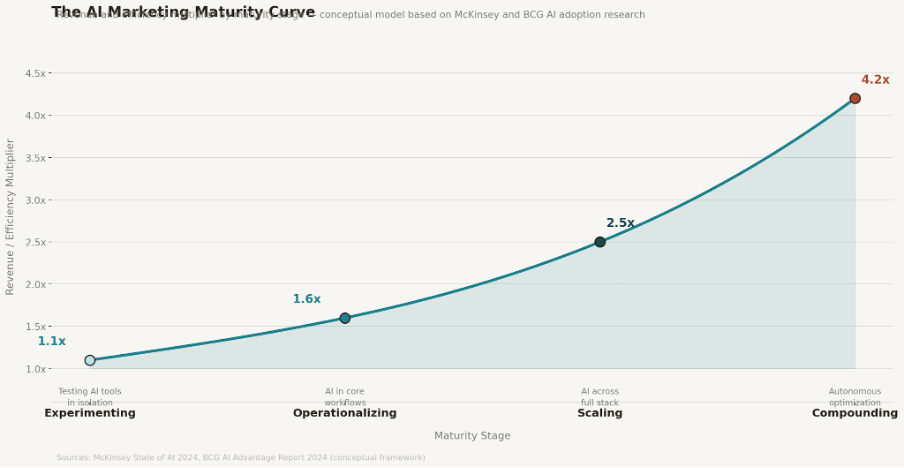
The AI marketing maturity curve showing revenue and efficiency multipliers across four stages: Experimenting (1.1x), Operationalizing (1.6x), Scaling (2.5x), and Compounding (4.2x).
Most brands know what stage they are at within 30 seconds of looking at this framework honestly. The harder question is why teams stall between stages.
Stage 1: Experimenting (1.1x multiplier)
You are using AI tools for discrete tasks. A copywriter uses ChatGPT. A media buyer tests Performance Max. An analyst experiments with an AI reporting tool. These tools live in individual workflows and do not talk to each other.
The lift at this stage is real but modest. You are getting productivity gains at the task level, not at the system level.
Most brands stay here too long because "experimenting" feels productive. You are shipping faster, your team is learning, and the tools are genuinely useful. The trap is mistaking activity for architecture.
Stage 2: Operationalizing (1.6x multiplier
You have moved AI from optional individual tools into required team workflows. Content briefs run through a structured AI process. Lead scoring is automated. Ad creative goes through AI pre-screening before going live. There is a defined feedback loop from performance data back into AI inputs.
The jump from Stage 1 to Stage 2 is structural. It requires process documentation, tool integration work, and some degree of organizational buy-in. But it is the foundation everything else compounds on.
The efficiency gap between brands at Stage 1 and Stage 2 is widening. That article covers what specifically separates operationalized from experimenting teams in 2026.
Stage 3: Scaling (2.5x multiplier)
AI is embedded across your full marketing stack. Content, paid media, CRM, website personalization, and reporting all have AI components that share data and feed each other. You are not just using AI to produce faster. You are using AI to make decisions that used to require a VP's approval and a 48-hour turnaround.
At this stage, AI starts compressing your go-to-market cycle. A campaign that previously took four weeks to develop, launch, and iterate can complete that cycle in five days.
Stage 4: Compounding (4.2x multiplier)
The data flywheel is running. AI is not just executing decisions, it is surfacing new opportunities your team would not have found manually. Your models are trained on your own first-party data, giving you a proprietary advantage that commodity tools cannot replicate.
Brands at this stage tend to have a dedicated AI operations function, a clean data infrastructure, and a culture of treating every campaign as a data-collection event as much as a revenue event.
The path to Stage 4 is not buying more tools. It is building better data and process architecture underneath the tools you already have.
The Diagnostic Before the Strategy
Before any brand can effectively operationalize AI across its marketing stack, it needs an honest picture of where the current funnel leaks. AI multiplies what is already working. It does not repair broken fundamentals.
The typical diagnostic covers four areas:
Conversion infrastructure. Are there hidden friction points between your ads and your checkout? Tools like Microsoft Clarity, Hotjar, and GA4 funnel reports surface these in hours. See the invisible friction AI audit framework for a structured approach.
Signal quality. Does your ad account have enough clean conversion data for AI optimization to work? Less than 30 conversions per campaign per month is insufficient for algorithmic learning.
Content-market alignment. Is your AI-generated content actually matching search and buyer intent, or is it producing fluent but irrelevant output? The AEO pillar covers how to align content strategy with how AI systems now interpret and surface information.
Attribution legibility. Can you trace revenue back to the specific touchpoints and decisions that drove it? Without clean attribution, AI budget allocation tools are working with corrupted inputs.
This diagnostic does not require a $50K agency engagement. It requires structured attention and the right tools. That is what the ThriveX AI Audit is designed to deliver.
Common Mistakes That Stall AI Marketing Adoption
The patterns repeat across industries and company sizes. Here are the ones that consistently delay ROI:
Starting with tools instead of outcomes. The first question should be: where is the biggest friction or gap in my current marketing system? Not: which AI tool should I buy?
Skipping the data layer. AI is only as good as the signals it learns from. Implementing AI tools on top of dirty CRM data, misconfigured GA4 tracking, or fragmented customer profiles produces confident-sounding wrong answers.
Treating AI content as finished product. AI-generated content is a first draft that requires human editorial judgment for brand voice, factual accuracy, and strategic framing. Teams that publish raw AI output at scale damage brand trust faster than they build it.
Not closing the feedback loop. The compounding gains from AI come from using performance data to improve the next cycle's inputs. Teams that run AI campaigns without capturing learnings stay at Stage 1 indefinitely.
Ignoring the CRO foundation. More relevant to brands scaling paid media: AI targeting can drive highly qualified traffic to a page with a 1.2% conversion rate. The ROI math still does not work. Fix conversion architecture before scaling AI-driven spend. The CRO before ads framework maps this out in detail.
For small and mid-size businesses specifically, the AI for small business guide provides a lean starting stack and implementation sequence that does not require a dedicated ops team.
Building the AI-Integrated Marketing Stack
Here is the practical sequence for a brand moving from Stage 1 to Stage 2 operationalization over 90 days:
Days 1 to 30: Diagnostic and infrastructure.
Audit GA4 conversion tracking. Fix any misconfigured events.
Run a funnel friction analysis using Microsoft Clarity or equivalent heatmap tool.
Identify your highest-volume, highest-intent pages and benchmark their current conversion rates.
Clean your CRM and define a consistent lead scoring model to serve as a baseline.
Days 31 to 60: Operationalize content production.
Build a standardized AI content brief template for your top three content formats (paid ad copy, email, landing page headline).
Create an AI pre-screening workflow for creative assets before media spend.
Set up a shared content performance tracker where AI outputs are tagged and results logged.
Days 61 to 90: Connect data to decisions.
Integrate your ad accounts with your CRM so lead quality data flows back to media buyers.
Set up predictive audience segments in GA4 using behavioral signals from your first 60 days of clean data.
Run your first AI-informed budget reallocation based on lead quality, not just volume metrics.
For teams in growth mode, the AI marketing trends article covers what the forward-looking AI marketing stack looks like in 2025 and 2026, including where platform-level AI (Meta, Google) is heading and what teams should be building to stay ahead.
Get a CRO Audit with Jetson for $49
What you get. A full AI-powered audit and a 1:1 recommendation session with Jetson. You will leave with a prioritized list of conversion and marketing infrastructure improvements specific to your current stack, ad spend level, and growth stage.
Why now. Early access is $49. At full launch, it goes to $99.
Who it is for. DTC, B2B, and SaaS founders or marketing leads spending at least $5K per month on paid media, or planning to scale.
Book it here. Lock in early access at $49 before it goes to $99.
Further Reading in the ThriveX Knowledge Hub
CRO Before Ads: Why Conversion Architecture Has to Come First. The sister pillar covering why fixing your funnel before scaling AI-driven spend is non-negotiable.
AEO and Google AI Overviews: How to Get Found in the New Search. How to align your content strategy with AI-powered search surfaces.
The Efficiency Gap 2026: What Separates Operationalized from Experimenting Teams. The specific operational differences between brands at Stage 1 and Stage 2 of AI adoption.
AI Marketing Trends 2025: What the Forward-Looking Stack Looks Like. Where platform AI and independent tools are converging and what to build toward.
AI for Small Business: A Lean Starting Stack. A practical starting guide for teams without a dedicated AI ops function.
The Invisible Friction AI Audit. How to identify and remove the hidden conversion blockers AI diagnostic tools surface in your funnel.