CRO Before Ads: Why Malaysian DTC Brands Burn Marketing Budget at the Wrong End of the Funnel
By Jetson, Head of CRO at ThriveX
Reading time: 6 minutes. Last updated: May 2026.

Author's Note:
Most growing brands scale ad spend on a website that converts at 1 to 2 percent. Baymard finds 70.19 percent of carts are abandoned, and 35 percent of conversions can be recovered with checkout design fixes alone. Scaling spend before the funnel is ready is its own failure mode, covered in detail in why more ad spend doesn't mean more conversions.
Doubling your conversion rate doubles your ROAS without spending another dollar on Meta or Google. CRO is the highest-leverage marketing decision you will make this year. Want a personal look at your funnel?
Lock in early access to the ThriveX AI Audit with Jetson for $49 before it goes to $99 at full launch.
The conversation I have every week
A founder messages me on LinkedIn.
The story is almost always the same.
"Jetson, we increased our Meta budget from $10K to $25K. Traffic is up 2.4 times. Sales are up maybe 30 percent. What gives?"
Nothing gives. The math is doing exactly what it was always going to do.
When you scale ad spend onto a website that was not built to convert, you do not buy growth. You buy a more expensive version of the same leak. This is the single most common, and most expensive, mistake I see across DTC and B2B brands globally.
It is also the reason I tell every new ThriveX client the same thing on day one.
Fix the conversion system first. Then, and only then, scale the media.
This is the foundational piece of our knowledge hub. If you only read one ThriveX article this year, read this one. Every other piece in the hub (cart abandonment, funnel leakage, AI audits, ad waste) is a downstream symptom of the problem we are about to unpack.
What CRO actually is, and what most agencies get wrong
Conversion Rate Optimization (CRO) is the systematic practice of increasing the percentage of visitors who take a meaningful action on your website. That action could be buying, booking, requesting a quote, or subscribing. The key point is that CRO improves results without increasing your traffic.
It is not "make the button bigger." It is not "add a popup." Nielsen Norman Group, the most respected name in user research, defines CRO as the deliberate alignment of design, copy, and information architecture with how users actually make decisions. It is a discipline grounded in usability ROI research going back two decades.
Most growth agencies skip CRO entirely because it is harder to bill for than running ads.
ThriveX exists because that gap is where the money is.
The leaky bucket: where every $100 of ad spend actually goes
Before we talk about fixes, look at where your ad budget actually ends up in a typical unoptimized funnel. This is a composite model based on global benchmarks: Baymard's 70.19 percent cart abandonment average, Statista's global ecommerce conversion rate of around 2 percent in Q4 2024, and WordStream's 2025 Google Ads benchmarks.
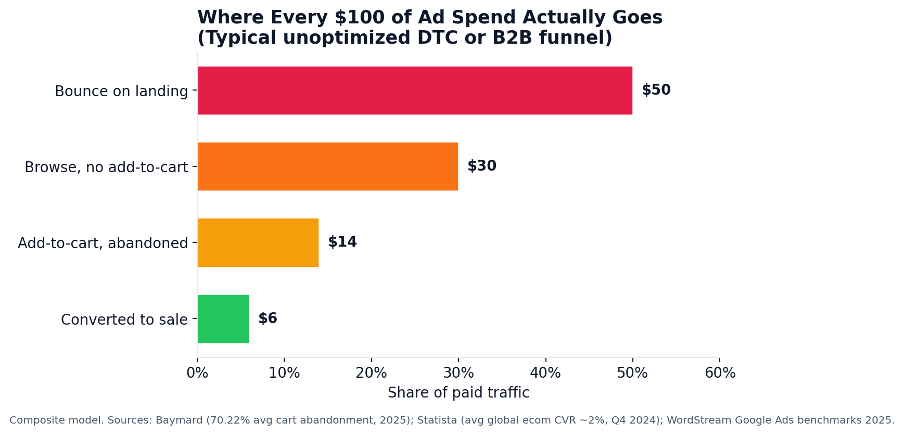
For every $100 you put into paid traffic, only about $6 makes it to a completed transaction on an unoptimized site. The other $94 (your money) disappears at four predictable leak points.
The four leak points, in order of severity:
1)Bounce on landing: about $50 of every $100. The page loads too slowly, the message does not match the ad, or the mobile experience is broken. Half of your ad spend never even sees the offer.
2)Browse without adding to cart: about $30 of every $100. Weak product pages, unclear value, or no social proof. Visitors saw the offer and decided to keep scrolling.
3)Add to cart but abandon: about $14 of every $100. Unexpected shipping costs, forced account creation, or a long checkout. The classic Baymard leak.
4)Final-step drop-off: about $6 of every $100 that actually converts. Payment errors, trust gaps, or confusing forms at the last mile.
Look at the top row. Half of your ad spend never even sees your offer. That is not a media buying problem. That is a CRO problem.
The math that should change how you budget
Here is the calculation I run in every first sales call. Same business. Same $10K monthly ad budget. Same $250 average order value. Same 10,000 monthly sessions. The only thing that changes is what you spend the next month optimizing.
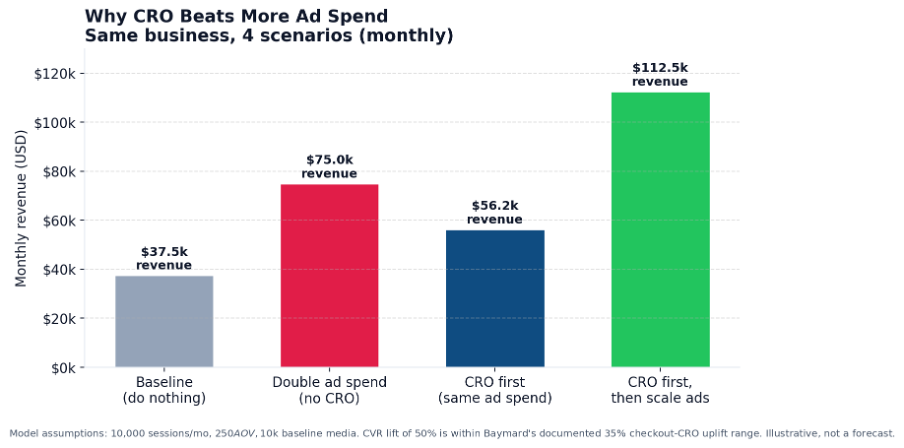
Figure 2. Same business, four scenarios. The same $10,000 baseline media spend produces dramatically different monthly revenue depending on whether CRO is sequenced before scaling ads.
The four scenarios side by side:
Scenario 1, Baseline (do nothing). $10K media, 10,000 sessions, 1.5% CVR, 150 sales, $37.5K monthly revenue.
Scenario 2, Double ad spend (no CRO). $20K media, 20,000 sessions, 1.5% CVR, 300 sales, $75K monthly revenue. You doubled spend to double revenue. ROAS is unchanged.
Scenario 3, CRO first (same ad spend). $10K media, 10,000 sessions, 2.25% CVR, 225 sales, $56.25K monthly revenue. Same spend, 50 percent more revenue. ROAS is up 50 percent.
Scenario 4, CRO first, then scale ads. $20K media, 20,000 sessions, 2.25% CVR, 450 sales, $112.5K monthly revenue. The compounding play. 3 times the revenue on 2 times the media.
A 50 percent relative lift in conversion rate (moving from 1.5 percent to 2.25 percent) is well within what Baymard has documented as achievable.
Their research shows the average ecommerce site can improve conversion by around 35 percent through checkout design fixes alone.
WordStream's data on page speed shows that conversion improves roughly 17 percent for every second a page loads faster.
Now look at what happens in scenario four. By fixing the conversion system first and then doubling the media, the same brand goes from $37.5K to $112.5K in monthly revenue.
That is a 3 times revenue lift on a 2 times media budget. This is the compounding effect of CRO. Every dollar of ad spend, today and forever, is more valuable on an optimized site.
The brands that win in 2026 will not be the ones with the biggest ad budgets. They will be the ones with the highest conversion rate inside their category.
The five leaks I find in nine out of ten audits
When my team runs a ThriveX growth audit, we find the same patterns over and over. None of these are hypothetical. These are the actual issues we see week after week across e-commerce, B2B services, and SaaS, from Singapore to San Francisco.
1. Mobile page speed is the silent killer
Think with Google's research is unambiguous. Mobile pages that load one second faster see up to a 27 percent increase in conversion rate. Bounce rates jump from 13 percent on a sub-3-second page to nearly 60 percent past 9 seconds.
Most SME sites I audit load on mobile in 5 to 8 seconds. The usual culprits are unoptimized hero images, third-party tag bloat, or a "modern" page builder dragging in 4MB of JavaScript. The fix is rarely glamorous: compressed images, lazy loading, and removing tracking pixels you stopped using two years ago. In mobile-first markets across Southeast Asia, this single fix often moves the needle more than anything else.
2. CTAs that ask for too much, too early
Nielsen Norman Group's hierarchy of trust framework describes five levels of commitment. They start at "is this site credible" and end at "do I trust them with my credit card." Most websites skip levels one through three and ask for level four information ("submit your phone number and we will call you") before the visitor has any reason to trust the brand.
The pattern I look for is simple. Every CTA should match the level of trust the page has earned by that point. A homepage CTA is "see how it works." A product page CTA is "view pricing." Only the bottom of the funnel earns "talk to sales."
3. No analytics, or worse, analytics that are silently broken
I would estimate that 4 in 10 sites I audit either have no GA4 installed, have duplicate tags, double-counting events, or have conversion events that have not fired since 2023. You cannot optimize what you cannot measure. This is the first thing we fix.
4. Mobile layouts designed on desktop
Over 75 percent of e-commerce traffic globally comes from mobile, yet most brand websites are still designed mobile-second. Buttons stack awkwardly, hero text crops, product images go full-bleed when they should be square. This is a CRO problem disguised as a design problem.
5. Checkout friction that nobody questions
Baymard's research is the gold standard here. The top reasons for cart abandonment are all fixable. They include unexpected shipping costs, forced account creation, a long or confusing checkout, and concerns about payment security. Each of these is a 4 to 8 hour fix that can lift conversion by single-digit percentages. On an ecommerce site, that is the entire game.
We have gone deep on cart abandonment specifically. See Why 70 Percent of Shoppers Abandon Their Carts (And 3 Checkout Fixes That Increase Conversions) for the checkout-by-checkout playbook.
The CRO-before-ads operating model
This is the sequence I run for every ThriveX client. It is not a theory. It is the order in which money compounds.
Phase 1, Weeks 1 to 2: Diagnose. Run a full AI-assisted CRO audit. Map the funnel. Identify the top 3 leaks. Deliverable is a prioritized issue list ranked by revenue impact.
Phase 2, Weeks 2 to 6: Fix the high-impact leaks. Mobile speed, checkout friction, broken analytics, and CTA hierarchy. Deliverable is measurable CVR lift on the top 3 landing pages.
Phase 3, Weeks 6 to 10: Build the measurement layer. Clean GA4, conversion-event hygiene, heatmaps, and session recordings. Deliverable is a dashboard you can actually trust.
Phase 4, Weeks 10 onward: Scale paid media. Now you can buy traffic profitably, because the system you are sending it to actually converts. Deliverable is compounding ROAS.
Most brands try to do phase four first. The result is the conversation I have on LinkedIn every week.
Why this matters more in 2026 than it did in 2022
Three forces are making CRO non-optional.
Media costs are rising faster than conversion rates.WordStream's 2025 benchmarks show Google Ads CPCs continuing to climb while CVRs in major categories sit below 3 percent. Every percentage point of CVR matters more than it did three years ago.
AI search is changing top-of-funnel discovery. As Google AI Overviews and ChatGPT eat zero-click queries, the visitors you do get are higher-intent and more expensive. Wasting them is more expensive than ever. We unpack this in How to Strengthen Visibility in Google AI Overviews.
Personalization is a baseline expectation.McKinsey's research shows personalization drives a 10 to 15 percent revenue lift, and over 70 percent of consumers now consider it a basic expectation, not a perk.
The brands that compound through this shift will be the ones who treated their website like a revenue asset, not a digital brochure.
What to do this week
If you only have 60 minutes, do these four things.
Pull your last 30 days of GA4. Find your top 3 landing pages by traffic. Note the conversion rate of each.
Open each page on your phone. Time the load. If it is over 3 seconds, that is your highest-ROI fix.
Map your checkout in screenshots. Count the form fields. Anything over 5 fields is a leak.
Look at your last 30 days of ad spend versus revenue. Calculate what would happen at a 25 percent higher CVR. That is the prize sitting on the table.
If you would rather have a CRO expert do this for you, that is exactly what the ThriveX AI Audit is built for.
Get a CRO audit with Jetson for $49
What you get. A full AI-powered audit of your website, plus a 1:1 recommendation session with me to walk through the highest-impact fixes for your specific funnel.
Why now. Early access is $49. At full launch, it goes to $99. The audit is the same. The price is not.
Who it is for. DTC, B2B, and SaaS founders or marketing leads spending at least $5K per month on paid media, or planning to scale.
Book it here. Lock in early access at $49 before it goes to $99.
Frequently asked questions
Why should brands fix CRO before increasing ad spend?
Because paid traffic only compounds when the website can convert that traffic efficiently. If your landing pages, product pages, checkout, or lead forms are leaking revenue, increasing ad spend simply sends more people into the same broken system.
CRO first makes every future ringgit or dollar spent on Meta, Google, or LinkedIn work harder.
What are the first CRO leaks a brand should fix?
Start with the obvious revenue blockers: slow mobile pages, unclear above-the-fold messaging, weak CTAs, missing trust signals, broken analytics, and checkout friction. These issues usually sit closest to the money. Fixing them first gives you cleaner data, stronger conversion rates, and a better foundation before you scale media spend.
When is the right time to run a ThriveX AI Audit?
Run the audit before you increase your ad budget, launch a major campaign, rebuild your website, or commit to a new growth channel.
The audit is designed to show where your funnel is leaking, which fixes matter most, and what to prioritise before spending more on traffic.
Further reading in the ThriveX knowledge hub
Why 70 Percent of Shoppers Abandon Their Carts (And 3 Checkout Fixes That Increase Conversions). The checkout-specific playbook.
The Add to Cart Bottleneck. Why high-traffic product pages still fail.
Why Running Ads Without Funnel Clarity Wastes Money. The ad-spend side of the same problem.
Beyond Google Analytics: How AI Audits Reveal the Invisible Friction. The diagnostic layer.
The 2026 Efficiency Gap. Why smart leaders are prioritizing diagnostics over ad spend.