By Jetson, Head of CRO at ThriveX
Reading time: 6 minutes. Last updated: May 2026.
Author's Note:
The average cart abandonment rate is 70.19% according to the Baymard Institute. The biggest culprits are unexpected costs, forced account creation, and complex checkout forms. Fix those three things, add recovery emails and exit-intent offers, and you stop losing revenue you already earned.
Lock in early access to the ThriveX AI Audit with Jetson for $49 before it goes to $99 at full launch.
The Math Nobody Wants to Look At
Here is a number that should reshape how you think about your ad budget: for every $100 in revenue you capture, roughly $230 walks out the door.
That is the practical implication of Baymard's 70.19% average cart abandonment rate, drawn from over 49,000 surveyed online shoppers. Seven in ten people who add something to their cart never complete the purchase. They wanted the product. They raised their hand. Then your checkout process pushed them away.
This is not a traffic problem. It is a conversion problem at the most valuable point in your funnel. If you are already working on broader funnel efficiency, this is the natural next step after understanding what causes add-to-cart drop-off.
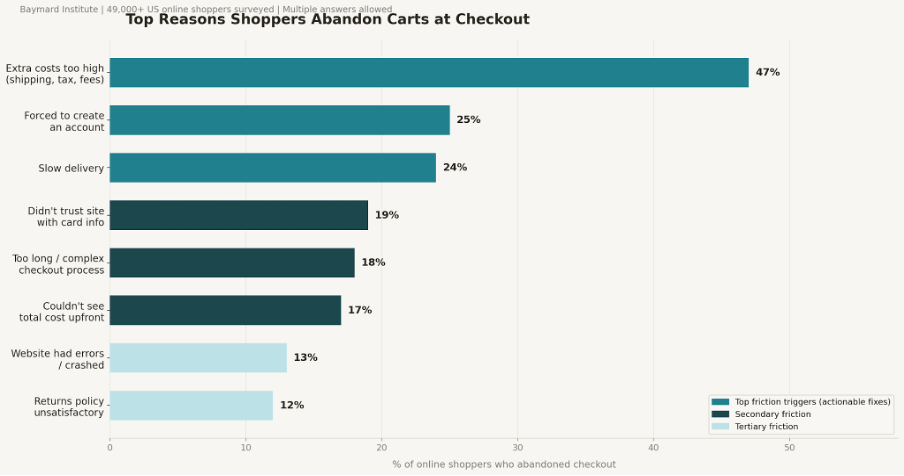
Top reasons shoppers abandon checkout, based on Baymard Institute data. Extra costs lead to 47%, followed by forced account creation (25%), slow delivery (24%), and distrust of site security (19%).
Why Shoppers Leave: What the Data Says
Baymard's research identifies the top reasons for cart abandonment:
Extra costs (shipping, tax, fees) revealed at checkout: 47%
Forced account creation: 25%
Estimated delivery too slow: 24%
Did not trust the site with card information: 19%
Too long or complex a checkout process: 18%
Could not see total cost upfront: 17%
Five of those six are entirely within your control. You are not losing buyers to a better competitor on price. You are losing them to friction you built into your own checkout. This is the core argument behind conversion rate optimization before ads: fix the checkout floor before scaling spend.
Fix 1: Kill the Cost Surprise
Nearly half of all abandoners (47%) leave because unexpected costs appear at checkout. Shipping fees and taxes that were not visible on the product page create a psychological rupture. The buyer committed mentally at one price, then discovered another. That gap feels like deception.
Show estimated shipping on the product page, not just at checkout.
Add a free shipping threshold and make it visible at the cart stage ("Free shipping over $75").
Surface tax estimates early, especially if you sell across state lines or internationally.
Scenario 1, Baseline. Customer adds a $45 product. Shipping appears for the first time at checkout: $9.99. Customer abandons.
Scenario 2, Upfront pricing. "$9.99 shipping or free over $75" is visible on the product page. Customer knows the true cost before adding to cart. Fewer surprises, fewer abandons.
Nielsen Norman Group's mobile checkout UX researchconfirms cost transparency is one of the highest-impact interventions available.
Fix 2: Remove the Account Wall
Forced registration, cited by 25% of abandoners, is the second biggest structural leak. When you require account creation before payment, you ask buyers to stop and do administrative work at the worst possible moment.
On mobile, this friction multiplies. In mobile-first markets across Southeast Asia, where buyers operate on lower-bandwidth connections, the registration wall is especially punishing.
Make guest checkout the default, not a buried secondary link.
Move account creation to the post-purchase thank-you page. The buyer has already converted and is in a positive state.
If your platform supports it, auto-create an account silently and send a password-setup email after purchase.
Baymard's checkout usability findings show the average checkout has nearly 15 fields, but most purchases only need 8. The excess is costing you real transactions.
Fix 3: Close the Trust Gap
One in five abandoners (19%) cites distrust of site security. This is a credibility signal problem, not a pricing problem.
Display trust badges near payment fields: SSL seals, recognized payment logos (Visa, Mastercard, PayPal, Stripe).
Add a visible customer review count near the buy button. Social proof reduces perceived risk at the moment of payment.
Surface your returns policy at checkout, not just in the footer. "Free 30-day returns" in one line next to the CTA addresses the risk concern without requiring a click.
For a broader look at diagnosing hidden friction across your funnel, the invisible friction AI audit guide covers systematic approaches.
Recovery Tactics: Capturing Buyers Who Left
Even with an optimized checkout, some buyers will leave. These are not lost sales. They are warm leads with demonstrated intent.
Cart abandonment emails are the most direct recovery tool. Klaviyo's abandoned cart benchmark reportshows a three-email sequence (immediate, 24-hour, 72-hour) can recover 5-10% of abandoned carts. The first should be a simple reminder. The third can include a time-limited offer.
Exit-intent overlays fire when a cursor moves toward the browser chrome, catching buyers at the exact moment of hesitation. A clean overlay ("Still thinking? Here's 10% off") converts a percentage of those who were about to leave.
Retargeting ads keep your product in front of abandoners across paid social. The key is relevance: show the specific product they carted, not generic brand creative. Meta's dynamic product ads pull directly from your catalog for this.
If ad spend is running but checkout conversion is not materializing, the link is direct. The waste ad spend conversion system guide covers how to align the full funnel before scaling.
What a 5% Recovery Is Worth
Store revenue: $50,000 per month
Cart abandonment rate: 70%
Implied total cart value initiated: approximately $167,000
Revenue abandoned: approximately $117,000 per month
A 5% recovery rate (achievable with optimized checkout plus emails): $5,850 per month recovered
Annualized: $70,200 in additional revenue, zero incremental ad spend
That is not a marketing cost. It is removing a structural tax on revenue you already earned.
Get a CRO Audit with Jetson for $49
What you get. A full AI-powered audit of your checkout flow and funnel, plus a 1:1 recommendation session with Jetson to prioritize fixes.
Why now. Early access is $49. At full launch, it goes to $99.
Who it is for. DTC, B2B, and SaaS founders or marketing leads spending at least $5,000 per month on paid media, or planning to scale.
Book it here.Lock in early access at $49 before it goes to $99.
Further Reading in the ThriveX Knowledge Hub
CRO Before Ads: The Complete Conversion Guide — The pillar resource for conversion rate optimization before scaling paid media.
What Causes Add-to-Cart Drop-Off — The step before cart abandonment: why shoppers browse but do not add.
The Invisible Friction AI Audit — Systematic diagnostics for hidden friction across your entire funnel.
Why Ad Spend Gets Wasted: Fix Your Conversion System First — How checkout performance directly affects paid media ROI.
Why Ads Waste Money With an Unclear Funnel — How funnel gaps multiply the cost of every ad click.