The Invisible Friction AI Audit: What Google Analytics Cannot Tell You
By Jetson, Head of CRO at ThriveX
Reading time: 6 minutes. Last updated: May 2026.

Author's Note:
Your GA4 dashboard shows where visitors drop off. It cannot explain why. An AI-powered audit adds the diagnostic layer that turns those numbers into a fix list. If your site has traffic but flat conversions, you have a friction problem, not a traffic problem.
Lock in early access to the ThriveX AI Audit with Jetson for $49 before it goes to $99 at full launch. Book here.
The Dashboard That Lies by Omission
Every founder eventually hits the same wall. Traffic is up. Users are landing on your pages. And yet conversion rates are stuck in the same range they have been for months.
You open GA4. You can identify the exact page where 80% of visitors exit. But then what? The data tells you where the leak is. It does not tell you what is causing it.
This is the core limitation of quantitative analytics, and it is where invisible friction lives. As covered in Why CRO Comes Before Ads, pouring spend into a leaking funnel does not fix the funnel. An AI audit is the tool that finds the leak.
What Is Invisible Friction?
Invisible friction is the set of psychological, cognitive, and structural barriers that prevent users from converting, but that no event tracker will label for you.
Unlike a broken checkout button, invisible friction is qualitative. It lives in the gap between what your copy says and what the visitor expects. It shows up when your pricing page forces a decision before trust has been established, or when your navigation structure makes a first-time visitor feel confused rather than guided.
Baymard Institute research consistently shows that most cart abandonments are not price-related. They are friction-related. That distinction shapes where you invest your CRO effort.
The friction types an AI audit surfaces most often:
Clarity friction. The visitor cannot understand what you offer or who it is for within the first few seconds. Your headline is written for an internal audience, not a first-time visitor. The value proposition is buried below the fold.
Trust friction. The commitment you are asking for (buy now, book a call) exceeds the trust you have established. No logos, no testimonials, no credibility signals near the conversion point.
Cognitive friction. Competing CTAs on the same page. A navigation menu with too many options. A checkout that asks for unnecessary information before the purchase decision is made.
Intent friction. When ad copy promises one outcome and your landing page delivers something different, you create a friction spike at arrival before a single scroll.
Journey friction. The drop-off is not caused by a single broken element. It is caused by a gap between steps, a form that is too long, a missing progress indicator, or a trust deficit between your acquisition page and your checkout.
None of these will appear as a labelled item in your GA4 dashboard.
GA4 vs. AI Audit: Two Different Questions
The mistake most founders make is treating these tools as equivalent. They are not. They answer fundamentally different questions.
GA4 answers: "What did users do?"
An AI audit answers: "What is likely making them do that?"
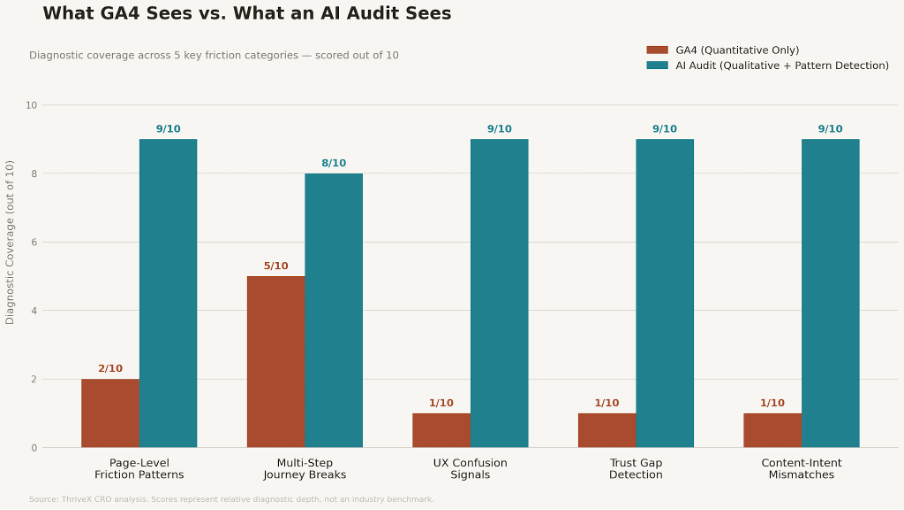
Diagnostic coverage scored out of 10 across five key friction categories. GA4 scores 1-2/10 on four of the five.
An AI audit scores 8-9/10 across all five.
These friction types map to real conversion decisions across your full growth system. Where GA4 gives you exit rates and click paths, the ThriveX AI Audit works through a 7-pillar diagnostic framework covering your complete funnel: from Executive Business Diagnosis and Website UI/UX and CRO, through SEO and AEO, Digital Presence, Growth Opportunities, Top Quick Wins, and your Phase 1 Priority Roadmap.
Each pillar is assessed in sequence because the constraint in one layer almost always affects what follows.
Here is what that means in practice:
Page-level friction patterns. GA4 can flag a high exit rate. It cannot tell you the hero headline is creating clarity friction or the CTA is buried below the fold.
Multi-step journey breaks. GA4 tracks funnel drop-off by step. What it misses is whether the drop-off is caused by a form that is too long, a missing progress indicator, or a trust gap between steps.
UX confusion signals. An AI audit flags structural issues like competing CTAs and unclear navigation hierarchy. Session recording tools give you raw data. The audit gives you a named diagnosis.
Trust gap detection. GA4 has no concept of trust. It cannot register that a visitor with high intent left your checkout page because the page had no social proof. This is the pattern behind most of the issues covered in How to Reduce Your Cart Abandonment Rate.
Content-intent mismatches. When ad copy promises one outcome and your landing page delivers something different, you create a friction spike at arrival. GA4 shows a high bounce rate. An AI audit tells you the copy is misaligned and how to close the gap.
The Case for Diagnostic-Led CRO
Traditional CRO looks like this: review analytics, form a hypothesis, run a test, wait. That cycle takes weeks per iteration. If the hypothesis was wrong because it was based on incomplete information, you have lost the time and the budget.
Diagnostic-led CRO reverses the sequence. Start with a structured diagnosis, form hypotheses grounded in that diagnosis, then test. Nielsen Norman Group research has shown that expert reviews surface the majority of usability issues before any quantitative testing begins. An AI audit operates on the same principle at greater speed.
If you are spending $5K to $10K per month on paid media, the gap between a 1.5% and a 3% conversion rate is not a traffic problem. It is a friction problem. The Efficiency Gap 2026 frames this exactly: most growth-stage brands are sitting on unlocked revenue in their existing funnel.
The same logic applies to search. The AEO and Google AI Overviews piece covers how intent mismatches between search queries and landing pages create friction at the very top of funnel, before a visitor ever reaches checkout.
When an AI Audit Makes the Most Sense
Traffic is growing but conversions are not moving. Your acquisition is working. Your conversion side has invisible friction neutralising the investment.
You are about to run a paid campaign. Running traffic to a page with undiagnosed friction is expensive. An audit before launch is cheaper than learning through wasted spend.
Your add-to-cart rate is healthy but checkout completions are low. Classic trust and cognitive friction. The Add-to-Cart Bottleneck covers this pattern in detail.
A redesign is coming. Most redesigns recreate friction because the team does not know what was broken. An audit gives you the fix list before the brief is written.
Stakeholders disagree on the problem. When product and marketing are arguing about the issue, an audit provides a neutral assessment grounded in CRO best practices rather than internal politics.
Frequently asked questions
What is invisible friction on a website?
Invisible friction refers to psychological, cognitive, or structural barriers that prevent visitors from converting, which quantitative analytics tools like GA4 cannot directly label or explain.
How is an AI audit different from Google Analytics?
GA4 measures what users do, such as exit rates and click paths. An AI audit diagnoses why those behaviours are occurring by pattern-matching your site against CRO best practices and flagging likely friction types across a structured 7-pillar framework.
What types of friction does a ThriveX AI audit detect?
The audit works through seven diagnostic pillars in sequence: Executive Business Diagnosis, Website UI/UX and CRO, SEO and AEO, Digital Presence, Growth Opportunities, Top Quick Wins, and your Phase 1 Priority Roadmap. Each pillar is assessed because a constraint in one layer typically affects everything downstream.
When should I get an AI audit for my website?
The best times are when traffic is growing but conversions are flat, before a paid campaign launch, before a redesign, or when stakeholders disagree about what is causing poor conversion performance.
Get a CRO Audit with Jetson for $49
What you get. A full AI-powered audit of your site plus a 1:1 recommendation session with Jetson. We map your friction patterns, prioritise the fixes, and walk you through where to focus first.
Why now. Early access is $49. At full launch, it goes to $99. A limited number of spots are open at this price before the program scales.
Who it is for. DTC, B2B, and SaaS founders or marketing leads spending at least $5K per month on paid media, or planning to scale. If you are driving traffic but not earning the conversion rate your budget should produce, this audit is built for you.
Book it here. Lock in early access at $49 before it goes to $99.
Further Reading in the ThriveX Knowledge Hub
Why CRO Comes Before Ads - The foundational case for fixing your funnel before scaling spend.
The Add-to-Cart Bottleneck - What causes healthy traffic to stall before purchase and how to fix it.
How to Reduce Your Cart Abandonment Rate - A practical framework for recovering lost revenue at checkout.
The Efficiency Gap 2026 - Why most growth-stage brands are leaving significant revenue in their existing funnel.
AEO and Google AI Overviews - How to position your content so AI-powered search surfaces it for high-intent queries.