The Marketing Visibility Problem: Why "We Rank #1 for X" No Longer Means Anything
By Jetson, Head of CRO at ThriveX
Reading time: 6 minutes. Last updated: May 2026.
Author's Note:
Brands built on Google rankings are watching visibility collapse. Customers now discover brands through AI Overviews, ChatGPT recommendations, Perplexity citations, and TikTok search, not by clicking the third organic result. The old metric ("we rank #1 for X") is becoming hollow. What matters now is brand-name search volume, citation share in AI engines, and branded direct visits.
Lock in early access to the ThriveX AI Audit with Jetson for $49 before it goes to $99 at full launch.
The Discovery Channel Has Changed Underneath Your Feet
Three years ago, ranking on page one of Google meant traffic. You showed up, users clicked, they arrived on your site. The formula was simple.
That formula is breaking down.
Google's AI Overviews now answer queries directly on the results page, and Search Engine Land research documents click-through rates falling sharply for queries that trigger AI summaries. Users now turn to ChatGPT or Perplexity as their first discovery tool, getting curated answers with citations. If your brand is not in those citations, you simply do not exist in that moment.
Add social search. In mobile-first markets across Southeast Asia and globally, younger buyers use TikTok and Instagram as their first search engine. A brand that appears nowhere on these platforms is invisible to a segment that never opens a Google SERP.
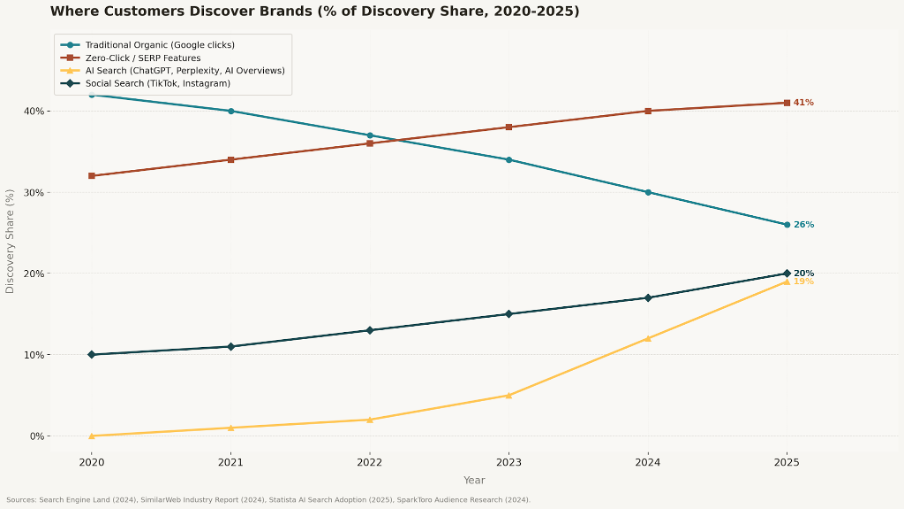
Multi-line chart showing brand discovery share from 2020 to 2025. Traditional organic Google clicks declining from 42% to 26%. Zero-click SERP features rising to 41%. AI search (ChatGPT, Perplexity, AI Overviews) growing from near-zero to 19%. Social search (TikTok, Instagram) rising from 10% to 20%.
Sources: Search Engine Land, SimilarWeb, Statista, SparkToro.
Why "We Rank #3" Is a Vanishing Metric
The traditional model assumed customers click organic results. Three forces are eroding that assumption simultaneously.
Zero-click SERPs. Google now resolves a growing share of queries directly on the results page. Featured snippets, knowledge panels, and AI Overviews give users the answer without a click. Statista data on zero-click searches shows organic click-through rates declining across informational queries year over year.
AI-mediated discovery. When someone asks ChatGPT "what CRM should I use for a DTC brand under $50K revenue," they get a recommendation. Ranking #3 on Google for that query is irrelevant to that moment. SparkToro audience research identifies AI search as a fast-growing discovery channel across demographics.
Social search. TikTok's search function, Instagram Explore, and YouTube discovery operate outside Google's index entirely. Ranking has zero influence here. Presence, authority, and creator mentions are the currency.
The brands that win the next five years are not optimizing for SERP position alone. They are building citation equity in AI engines and presence in social discovery.
What to Measure Instead
Standard analytics tools measure what happens after a user arrives. They are not built to measure where users decided, before arriving, whether your brand was worth visiting. These three metrics fill that gap.
Brand-Name Search Volume
Track your brand name in Google Search Console and Google Trends. Rising brand-name searches signal that customers encountered you somewhere outside direct search and came looking for you. It is the clearest early indicator that AI and social discovery is working. Ahrefs' brand monitoring methodology covers how to track this systematically.
Citation Share in AI Engines
Test your 10 most important category queries in ChatGPT, Perplexity, and Google AI Overviews. Document which brands get cited and whether yours appears. This manual quarterly audit surfaces citation presence problems before they show up in revenue. The AEO strategies in our AI Overviews guide are the foundational playbook for building citation share.
Branded Direct Visits
Direct traffic increasingly includes users arriving from AI recommendations or social discovery who searched your brand name directly. A rising direct channel share alongside rising brand search volume is a compound signal that you are building recognition outside trackable paid and organic channels. Track this in GA4 as a quality-adjusted composite metric.
What This Means for Your Content Strategy
If AI engines are the new discovery layer, the structural question is: what makes a brand citeable?
AI models cite brands that appear in authoritative, frequently referenced sources. This maps directly to Answer Engine Optimization (AEO): structured content, clear entity definition, presence on credible third-party domains, and direct answers to category questions. These are not new tactics. They are the SEO fundamentals that have always built durable authority, now applied to a different delivery mechanism.
Pages that earn featured snippets are often the same pages pulled into AI answers. The underlying quality signal is the same. What changes is the destination: visibility now serves both the Google SERP and the AI context window.
For a practical diagnostic of where your site currently sits relative to AI discovery, the ThriveX invisible friction AI audit walks through the process step by step. Before scaling discovery, make sure your site converts the visitors it already gets. The conversion work in CRO Before Ads is the upstream prerequisite. The AI marketing trends overview covers the broader strategic landscape.
Three Starting Actions
These three actions take less than an hour and will surface directional signal quickly.
Run an AI citation audit this week. Test your 10 most important category queries in ChatGPT, Perplexity, and Google AI Overviews. Note which brands appear and whether yours does.
Set up brand search tracking. Filter impressions for your brand name in Google Search Console. Create a Google Trends alert. Free, 15 minutes.
Segment direct traffic in GA4. Create a segment for direct visits that convert or engage. Rising quality-adjusted direct traffic alongside rising brand search is your early composite signal.
Get a CRO Audit with Jetson for $49
What you get. A full AI-powered audit plus a 1:1 recommendation session with Jetson. We identify your primary visibility and conversion constraint, quantify the cost of delay, and give you a prioritized fix list.
Why now. Early access is $49. At full launch, it goes to $99.
Who it is for. DTC, B2B, and SaaS founders or marketing leads spending at least $5K per month on paid media, or planning to scale.
Book it here. Lock in early access at $49 before it goes to $99:
Further Reading in the ThriveX Knowledge Hub
Answer Engine Optimization and Google AI Overviews . The full AEO playbook for building citation share in AI-powered search.
CRO Before Ads. Why conversion infrastructure must come before you scale any discovery channel.
The Invisible Friction AI Audit . A diagnostic for identifying where AI and users are abandoning your funnel.
AI Marketing Trends Malaysia 2026. The strategic landscape that visibility strategy sits inside.
The Efficiency Gap 2026. Why marketing efficiency diverges between brands that adapt and those that do not.
Frequently asked questions
What is the marketing visibility problem?
Traditional Google rankings no longer capture where customers discover brands, because AI Overviews, ChatGPT, and social search have fragmented the discovery journey.
How do I track brand citation share in AI engines?
Run manual quarterly audits of your top category queries in ChatGPT, Perplexity, and Google AI Overviews. Document which brands appear and how often yours does.
Is SEO dead because of AI Overviews?
No. Pages earning featured snippets are often the same pages pulled into AI answers. AEO and traditional SEO share underlying quality signals.
What should I measure instead of keyword rankings?
Brand-name search volume, AI citation share (manual audit), and branded direct visits in GA4.
Why is direct traffic rising for some brands?
Users discovering a brand through AI recommendations or social search often arrive via direct URL or branded search.
How does zero-click SERP affect content strategy?
Prioritize transactional and navigational content for click-through. Invest in AEO-structured content for informational queries.