Answer Engine Optimization and Google AI Overviews: The Complete Pillar Guide for 2026
By Jetson, Head of CRO at ThriveX
Reading time: 10 minutes. Last updated: May 2026.
Author's Note:
Google AI Overviews now appear in up to 25% of queries at peak periods, and nearly 60% of all searches end without a click. Ranking on page one is no longer enough. Answer Engine Optimization (AEO) is how you structure content so AI systems can extract, cite, and surface your brand inside those generated answers.
Why the Rules of Search Just Changed
For years, the job of an SEO strategy was simple on paper: rank higher, get more clicks, drive more traffic. Build links, optimize title tags, publish content. Rinse and repeat.
That model is under real pressure now. According to Search Engine Land's zero-click study , 58.5% of U.S. Google searches end without a single click to any website.
By March 2025, that share was still climbing, with Search Engine Land reporting zero-click searches at 27.2% of all U.S. queries, up from 24.4% a year earlier.
The reason is not hard to find. Google AI Overviews sit above every organic result.
On mobile, Wordstream data shows they occupy 48% of the user's screen.
The user gets an answer synthesized from multiple sources, attributes it to Google, and moves on. Your page may have been cited, but the click never happened. This does not mean traditional SEO is dead. It means the optimization game now has two layers, and most businesses are only playing one of them.
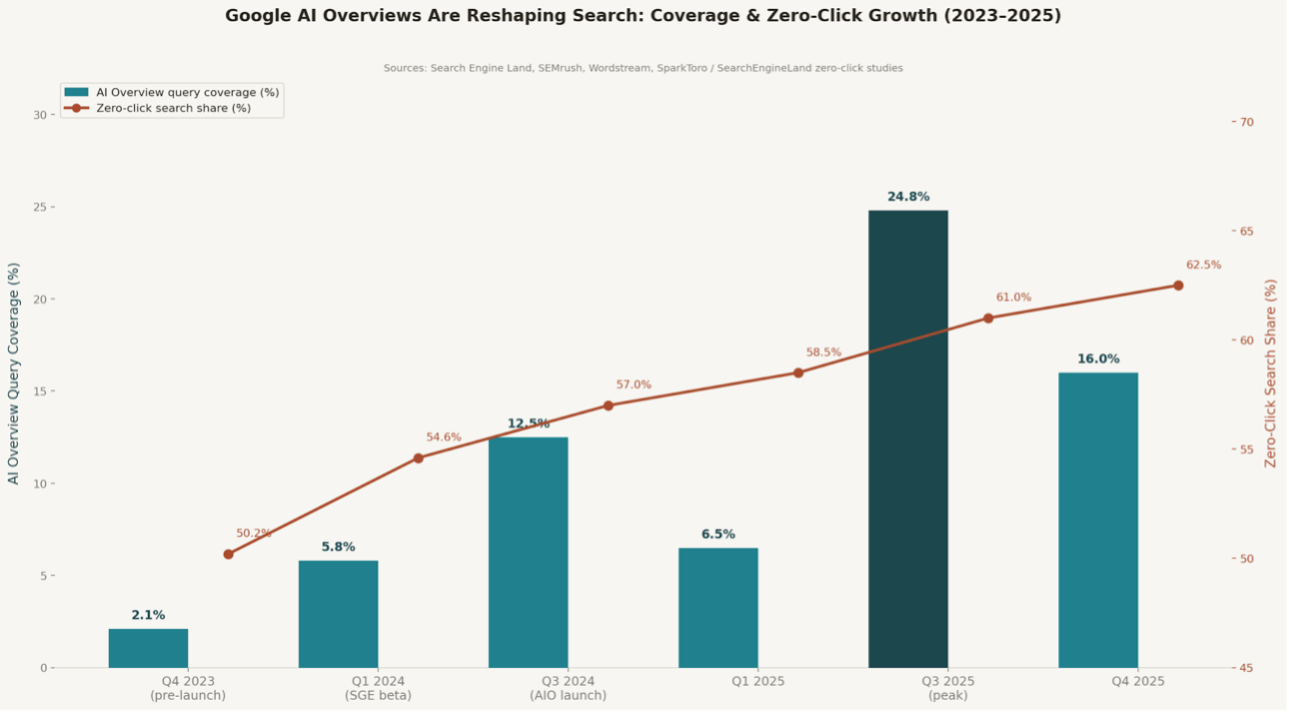
Google AI Overview query coverage grew from 2.1% in Q4 2023 to a peak of 24.8% in Q3 2025, while zero-click search share rose from 50% to over 62% across the same period.
What AEO Actually Is (and What It Is Not)
Answer Engine Optimization is the practice of structuring your content so that AI-powered systems, including Google AI Overviews, ChatGPT, Perplexity, and Gemini, can extract, interpret, and cite your pages as authoritative sources in generated answers.
It is not:
Stuffing FAQ schema onto every page hoping for a rich result
Using AI to mass-produce generic content that looks like answers
A replacement for traditional SEO
A quick fix that bypasses the need for genuine expertise
AEO works on top of SEO. You need to be discoverable and indexed before any AI system will consider surfacing your content. Think of it as a two-layer visibility system. The first layer is discovery: can search engines find, index, and rank your page? The second layer is interpretability: when your page is found, can an AI system extract a clear, citable answer from it?
Most businesses are reasonably solid on layer one and completely blind to layer two.
The Shift from Rankings to Citations
PromptWire's 2025 AEO trend report calls this the shift from a "ranking economy" to a "citation economy." Visibility is no longer about securing position #1. It is about being named as the source inside an AI-generated answer.
An Ahrefs study analyzing 15,000 prompts across AI platforms found that only 12% of URLs cited by AI engines also appear in Google's top 10 results.
For Google AI Overviews specifically, the overlap with traditional top rankings is 76%, which means if you want to be cited in Google's own AI answers, traditional SEO still matters enormously.
But for ChatGPT, Perplexity, and Gemini, ranking #1 on Google is far from sufficient.
How Google AI Overviews Decide What to Cite
Understanding the citation mechanism is the foundation of any AEO strategy.
This is not a black box. Research from multiple sources converges on a consistent set of signals.
Semantic Completeness
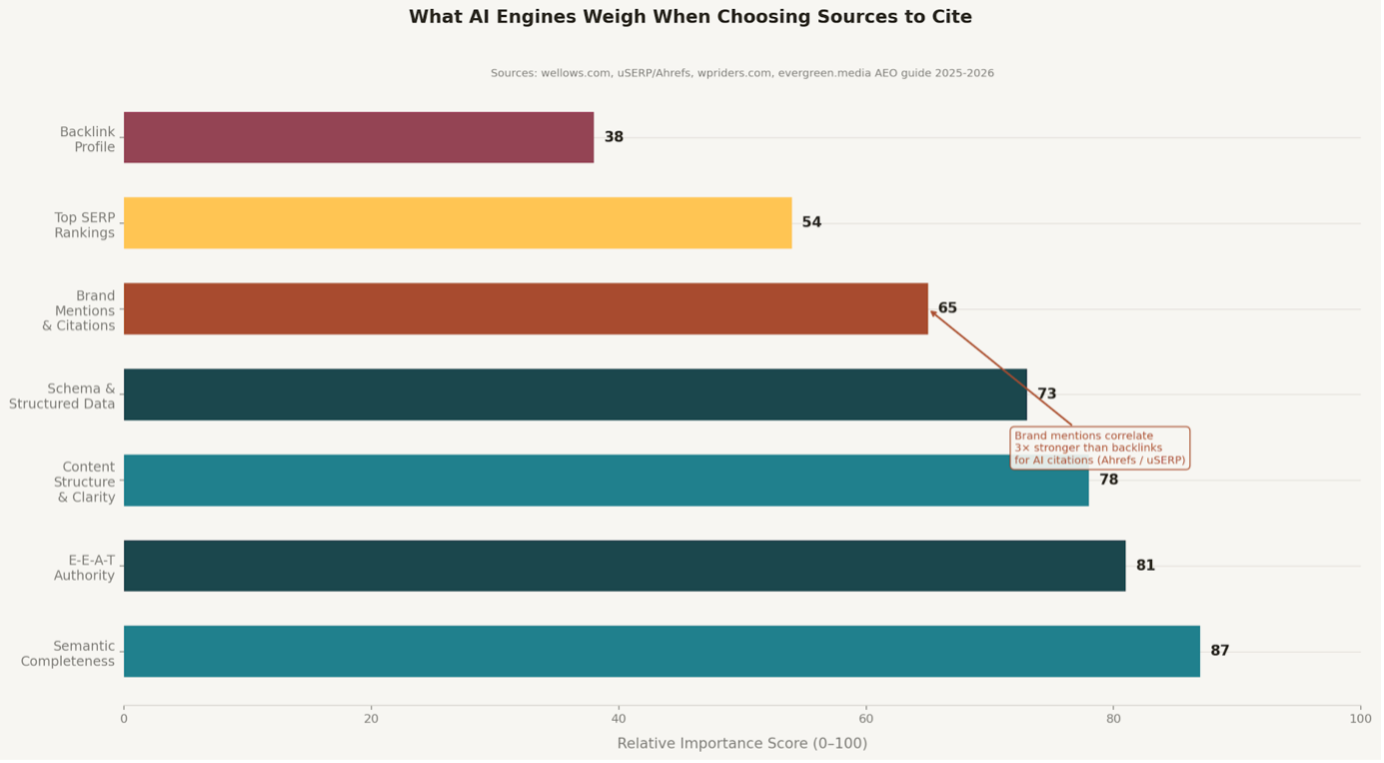
The highest-weighted factor in recent correlation studies (r=0.87) is whether your content answers a question completely without requiring the reader to go somewhere else. AI systems are building synthesized answers.
They want sources that contain the full claim, the supporting context, and enough detail to verify the point.
A page that opens with a company tagline and buries the actual answer three paragraphs down scores poorly here. A page that leads with a clear, question-matched heading and delivers a 40-60 word answer in the first sentence of each section scores much better.
E-E-A-T Authority
Experience, Expertise, Authoritativeness, and Trustworthiness signals carry an r=0.81 correlation with AI Overview citations, according to wellows.com's ranking factor analysis . That same research notes that 96% of AI Overview citations come from sources with verified E-E-A-T signals.
In practice this means:
Named authors with verifiable credentials and professional profiles.
Original research, proprietary data, or case studies that cannot be rephrased from someone else
Consistent entity definitions across your entire digital presence (website, Google Business Profile, LinkedIn, third-party mentions)
Citation by other authoritative sources in your niche
Content Structure and Clarity
AI systems parse HTML. They follow the heading hierarchy, find list items, and extract table data. A page with logical H1, H2, H3 structure, question-format headings, and clearly demarcated answer blocks is far easier to parse than a page full of long flowing paragraphs with no structural markers.
In practical terms, that means reformatting your strongest existing pages to use:
H2 headings phrased as the exact question a buyer would ask
A concise direct answer in the first 1-2 sentences of each section
Bulleted or numbered lists for any multi-part explanation
Crawlable HTML (not text inside images, PDFs, or JavaScript-rendered blocks)
Schema and Structured Data
Schema markup adds 73% to AI Overview selection probability according to the wellows.com analysis and pages with schema are 36% more likely to appear in AI-generated summaries according to wpriders.com research
Microsoft's Fabrice Canel confirmed at SMX Munich in March 2025 that schema markup helps Microsoft's LLMs understand content, per averi.ai's technical implementation guide
The schema types that matter most for AEO are:
FAQPage (the format AI systems favor most for extractable Q&A)
Article and BlogPosting (with author, datePublished, publisher)
Organization with same as properties (entity authority across knowledge graphs)
Service and LocalBusiness (for any service-area pages)
Person (for author bios and team pages)
Note: schema does not compensate for weak content. If the underlying page is vague or poorly structured, adding JSON-LD will not rescue it.
Brand Mentions and Off-Page Signals
Here is where AEO departs most sharply from traditional SEO. An Ahrefs study analyzing 75,000 brands found that unlinked brand mentions correlate 3 times more strongly with AI
Overview citations than backlinks do.
Raw domain authority and link counts are becoming weaker signals for AI citation.
What matters instead is whether your brand is talked about across the web: mentioned in forums like Reddit and Quora, listed in third-party comparison sites, referenced in industry publications, and featured in real product or service reviews.
The Two-Layer Visibility Audit: Where to Start
The most common mistake I see is treating AEO as a content production problem. Founders assume they need more pages, more articles, or a bigger content calendar. In most cases, the real problem is that existing pages are unclear.
Before adding content, run a quick diagnostic on your most important pages:
Layer 1 check (discovery):
Does Google have the page indexed?
Does it rank for any relevant queries (even if on page 2 or 3)?
Is the crawl path clean (no robots.txt blocks, no noindex tags, no JavaScript-only rendering)?
Layer 2 check (interpretability):
Does the page open with a question-matched heading or a company slogan?
Is the core answer visible in the first 2 sentences of each major section?
Are there structured lists, clear H2/H3 hierarchy, and consistent terminology?
Does the About/Team page define the entity clearly?
Is there a FAQPage schema with the same questions your buyers actually ask?
Are author bylines present with schema markup linking to verifiable profiles?
A page that passes layer 1 and fails layer 2 ranks but does not get cited. That is where most SME websites sit today.
Prioritize Existing Pages Over New Content
According to SEOClarity research , 97% of AI Overviews cite at least one source from the top 20 organic results, and the number one organic result is cited in 54% of cases. Start with pages that:
Already rank on page 2 or 3 for a relevant query
Appear in Google Search Console with meaningful impressions but low click-through rate
Are closest to a purchase decision (product pages, service pages, pricing pages, comparison pages)
Map to the questions your sales or support team hears most often
Reformat those pages first. Move answers to the top of each section. Add question-format H2s. Add FAQPage schema.
Then measure impact in Search Console before publishing new content.
AEO in Practice: What a Page Rewrite Actually Looks Like
A B2B SaaS client had a service page ranking in position 14 for a mid-funnel query. The page opened with three paragraphs about company history and philosophy. The buyer's actual questions were: who is this for, how long does implementation take, what resources are needed, and when is this not the right fit? None had an explicit heading.
Here is what changed:
H1 stayed the same (keyword-optimized)
Added four new H2s phrased as the exact questions above
Each section opened with a direct 40-50 word answer, followed by supporting detail
Removed the founding story from the first screen (moved to the About page)
Added FAQPage schema replicating the four H2s
Added author byline with Organization and Person schema
Within eight weeks, that page moved from position 14 to position 6, and it began appearing as a cited source in AI Overviews for several related long-tail questions. In mobile-first markets across Southeast Asia, where buyers use voice and AI search heavily for commercial queries before clicking anywhere, this type of clarity improvement has an outsized effect on whether your brand enters the buyer's consideration set.
The AEO Toolkit: What to Build
Content structure (every priority page):
Rewrite H2s as buyer questions
Open each section with a direct 40-60 word answer
Add a FAQ block at the bottom of the page (4-6 questions minimum)
Ensure consistent entity terminology across all pages
Technical (schema, once per site then page-by-page):
Organization schema with sameAs properties on every page
Article or BlogPosting schema on all editorial content
FAQPage schema on service pages and blog posts with FAQ blocks
Person schema on author bios
BreadcrumbList schema for navigation context
Off-page (ongoing):
Build brand mentions in independent publications, industry forums, and comparison directories
Create original data or research that other sites will reference
Publish on platforms (LinkedIn, industry blogs) where AI systems index and reference content
Collect and display reviews that mention your specific service category
Measurement:
Track AI Overview impressions separately in Google Search Console
Monitor brand mention volume using SEMrush Brand Monitoring.
Measure assisted conversion from AI-sourced traffic
Before Google Answers for You
Is AEO replacing traditional SEO?
No. AEO works on top of SEO, not instead of it. Traditional SEO helps search engines discover, index, and rank your page. AEO helps AI systems understand, extract, and cite your content inside generated answers. If SEO gets you found, AEO helps you become the answer.
Why do Google AI Overviews matter for businesses?
Google AI Overviews matter because users can now get answers before clicking any website. Ranking on page one is no longer enough if your brand is not being cited inside the AI-generated answer. The new visibility game is not just ranking higher. It is becoming the trusted source AI systems choose to quote.
What makes a page more likely to be cited by AI search engines?
AI systems prefer pages with clear structure, direct answers, credible authorship, consistent entity signals, and supporting evidence. A page with question-based headings, short answer blocks, FAQ schema, strong author details, and original expertise is easier for Google AI Overviews, ChatGPT, Perplexity, and Gemini to understand.
What should I fix first for AEO?
Start with your existing high-value pages before creating new content. Rewrite H2s as buyer questions, add a 40-60 word direct answer at the start of each section, clean up schema markup, strengthen your author and company signals, and add FAQ blocks based on real customer questions.
Get a CRO Audit with Jetson for $49
What you get. A full AI-powered audit of your key pages, including AEO interpretability, conversion path, and entity clarity, plus a 1:1 recommendation session with Jetson.
Why now. Early access is $49. At full launch, it goes to $99.
Who it is for. DTC, B2B, and SaaS founders or marketing leads spending at least $5K per month on paid media, or planning to scale.
Book it here. Lock in early access at $49 before it goes to $99: https://www.thrivex.tech/ai-audit-early-access
Further reading in the ThriveX knowledge hub
Why 70 Percent of Shoppers Abandon Their Carts (And 3 Checkout Fixes That Increase Conversions). The checkout-specific playbook.
The Add to Cart Bottleneck. Why high-traffic product pages still fail.
Why Running Ads Without Funnel Clarity Wastes Money. The ad-spend side of the same problem.
Beyond Google Analytics: How AI Audits Reveal the Invisible Friction. The diagnostic layer.
The 2026 Efficiency Gap. Why smart leaders are prioritizing diagnostics over ad spend.