Why More Ad Spend Doesn't Mean More Conversions Without CRO First
By Susan, Head of Paid Ads at ThriveX
Reading time: 6 minutes. Last updated: September 2026.

Author's Note
The most common request I get is "can we just increase the budget." It is rarely the right next move, because more ad spend doesn't mean more conversions if the conversion path after the click is not converting well. A bigger budget does not fix that, it just buys more of the same loss at a larger scale. I have seen this play out in both directions: accounts that scaled spend into a broken funnel and made the leak worse, and accounts that held budget steady, fixed conversion quality first, and outperformed accounts spending far more. This guide walks through why sequence matters more than spend size. If you want a direct read on whether your account is ready to scale, the ThriveX AI Audit checks this specifically.
Why More Ad Spend Doesn't Mean More Conversions
Most founders treat budget increase as the default next move after a good month or a tight quarter. More budget feels like progress, even when nothing about the funnel has changed.The pattern arrives looking the same way every time: ad spend doubled, conversions stayed flat, and nothing inside the ad account explains where the money went.That instinct skips a question that should come first: is the current spend already converting at the rate it should. If the conversion path has a leak, a budget increase does not bypass that leak. It runs more money through the exact same hole.The real bottleneck is sequence, not size. A RM2,000 monthly budget into a tight, high-quality conversion path can outperform a RM10,000 budget into a leaking one, because ROAS is a ratio, not a volume metric. Bigger spend on a bad ratio just produces a bigger loss.This connects directly to revenue because every ringgit added to a broken funnel is a ringgit spent confirming the same problem at a larger scale, instead of fixing it once at a smaller one.
What "Making the Leak More Expensive" Actually Means
Making the leak more expensive means that increasing ad spend before fixing conversion quality does not improve ROAS, it multiplies the same loss ratio across a larger budget, turning a small, fixable problem into a larger, costlier one. It is not the same as a campaign simply needing more time to optimize, and it is not solved by switching platforms or creative while the conversion path stays the same.It matters because budget scaling assumes the destination the ad sends traffic to is already working. When that assumption is false, every additional ringgit of spend inherits the same conversion rate as the spend before it, just at a bigger scale.For example, an account converting at half its potential rate that doubles its budget does not recover that lost half. It simply spends twice as much to lose the same proportion of revenue.
What the Data Confirms
Two verified data points show why spend scaling amplifies whatever conversion experience already exists. The average documented cart or checkout abandonment rate across 50 separate studies is 70.22%. An account scaling budget into a funnel with this level of leakage is not buying more revenue, it is buying more abandoned carts at a larger cost per cart. Google's analysis of 11 million mobile ad landing pages across 213 countries found that as load time increases from 1 to 10 seconds, the probability of a mobile visitor bouncing increases 123%. Doubling ad spend into a slow or mismatched landing experience does not double conversions. It doubles the number of visitors who bounce before converting.
Where Budget Scaling Backfires
Budget scaling backfires in four recognizable patterns.
Scaling Into a Conversion Ceiling
If conversion rate has been flat for several months, the funnel has a ceiling that more traffic will not raise. Scaling spend into that ceiling produces proportionally more cost without proportionally more revenue, the defining sign that the problem sits past the click, not in reach or frequency.
Scaling Too Fast for the Algorithm to Learn
Aggressive, sudden budget increases disrupt the delivery system's ability to find the right audience efficiently, producing volatility and higher cost per result exactly when a founder is expecting the opposite. Gradual, consistent pacing lets the system build stronger signals before it is asked to spend more.
Scaling Volume When the Real Constraint Is Lead Quality
For high-ticket or high-consideration offers, more leads do not mean more revenue if the leads are not being converted with enough care after they arrive. Volume-first scaling treats every lead as equally valuable, which is rarely true for services where the conversion journey, not the lead count, decides revenue.
Scaling as a Reaction to a Bad Month
Increasing budget specifically to compensate for a slow month treats spend as the lever for a problem that spend did not cause. If the slow month was caused by conversion friction, a bigger budget the following month repeats the same friction, just at a higher cost.
Should You Spend More on Ads or Improve Your Conversion Rate First?
For an account that is already spending, conversion comes first. There is a specific check inside your own ad account that settles this without relying on instinct.Look at your Lost impression share due to budget metric. If it reads 0%, raising your budget is unlikely to have any impact, because there is no additional impression inventory your current budget is missing out on. The extra money buys the same impressions you already win, at the same conversion rate you already have.Even when that metric shows genuine room to grow, more impressions only become more revenue if the page receiving them converts. A budget increase multiplies whatever conversion rate already exists. When that rate is the constraint, the increase multiplies the constraint along with the spend.The practical sequence is to confirm whether budget is genuinely limiting your reach, then confirm whether the post-click experience converts the traffic you already send it. Fix the second before funding the first.
Is Your Account Ready to Scale?
Your account is not ready for more budget if: Conversion rate has been flat or declining for the last two reporting periodsYou are considering a budget increase specifically to make up for a slow monthLead quality, not lead volume, is the actual constraint on revenue for your offerYour last significant budget increase caused volatility instead of stable improvementYou have not confirmed whether the post-click experience matches what your ads promiseNo one can say, with evidence, what your current account's actual conversion ceiling is.
The Sequence Before You Increase Budget
Work through this before approving a budget increase.Pull conversion rate for the last two reporting periods, not just the most recent oneConfirm whether your landing page or chat flow continues the promise made in your top ads. Identify whether lead volume or lead quality is the actual constraint for your offerHold budget steady while fixing the highest-impact conversion issue firstIncrease budget gradually once fixed, rather than in one large jump, to protect algorithm learningOnly scale spend once the conversion ratio, not just the lead count, has improved.
How This Plays Out: A Penang Dental Clinic
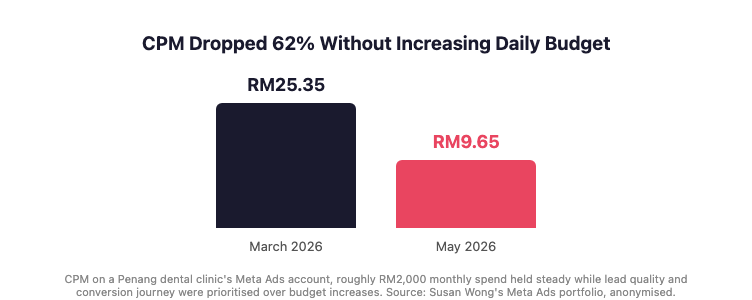
Figure 1 demonstrates the CPM drop on a Penang dental clinic's Meta Ads account after holding budget steady at roughly RM2,000/month and prioritising lead quality over lead volume.
Before: A Penang dental clinic started its Meta Ads account from zero data, running Messaging and Engagement campaigns on a daily budget of RM150, roughly RM2,000 per month. CPM started high at RM25.35 in March 2026, typical for a brand new account still being learned by the algorithm.
Diagnosis: The instinct many clinics have at this stage is to increase budget to compensate for high early CPM. Instead, the account held budget steady and focused on lead quality and conversion journey rather than lead volume, consistent with the principle that high-value services depend on how leads are converted, not how many arrive.
Fix: Budget pacing stayed consistent rather than scaling aggressively, allowing the algorithm to build stronger optimisation signals over time, while the post-lead conversion journey was prioritised over simply generating more leads.
After: CPM dropped from RM25.35 to RM9.65 by May 2026, a 62% reduction in two months, without increasing the daily budget. On roughly RM2,000 in monthly spend, the clinic closed 4 dental implant cases worth RM20,000 in total value, an approximate 10x ROAS.
The same underlying pattern showed up in a Malaysian health supplement brand, where ROAS stayed stuck at 1.05x until the post-click conversion flow was fixed directly, not by increasing budget, after which ROAS stabilized at 2.5x on the same spend. In both cases, fixing the conversion path outperformed scaling the budget.
This data is real and verified from Susan Wong's Meta Ads portfolio, anonymised per ThriveX's client confidentiality practice.
Where the ThriveX AI Audit Fits
Budget decisions deserve evidence, not instinct. Most teams cannot say with confidence whether their account is genuinely ready to scale or quietly running into a conversion ceiling, the same diagnostic gap covered in .
This is where the ThriveX AI Audit fits. As a CRO and AEO diagnostic consultancy, ThriveX reviews your funnel and your account's conversion path before you commit more budget, identifying whether lead volume, lead quality, or post-click experience is the actual constraint.
If you are weighing a budget increase and want to know whether your account is ready to scale or still has a leak to fix first, the audit is priced at $49 during beta, with standard pricing at $99.
FAQ
What does it mean for ad spend to "make the leak more expensive"?
It means increasing budget before fixing conversion quality does not improve ROAS, it multiplies the same loss ratio across a bigger spend. A small, fixable conversion problem at low budget becomes a larger, costlier one at higher budget, because the underlying conversion rate has not changed.
Is this different from normal early-stage CPM volatility on a new account?
Yes. Early-stage high CPM on a new account is normal and expected, since the algorithm is still learning your audience. The problem this article addresses is reacting to that normal volatility by increasing budget instead of holding it steady and fixing conversion quality, which disrupts the learning process instead of supporting it.
How do I know if my account is actually ready to scale?
Check whether conversion rate has been stable or improving over the last two reporting periods, and whether your landing page or chat flow continues the promise your ads make. If both are true and ROAS is consistent, the account is more likely ready. If conversion rate is flat or unclear, fix that first.
What should I do instead of increasing budget?
Hold your budget steady and fix the highest-impact conversion issue first, whether that is lead quality, post-click continuity, or pacing. Once conversion rate improves and stabilizes, increase budget gradually rather than in one large jump, so the algorithm's learning process is supported rather than disrupted.
Why is my social media ad spend increasing but conversions staying flat?
Rising social media ad spend with flat conversions usually means the extra budget is buying more of the same traffic into the same conversion path. Meta will spend what you give it, but the conversion rate after the click is set by your landing page and offer, not by the budget.
Check whether your conversion rate held steady while spend rose. If it did, the funnel is the constraint, not the budget.
Further Reading
Why Meta Ads Underperform When the Landing Page Breaks Message Match:
The Website Conversion Audit Checklist to Run Before Increasing Ad Spend:
CRO Before Ads: Why Malaysian DTC Brands Burn Marketing Budget at the Wrong End of the Funnel:
The Conversion System That Stops Wasted Ad Spend for Malaysian Brands: