"Crawled – Currently Not Indexed": Why It Happens and How to Fix It
By Jetson, Head of CRO at ThriveX
Reading time: 5 minutes. Last updated: August 2026.
Author's Note
"Crawled - currently not indexed" is one of the most confusing statuses in Google Search Console, because it looks like an error but Google explicitly says it isn't one. It sits at the foundation of AEO: a page that isn't indexed can't be optimized for anything downstream. This guide explains what the status actually means, why it happens, and the fix sequence that gets pages moved into the index. If you want a direct read on your own site's indexation health, the ThriveX AI Audit checks this specifically.
What "Crawled – Currently Not Indexed" Actually Means
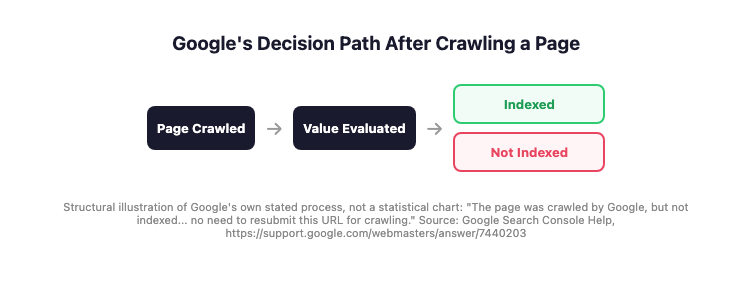
Figure 1 demonstrates Google's own stated decision path after crawling a page — that a page can be seen and still excluded from the index based on value, not blocked by a technical error.
Google's own Search Console Help documentation defines this status plainly: "The page was crawled by Google, but not indexed. It may or may not be indexed in the future; no need to resubmit this URL for crawling".
That last line matters. Google is not describing a bug on your end. It is describing a decision it made after reading the page, that the page did not clear the bar for inclusion in the index right now.
John Mueller, Google's Search Advocate, has said directly that indexing is not guaranteed even for correctly crawlable pages: Google evaluates whether a page adds enough distinct value to be worth indexing, separate from whether it is technically accessible. Crawlability gets you seen. It does not get you indexed.
Why This Happens
Three patterns account for most "crawled, not indexed" pages.
The Page Doesn't Add Enough Distinct Value
Thin content, near-duplicate pages, or pages that repeat information already indexed elsewhere on your site are the most common cause. Google crawled it, recognized it wasn't meaningfully different from something already in the index, and decided not to add it.
Quality Signals Are Weak Site-Wide
Indexing decisions are influenced by the overall quality signal of the domain, not just the individual page. A site with many thin or low-value pages can see even genuinely useful pages struggle to get indexed, because Google's confidence in the domain is lower. This is the same underlying problem entity clarity addresses: a domain that reads as vague or interchangeable gets less benefit of the doubt on every page it publishes.
The Page Was Recently Published
New pages sometimes sit in "crawled, not indexed" temporarily while Google continues evaluating them against existing content. This resolves on its own for genuinely valuable pages, but it can look identical to a permanent exclusion in the short term.
Search Engine Land's own crawl budget guide notes that duplicate and thin content are the two most common reasons Google's systems choose not to prioritize a page for indexing, the same mechanism behind all three patterns above.
Diagnostic Checklist
Run this against any page stuck in "crawled, not indexed."
Does this page say something genuinely different from your other pages, not just a reworded version?
Is the content substantial enough to justify a dedicated URL, or would it work better folded into an existing page?
Has it been more than a few weeks since publish, ruling out normal evaluation delay?
Are there other thin or near-duplicate pages on the site that might be dragging down domain-wide quality signals?
Does the page have any internal links pointing to it, or is it isolated?
Would you personally bookmark or reference this page, or does it exist mainly to fill a content calendar slot?
Fix Sequence
Read the page as a stranger would and identify what it adds that nothing else on the site already says
If it doesn't add anything distinct, merge it into a related page instead of leaving both live
Add internal links from at least one other relevant, already-indexed page
Audit the rest of the site for thin or near-duplicate pages that may be lowering domain-wide quality signals
Wait a genuine evaluation period, several weeks, before treating the status as permanent
If still unindexed after that, the content itself is the most likely blocker, not a technical crawling issue
How This Plays Out for a Malaysian SME
Before: A KL-based home services company had 40 published blog pages, several of which were near-identical variations on the same service topic written for different suburb names.
Diagnosis: Google Search Console showed a growing number of pages stuck in "crawled, currently not indexed," concentrated almost entirely among the suburb-variation pages, which added no distinct value beyond a swapped place name.
Fix: The suburb-variation pages were consolidated into fewer, more substantial location pages with genuinely different content per area, and internal links were added from the site's core service pages.
After: The consolidated pages moved into the index within the following crawl cycle, and overall indexation rate across the site's remaining pages improved as domain-wide quality signals strengthened.
This example is illustrative, not drawn from a documented ThriveX case study. Real case study data is available at thrivex.tech/casestudy.
Where the ThriveX AI Audit Fits
Most founders discover indexation problems by accident, months after publishing content that never showed up in search. Reading Search Console status codes correctly, and knowing which ones require a content fix versus a technical fix, is not intuitive.
This is where the invisible friction AI audit fits. ThriveX reviews your site's indexation health directly, distinguishing pages that need a content rework from pages with a genuine technical blocker.
If you have pages stuck in "crawled, not indexed" and aren't sure why, the audit is priced at $49 during beta, with standard pricing at $99, and built to answer that directly.
FAQ
Is "crawled - currently not indexed" an error I need to fix?
Not necessarily. Google explicitly states it does not require resubmission and may resolve on its own. It becomes something to fix when it persists for weeks on a page you believe is genuinely valuable, since that signals a content or domain quality issue rather than a temporary evaluation delay.
How is this different from a page that's blocked from indexing entirely?
A blocked page (via noindex tag or robots.txt) is deliberately excluded and Google will not index it regardless of quality. "Crawled, not indexed" means Google read the page and chose not to include it based on value, not a technical block.
How long should I wait before treating the status as a real problem?
Several weeks past publish is a reasonable evaluation window for a new page. If the status persists well beyond that on a page you're confident adds real value, the more likely explanation is thin content or weak domain-wide quality signals rather than a temporary delay.
Can fixing other pages on my site help an unrelated page get indexed?
Yes. Indexing decisions are influenced by the overall quality signal of the domain, not just the individual page. Cleaning up thin or duplicate content elsewhere on the site can improve Google's confidence in indexing your other pages.
Further Reading
What Entity Clarity Means and Why AI Search Cannot Find Unclear Businesses: https://www.thrivex.tech/blogs/entity-clarity-ai-search
Why Google Business Profile Is the First AEO Fix, Not the Last: https://www.thrivex.tech/blogs/google-business-profile-first-aeo-fix
Why Your Product Pages Are Invisible to AI Shopping Agents: https://www.thrivex.tech/blogs/ai-shopping-agents-product-pages
The Invisible Friction AI Audit: https://www.thrivex.tech/blogs/invisible-friction-ai-audit