The Website Conversion Audit Checklist to Run Before Increasing Ad Spend
By Jetson, Head Of CRO at ThriveX
Reading time: 6 minutes. Last updated: June 2026.
Author's Note
Most founders ask "should we increase the ad budget" before asking "can our funnel actually convert more traffic right now." That order is backwards, and it is the single most expensive sequencing mistake in paid marketing, which is why more ad spend doesn't mean more conversions when the funnel isn't ready. This guide gives you the website conversion audit checklist ThriveX uses with Malaysian and UK ecommerce brands to answer that question before another ringgit or pound goes to ad spend. If you want a definitive answer rather than a guess, the ThriveX AI Audit is built to give you one.
Spending More Will Not Fix a Funnel That Cannot Convert
Most founders treat a flat ROAS as a media buying problem. The instinct is to test a new creative, switch platforms, or raise the budget and hope scale fixes it.
That instinct is usually backwards. If your landing page, product page, or checkout cannot convert the traffic you already have, more traffic simply produces more of the same loss, at a higher cost.
The real bottleneck is sequencing. CRO before ads is not a slogan, it is an order of operations. Fixing the funnel first means every dollar spent afterward works harder, because it lands on a system that already converts.
This is a money problem, not a theory. A funnel converting at half its potential rate does not just lose sales, it actively pays for traffic that has no chance of converting before it is fixed.
What "CRO Before Ads" Actually Means
CRO before ads means diagnosing and fixing the conversion path before increasing the budget that drives traffic into it, so that scaling spend amplifies a system that already works rather than a system that is still leaking. It is not a one-time audit you do once and forget, and it is not the same as redesigning your website.
It matters because ad platforms reward what happens after the click far less than what happens before it. Google, Meta, and TikTok can only deliver the visitor. What that visitor does next is entirely a funnel question, not a media buying question.
For example, doubling your budget on a campaign with a 1.2% conversion rate produces twice the spend and twice the waste, not twice the revenue, unless the underlying conversion path improves first.
What the Data Shows
Two verified data points show why spending more before fixing the funnel rarely pays off.
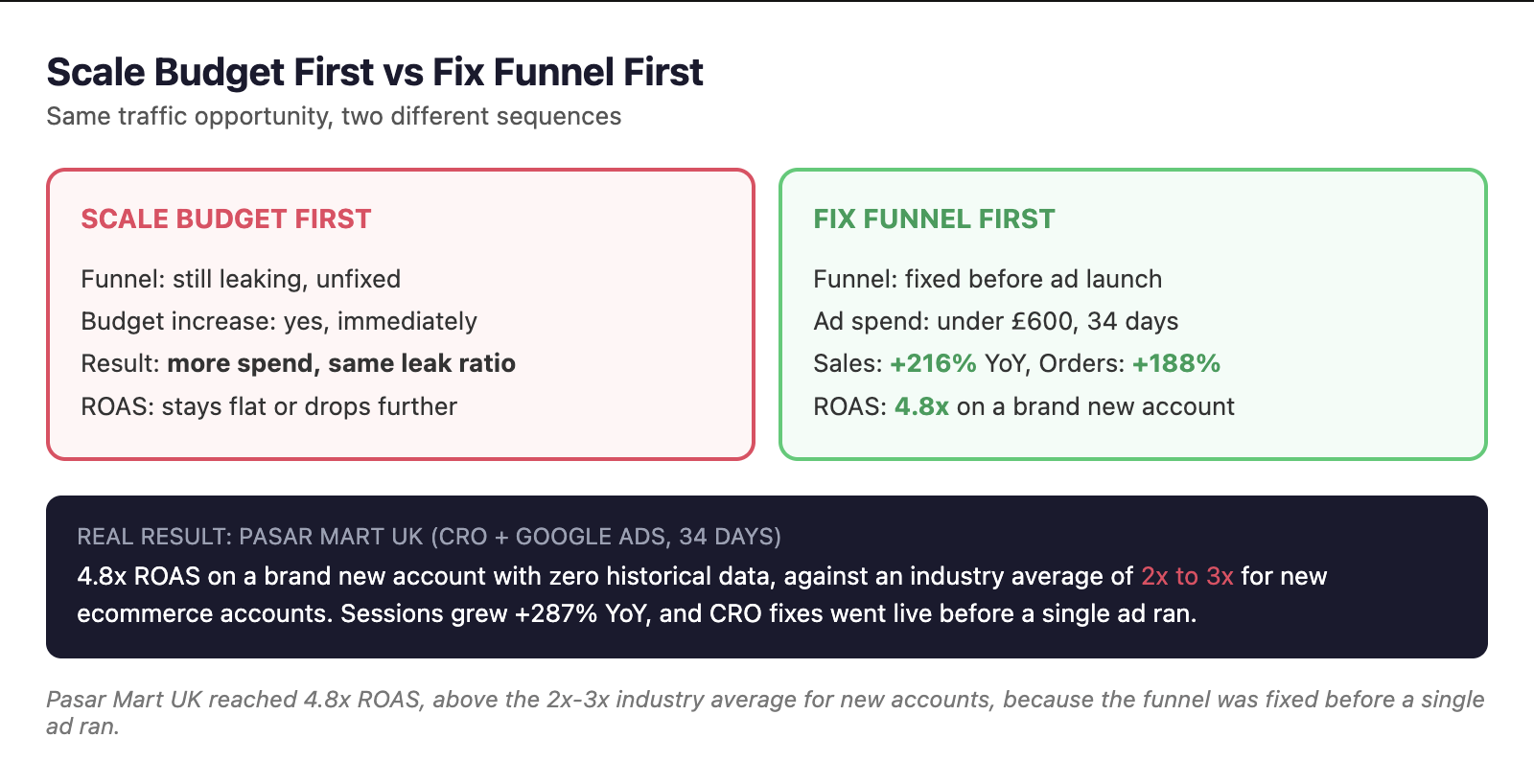
Figure 1 demonstrates the outcome difference between scaling ad spend into an unfixed funnel versus fixing conversion first, using Pasar Mart UK's real 34-day campaign results (4.8x ROAS, +216% sales YoY).
The average documented cart abandonment rate across 50 separate studies is 70.22%. That means most of the traffic an ad budget pays to acquire never completes a purchase, regardless of how well the ad itself performed. Increasing spend without addressing this simply buys more abandoned carts at a higher cost per cart.
The median landing page conversion rate across 41,000 landing pages and 464 million visits is 6.6%, while the top 10% of pages convert at 11.45% or higher. That gap, nearly double between a median page and a top-performing one, is headroom most funnels have not captured yet. Scaling budget before closing that gap means paying full price for traffic your own page is still underconverting.
The 4 Situations Where More Ad Spend Makes Things Worse
Four situations consistently mean the problem is the funnel, not the budget.
Rising Spend, Flat or Falling ROAS
If you have increased budget over the last two quarters and ROAS has stayed flat or dropped, the campaigns are not underperforming randomly. They are running into the same conversion ceiling every time, and more spend just hits that ceiling harder.
Strong Click-Through, Weak Post-Click Conversion
High click-through rate with low conversion means the ad is doing its job and the landing page is not. This is a funnel diagnosis, not a creative or targeting problem, and no amount of A/B testing the ad itself will fix it.
New Campaigns Underperform Even With Good Creative
If a new campaign with strong creative and solid targeting still underperforms, the variable that did not change is the destination it sends traffic to. Good ads pointing at a weak funnel will always look like a media buying failure that is actually a funnel failure.
You Cannot Explain Last Quarter's Numbers
If no one on the team can say with evidence why last quarter's ROAS moved up or down, the account is being managed on instinct, not data. That is expensive to discover after the next budget increase rather than before it.
The Website Conversion Audit Checklist: 6 Signs You Need One
You likely need an audit before spending more if:
1. ROAS has stayed flat or declined over the last two reporting periods despite increased budget
2. Click-through rate is healthy but conversion rate on the landing page is below 2%
3. A new campaign with strong creative still underperforms within its first two weeks
4. No one can explain, with data, why last quarter's numbers moved the way they did
5. Mobile traffic converts at less than half the rate of desktop traffic
6. You are considering a budget increase specifically to "make up for" a slow month
The Decision Sequence Before You Increase Ad Spend
Work through this in order before approving the next budget increase.
1. Pull conversion rate and ROAS for the last two reporting periods, not just the last 30 days
2. Compare mobile and desktop conversion rate to isolate where the leak is concentrated
3. Check whether click-through rate and landing page conversion rate tell the same story or contradict each other
4. Identify the single highest-impact fix and implement it before any new spend
5. Hold budget steady for one full cycle after the fix to measure the actual change
6. Only increase spend once the funnel is converting at a rate that justifies the larger budget
How This Plays Out: The Pasar Mart UK Pattern
Before: Pasar Mart UK had loyal customers and strong organic reach from a diaspora community ahead of Hari Raya 2025, but zero prior paid ad spend, zero historical campaign data, and a fixed 34-day deadline to capture the seasonal opportunity.
Diagnosis: ThriveX reviewed the site before any ad budget was committed. The conclusion was direct: paid traffic into a site with structural gaps does not produce growth, it amplifies the leak. CRO came before any campaign was switched on.
Fix: Homepage changes reduced drop-off and surfaced the right products for high-intent visitors first. Only after that did Google Ads infrastructure go live, with targeting aligned to actual inventory and purchase intent rather than click volume.
After: Over the 34-day campaign, total sales grew 216% year on year, total orders grew 188%, and website sessions grew 287%. ROAS reached 4.8x on a brand new account with zero historical data to optimize from, against an industry average of 2x to 3x for new e-commerce accounts. Total ad spend was under £600.
Full case study: https://www.thrivex.tech/casestudy/pasarmart
Where the ThriveX AI Audit Fits
The decision in front of you is not whether to spend on ads. It is whether your funnel deserves the spend you are about to give it. Most teams cannot answer this with evidence, only with intuition about what feels true.
This is where the ThriveX AI Audit fits. As a CRO and AEO diagnostic consultancy, ThriveX reviews your funnel before you commit more budget, identifying exactly which signals from this article are active and what they are costing you per month, alongside the broader 7 signals of revenue leakage.
If you are weighing a budget increase right now and want evidence instead of a guess, the audit is priced at $49 during beta, with standard pricing at $99, and designed to answer that question before you spend anything else.
FAQ
What does "CRO before ads" actually mean?
CRO before ads means fixing the conversion path on your site before increasing the ad budget that sends traffic into it, so additional spend amplifies a system that already converts rather than a system that is still leaking. It is a sequencing decision, not a one-time project, and it applies every time you consider a meaningful budget increase.
How do I know if my problem is the funnel or the ad campaign?
Compare click-through rate to landing page conversion rate. If click-through rate is healthy but conversion rate is low, the ad is doing its job and the page is not, which means the problem is the funnel. If both are weak together, the campaign itself may also need work, but fix the funnel first regardless.
What should I check first before approving a budget increase?
Start with conversion rate and ROAS over the last two reporting periods, not just the most recent month, since short windows hide real trends. Then compare mobile and desktop conversion rate, since this is where the largest gaps usually concentrate. Fix the highest-impact issue before any new spend goes live.
Does a CRO audit actually improve ROAS, or just user experience?
It improves ROAS directly, because ROAS is revenue divided by ad spend, and fixing conversion increases revenue without increasing spend. Pasar Mart UK reached a 4.8x ROAS on a brand new account by fixing the funnel before any ad budget was committed, not after. User experience improves as a byproduct, not as the goal.
Further Reading
- The Invisible Friction AI Audit: https://www.thrivex.tech/blogs/invisible-friction-ai-audit
- The 7 Signals Your Website Is Leaking Revenue Right Now: https://www.thrivex.tech/blogs/7-signals-website-leaking-revenue
- CRO Before Ads: Why Malaysian DTC Brands Burn Marketing Budget at the Wrong End of the Funnel: https://www.thrivex.tech/blogs/cro-before-ads
- The Conversion System That Stops Wasted Ad Spend for Malaysian Brands: https://www.thrivex.tech/blogs/conversion-system-stop-wasted-ad-spend
- The 2026 Efficiency Gap: https://www.thrivex.tech/blogs/2026-efficiency-gap
- Pasar Mart UK Case Study (Paid Ads + CRO): https://www.thrivex.tech/casestudy/pasarmart