Why Meta Ads Underperform When the Landing Page Breaks Message Match
By Susan, Head of Paid Ads at ThriveX
Reading time: 6 minutes · Last updated: July 2026
Author's Note
Most Meta Ads accounts I review get blamed for the wrong thing. The ad gets pulled, the creative gets refreshed, the audience gets rebuilt, and ROAS barely moves, because the ad was never the problem. What is actually broken is message match, the continuity between what the ad promises and what the landing page or chat flow delivers. I have watched this exact pattern play out across health, wellness, and e-commerce accounts: strong creative, healthy click-through, and a post-click experience that quietly breaks message match. This guide walks through why that gap costs more than people think and how to fix it before touching the ad again. If you want a direct read on your own account, the ThriveX AI Audit checks this specifically.
The Ad Did Its Job. The Page Did Not.
Most founders watching a Meta campaign underperform assume the problem is the ad. They refresh creative, test new angles, or rebuild the audience, and ROAS barely moves. That assumption is usually wrong. If click-through rate is healthy and cost per click is reasonable, the ad already did its job. It got the right person to click. What happens in the three seconds after that click is a completely different system, and it is usually where the actual loss is happening. The real bottleneck is continuity. A buyer who clicks an ad promising a specific offer, tone, or product expects the next thing they see to continue that promise. When the landing page or chat flow looks generic, slower, or different in tone, the buyer's trust drops at the exact moment they were closest to converting. This is one of the most expensive mistakes in Meta Ads because the spend already happened. You paid for the click. A broken continuity after that click means you paid full price for a visitor who was never going to convert, no matter how good the ad was.
What Message Match Actually Means
Message match means the visual style, message, offer, and tone of your ad carry through unbroken into whatever the click lands on, a website landing page, a Messenger conversation, or a chat commerce flow. It is not the same as having a fast-loading page, and it is not solved by a generic, well-designed page that ignores what the ad actually promised. It matters because the buyer's decision is still in motion when they click. They have not paused to reconsider. A page or chat opener that does not pick up exactly where the ad left off forces the buyer to re-evaluate the offer from scratch, and most do not bother. For example, an ad showing a specific bundle price that lands on a generic catalog page, or a warm, casual ad tone that opens into a flat, scripted chat message, both break continuity even though neither page is technically broken. This is a structural CRO problem wearing a Meta Ads costume. The fix sits in the page or flow, not in the ad account.
What the Data Confirms
The median Meta Ads conversion rate for lead campaigns across all industries was 7.72% between April 2024 and June 2025, down from 8.67% the year before. That decline happened industry-wide, across the same platform, the same auction, the same targeting tools. What changed underneath most accounts was not the ad. It was whatever buyers found after the click. The average documented cart or checkout abandonment rate across 50 separate studies is 70.22%. Most of the traffic an ad budget pays for, even traffic that clicked with real intent, still leaves before completing the action, and a discontinuous post-click experience makes that worse, not better.
Where Continuity Breaks in Meta Ads Specifically
Visual Tone Mismatch: an ad using warm, intimate, lifestyle visuals that lands on a page full of plain product shots creates an immediate tone gap.
Offer or Price Mismatch: an ad promoting a specific bundle that lands on a page without that exact offer visible forces the buyer to hunt for what they were promised.
Chat Flow That Doesn't Pick Up Where the Ad Left Off: a scripted, generic greeting after a specific, warm ad creates the same continuity break a mismatched webpage would.
Generic Pages for Specific Promises: sending every ad to the same generic homepage is one of the most common patterns behind flat ROAS.
Is a Continuity Break Costing You ROAS?
Your Meta Ads account likely has a continuity problem if: (1) click-through rate is healthy but conversion rate after the click is low, (2) your landing page or chat opener uses different visuals or tone than the ad, (3) the specific offer, price, or bundle shown in the ad is not immediately visible after the click, (4) every ad sends traffic to the same generic page regardless of angle, (5) you have refreshed creative multiple times without ROAS improving, (6) no one has compared the ad and the post-click experience side by side recently.
The Fix Sequence for Ad-to-Page Continuity
Fix this before changing the ad or the budget:
pull click-through rate and post-click conversion rate separately to confirm where the drop happens,
compare the visual style and tone of your top ad against the page or chat opener it leads to,
confirm the specific offer shown in the ad is immediately visible after the click,
match landing pages or chat openers to ad angles instead of routing everything to one generic destination,
fix the highest-traffic mismatch first and measure the change before touching the ad again,
re-check continuity every time you launch a new creative angle or offer.
How This Plays Out: A Malaysian Health Supplement Brand
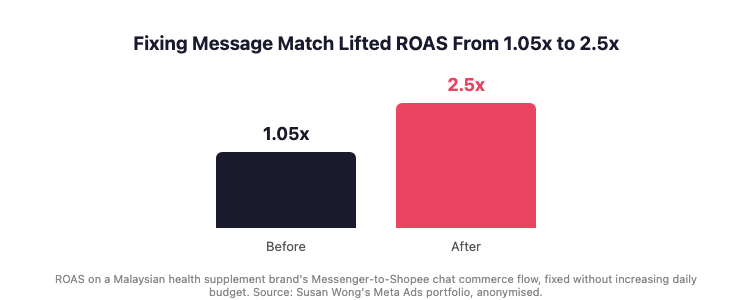
Figure 1 demonstrates that ROAS rose from 1.05x to 2.5x after fixing message match in the post-click chat flow, with no increase in daily ad spend, showing that continuity, not budget, was the actual constraint.
Before: a Malaysian health supplement brand running Meta Ads on a Messenger-to-Shopee chat commerce flow had a daily budget of RM335 and a CPM around RM18.24. ROAS sat at 1.05x in 2024, barely breaking even.
Diagnosis: the constraint was not the creative or the budget. It was conversion friction inside the post-click chat-commerce flow itself.
Fix: rather than increasing spend to compensate for low ROAS, the post-click conversion flow was fixed directly, tightening the chat sequence between ad click and purchase completion.
After: ROAS stabilized at 2.5x without increasing the daily budget. CPM also improved from RM18.24 to RM14.68 (19.57% reduction), and the same account's Shopee CPAS campaigns reached a peak ROAS of 17x against roughly 5x for chat commerce alone. This data is real and verified from Susan Wong's Meta Ads portfolio, anonymised per ThriveX's client confidentiality practice.
Where the ThriveX AI Audit Fits
Meta Ads underperformance is rarely a media buying problem. It is a continuity problem between what the ad promises and what the click delivers, which makes it structurally the same issue covered in CRO Before Ads, just expressed through an ad account instead of organic traffic. This is where the ThriveX AI Audit fits. As a CRO and AEO diagnostic consultancy, ThriveX reviews whether your top-performing ads actually continue into a matching page or chat experience. If your ROAS has been flat despite creative refreshes, the audit is priced at $49 during beta, with standard pricing at $99.
FAQ
What does "ad-to-page continuity" mean in Meta Ads?
It means the visual style, tone, offer, and message of your ad continue unbroken into whatever the click leads to. A continuity break happens when that destination looks, sounds, or offers something different than what the ad promised, even if the page itself works fine technically.
Is this different from a slow page or technical issue?
Yes. A slow page is a technical problem with a technical fix. A continuity break can happen on a fast, well-built page if its tone, offer, or visuals do not match what the ad promised.
How do I know if continuity is hurting my Meta Ads ROAS?
Compare your click-through rate to your post-click conversion rate. If click-through rate is healthy but conversion after the click is low, and you have already refreshed creative without improvement, the destination the ad leads to is the more likely cause.
What should I fix first, the ad or the landing experience?
Fix the landing experience first if click-through rate is already healthy. Match the visuals, tone, and offer on the page or chat opener to what the specific ad promised.
Further Reading
The Website Conversion Audit Checklist to Run Before Increasing Ad Spend — https://www.thrivex.tech/blogs/website-conversion-audit-checklist
The 7 Signals Your Website Is Leaking Revenue Right Now — https://www.thrivex.tech/blogs/7-signals-website-leaking-revenue
CRO Before Ads — https://www.thrivex.tech/blogs/cro-before-ads
Why Ads Waste Money When Your Funnel Is Unclear — https://www.thrivex.tech/blogs/why-ads-waste-money-unclear-funnel