Why B2B Funnels Leak Revenue (And How to Fix the Gaps That Cost You Deals)
By Jetson, Head of CRO at ThriveX
Reading time: 6 minutes. Last updated: May 2026.
Author's Note:
Most B2B teams treat slow growth as a traffic problem. It is not. The real issue is pipeline leakage at every stage from MQL to closed-won. Benchmarks show that only 0.4% of your initial lead pool reaches closed-won. If you are spending $5K or more per month on paid media and not auditing your funnel first, you are accelerating a loss, not a gain.
Lock in early access to the ThriveX AI Audit with Jetson for $49 before it goes to $99 at full launch.
B2B Funnels Break Differently Than DTC Funnels
If you have spent time in DTC, your mental model of funnel leakage is anchored around cart abandonment and post-click drop-off. B2B is a different problem. The buying journey is longer, the stakeholder group is larger, and the failure modes do not show up in your analytics dashboard.
According to Forrester's State of Business Buying 2024, 86% of B2B purchases stall during the buying process, and an average of 13 people inside a buyer's organization are involved in a purchase decision. That is a process and coordination problem, not a traffic problem. A deal that stalls at the opportunity stage can represent $80,000 in pipeline value that disappears from the forecast without a single Google Analytics alert.
The Funnel Math Nobody Wants to See
Let me walk through what typical B2B funnel benchmarks actually look like against a $1,000,000 lead pipeline. This is not a worst-case scenario. This is industry average.
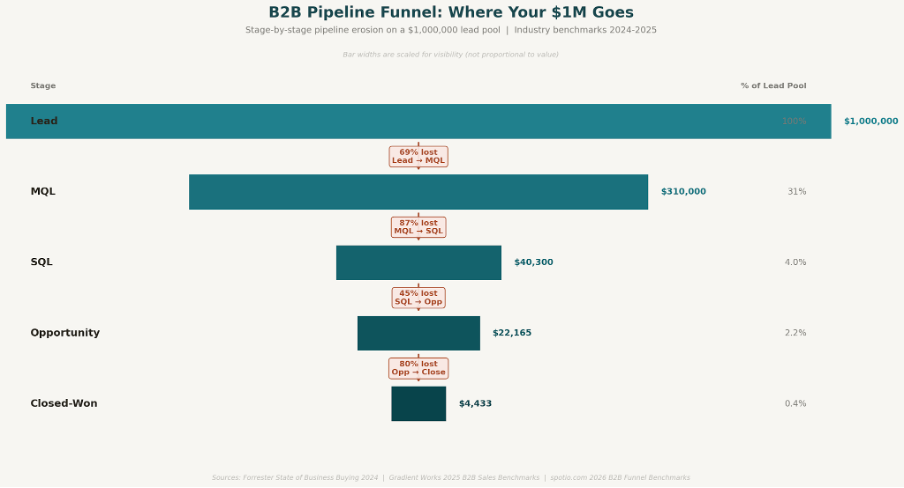
Figure 1 demonstrates a B2B pipeline funnel showing stage-by-stage value erosion from a $1,000,000 lead pool to $4,433 at closed-won, using 2024-2025 industry benchmarks.
Here is what the stages look like:
Lead pool: $1,000,000 (baseline)
MQL: $310,000 (31% conversion, per Gradient Works 2025 B2B Sales Benchmarks)
SQL: $40,300 (13% MQL-to-SQL, median per Gradient Works)
Opportunity: $22,165 (55% SQL-to-opportunity)
Closed-Won: $4,433 (20% close rate on opportunities)
By the time you reach closed-won, less than half a percent of your original lead pool value survives. Every percentage point improvement at the MQL-to-SQL stage recovers tens of thousands of dollars. The question is not whether your funnel leaks. Every B2B funnel does. The question is which leaks are fixable in 30 days versus which require structural changes.
The Four Most Common B2B Funnel Leaks
1. The MQL-to-SQL Drop-Off Is Mostly a Definition Problem
The biggest single drop in most B2B funnels happens between MQL and SQL. According to Forrester data cited by digitalapplied.com, the median MQL-to-SQL conversion rate fell from 13% in 2024 to 9.8% in 2026, driven largely by teams routing marketing-engaged contacts to sales without proper intent qualification.
The fix is not more leads. It is a shared definition between marketing and sales about what a qualified lead actually looks like. Teams that add behavioral or third-party intent signals to their MQL criteria report MQL-to-SQL conversions of 16.4%, nearly 70% above the unfiltered median. That is a problem you can fix with a two-hour alignment session and a CRM rule change.
2. Slow Response Time Destroys Intent Before It Gets to Sales
Research from MIT and InsideSales.com published via HubSpot consistently shows that responding to a lead within five minutes makes you 21 times more likely to qualify it compared to waiting 30 minutes. In B2B practice, the average response time across industries is closer to 47 hours.
That gap between five minutes and 47 hours is where serious buyers move on. In mobile-first markets across Southeast Asia, this is compounded by managing leads through personal messaging apps with no centralized tracking. A lead that arrives Monday and gets a first response Wednesday has cooled through two business days. If a competitor responded within the hour, you are already chasing.
3. Demo No-Shows Are Eroding Pipeline Value You Already Counted
Industry data shows 20-40% of booked demos do not show. LinkedIn benchmark data from 2026 puts the cost at approximately $730 per no-show in burned rep time and spend. At 80 demos per month with a 25% no-show rate, that is close to $100,000 per year in wasted pipeline activity.
The root causes are consistent: weak qualification before booking, no structured reminder sequence, and no clear framing of what the prospect needs to prepare. The fix is to qualify before booking, add a pre-demo confirmation that requires the prospect to confirm a pain point, and automate a two-touch reminder. None of this requires new software.
4. Follow-Up Failure Is Killing Deals That Were Already Warm
HubSpot's sales statistics are direct: 48% of sales reps never make a second follow-up attempt, and 44% give up after just one. Most B2B deals require five to twelve touchpoints to close. The gap is not motivation. It is structure. Without a defined cadence and CRM task automation, follow-up becomes ad hoc and the deals that need five more touches get one, then silence. A standardized follow-up playbook with automatic next-step triggers at each stage fixes this. It does not need to be complex. It needs to be consistent.
How to Prioritize the Fixes
These are process problems, not traffic problems. Here is a practical framework:
Scenario 1, Quick Fix (0-30 days). Define a shared MQL-to-SQL qualification rule between marketing and sales. Set up automated CRM tasks for follow-up at each stage. Add a pre-demo confirmation question. No new software required.
Scenario 2, Process Improvement (30-90 days). Build a five to seven touch follow-up cadence. Implement a lead routing rule with response time targets. Create a buyer-enablement pack to support late-stage deals through buying committees.
Scenario 3, System Upgrade (90+ days). Add intent signals to MQL criteria. Integrate CRM with calendar booking. Implement automated demo reminder sequences.
Most of the wins sit in Scenario 1 and 2. Fix the process first, then invest in software to systematize what works.
89% of B2B buyers report at least one stalled deal in 2024, per Gradient Works. The sellers who close more are not better at persuasion. They are better at removing barriers in the buyer's internal process.
If you want to see exactly where your funnel is leaking, the ThriveX Invisible Friction AI Audit surfaces friction at each stage and gives you a prioritized fix list. For the foundational argument on why conversion infrastructure comes before ad spend, the CRO Before Ads guide covers it in full.
Get a CRO Audit with Jetson for $49
What you get. A full AI-powered audit of your B2B funnel, including MQL-to-SQL handoff analysis, demo sequence review, and follow-up cadence assessment, plus a 1:1 recommendation session with Jetson.
Why now. Early access is $49. At full launch, it goes to $99.
Who it is for. B2B, DTC, and SaaS founders or marketing leads spending at least $5K per month on paid media, or planning to scale.
Book it here. Lock in early access at $49 before it goes to $99.
Further Reading in the ThriveX Knowledge Hub
CRO Before Ads: Why Conversion Infrastructure Comes First. The foundational guide to why you need a working funnel before scaling paid spend.
Why Ads Waste Money When Your Funnel Is Unclear. How funnel ambiguity multiplies ad waste across every campaign.
Waste Ad Spend? Fix Your Conversion System First. The practical playbook for diagnosing and fixing conversion leaks before investing more in traffic.
The Invisible Friction AI Audit. How to surface the friction points your analytics miss, and what to do about them.
AI Marketing Strategy for Malaysian SMEs. How to use AI tools to compound the gains from a fixed conversion foundation.