By Jetson, Head of CRO at ThriveX
Reading time: 5 minutes. Last updated: October 2026.

Author's Note
Ask ChatGPT about your own business and you may get last year's prices, a service you dropped, or a description of the company you were three years ago. Prospects read that answer before they contact you, and many will not double-check it. Most of it traces back to sources that were true once and are still online. This guide explains where the wrong information comes from, how to test for it, and the order to correct it in. If you want a direct read on whether your own site states the right facts, the ThriveX AI Audit reviews that.
Why Does ChatGPT Get My Business Wrong? The Short Answer
ChatGPT repeats what it learned in training and what it finds when it searches the web. If old prices, past services or outdated listings are still online, or your own site does not state current facts clearly, the answer reflects them. It can also simply make mistakes.
OpenAI's help page sets out the mechanics. Its models are trained on data up to a certain point. Search is enabled by default and lets ChatGPT cite current web sources. ChatGPT can produce incorrect facts, and may not be able to read a site because of technical issues, paywalls or robots.txt settings.
What Kinds of Wrong Information Show Up?
Four kinds, each with a different fix:
Outdated facts: old prices, opening hours, addresses, product models or service areas still published somewhere
The business you used to be: old reviews, early press and budget roundups describing your previous positioning
Half the picture: AI knows one product or service line, but not the full offer
Mix-ups and plain mistakes: true reports about other companies attached to yours, or errors with no source behind them, which OpenAI acknowledges can happen
If AI cannot identify your business at all, start with entity clarity instead. This guide covers descriptions that exist but are wrong or stale.
Can a Wrong AI Answer Cost a Business Real Money?
It can, and one case has reached court. Wolf River Electric, a Minnesota solar installer, sued Google in 2025 after a Google AI Overview said the state Attorney General was suing the company for deceptive sales practices. The Attorney General had sued four other solar-lending companies. According to the complaint, none of the sources the AI Overview cited said Wolf River had been sued, and a customer ended a US$150,000 contract after raising the claim.
These are the company's allegations. Google has denied them, and no ruling had been reported at the time of writing. The case matches the mix-up pattern above.
Where Does ChatGPT Find Information About Your Business?
Mostly outside your website. Profound found that 47% of ChatGPT's citations point to company-operated websites, the lowest share among the major AI engines, with most of the rest coming from editorial coverage, institutional sites, press releases and social platforms. Profound counts any company's site in that 47%, so outdated third-party pages carry real weight.
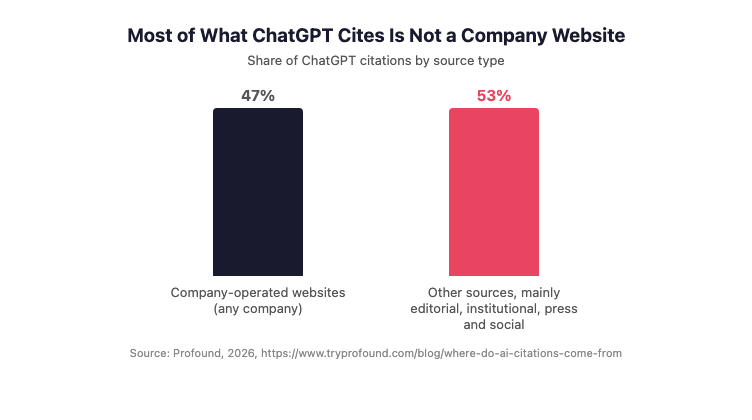
Figure 1 demonstrates that more than half of ChatGPT's citations come from sources other than company websites, mainly editorial, institutional, press release and social sources, which is why outdated outside listings and articles shape what it says about a business.
Your site also has to be readable. OpenAI says sites that opt out of its search crawler, OAI-SearchBot, are not shown in ChatGPT search answers, and that its systems take about 24 hours to adjust after a robots.txt change.
Diagnostic Checklist
ChatGPT is likely to describe your business wrongly if:
Old pricing, service or product pages are still live and indexed
Your Google Business Profile, directories or marketplace listings show older details
You changed your positioning or main service in the past two years without updating outside listings
Your website never states your price range, who you suit and who you do not
Most articles and reviews that mention you are over a year old
Your robots.txt blocks OAI-SearchBot
Fix Sequence: How to Correct What ChatGPT Says
Correct the sources, starting with the one you control.
Test: ask ChatGPT a buyer's question in your category, then ask what your business does, who it is for and what it costs. Save the answers and every cited source
Write one paragraph of truth: what you do, who it suits, who it does not suit, price range and service area
Fix your website: publish that paragraph and the key facts as plain text, remove or redirect pages with old facts, and allow OAI-SearchBot in robots.txt. Check the pages are indexed, as covered in crawled, currently not indexed
Update your Google Business Profile: you can edit a verified profile's hours, address and description, and Google reviews changes before they go live (Source: Google Business Profile Help, 2026, https://support.google.com/business/answer/3039617)
Fix outside pages: ask owners of outdated articles and listings to correct them. If a page about you has been removed or significantly changed, Google's Refresh Outdated Content tool asks Google to update its search result, though it does not change the page itself (Source: Google Search Console Help, 2026, https://support.google.com/webmasters/answer/7041154)
Report wrong Google AI Overviews: select the thumbs-down icon under the overview, choose Report a problem and add details. Google says AI Overviews "can and will make mistakes" (Source: Google Search Help, 2026, https://support.google.com/websearch/answer/14901683)
Re-test every two to four weeks with the same questions
What This Check Looks Like in Practice
Say your business moved from budget packages to a premium service last year, and new enquiries still ask for the old prices.
Ask ChatGPT the way a buyer would: who offers this service in your city, and at what budget. Note whether you appear and in which tier. Then ask directly what your business does and what it costs.
Open every cited source and note what each says against what it should say. Then check your homepage. If it never states the new price range or who the service is for, the old material has nothing to outweigh it. Judge progress by the answers and by enquiries, since AI visits often show up as Direct, as explained in why ChatGPT traffic shows as Direct in GA4.
Where the ThriveX AI Audit Fits
Every correction depends on your own website stating the right facts. The ThriveX AI Audit reviews whether your site says who you are, who you serve and what you offer clearly enough for buyers, search engines and AI systems to read, and returns a prioritised fix list.
If ChatGPT is describing an older version of your business, the ThriveX AI Audit is priced at $49 during beta, with standard pricing at $99.
FAQ
Why does ChatGPT have wrong information about my business?
Usually because it is repeating something that was true once and is still online, such as old prices, listings or articles, or because its training data predates a change. ChatGPT can also make plain mistakes. OpenAI says its models are trained up to a point and can produce incorrect facts.
Can I ask OpenAI to correct what ChatGPT says about my business?
You cannot edit ChatGPT's answers directly. The practical route is to correct the sources it reads: your website first, then your Google Business Profile, directories, marketplace listings and outdated articles. When ChatGPT searches, it can cite current web sources, so corrected pages can change the answer.
How long does it take for ChatGPT to show updated information?
It varies. Answers that use search can change once corrected pages are found and cited, while information from training data changes only with newer models. Profound reports that half of the content AI engines cite is less than 13 weeks old, so re-test every two to four weeks.
What if Google's AI Overview gets my business wrong?
Report it and fix its sources. Google's help page says to select the thumbs-down icon under the overview, choose Report a problem and add details. Then open every link the overview cites. In the Wolf River case, one cited news report was about other companies and mentioned the business only in passing.
Further Reading
What Entity Clarity Means and Why AI Search Cannot Find Unclear Businesses: https://www.thrivex.tech/blogs/entity-clarity-ai-search
Why Google Business Profile Is the First AEO Fix, Not the Last: https://www.thrivex.tech/blogs/google-business-profile-first-aeo-fix
Why Does ChatGPT Traffic Show as Direct in GA4?: https://www.thrivex.tech/blogs/chatgpt-traffic-showing-as-direct-ga4
Why Is My Website Getting Traffic But No Sales? What Google Analytics Cannot Tell You: https://www.thrivex.tech/blogs/invisible-friction-ai-audit