Why Does ChatGPT Traffic Show as Direct in GA4?
By Jetson, Head of CRO at ThriveX
Reading time: 7 minutes. Last updated: October 2026.
Author’s Note
In the second week of October 2026, site owners reported that their ChatGPT sessions in GA4 had fallen sharply. Several analytics firms traced much of it to a change in how ChatGPT labels the links it opens, which moved visits into other rows of the report, and by 16 October Profound’s data showed link tagging back to about 99%. The same mechanism is behind the long-running habit of AI visits turning up as Direct, so the checks below stay useful after the fix. This guide explains how GA4 decides what counts as Direct, what the October reports showed, and how to check whether your own traffic fell or was simply relabelled.
If you want a direct read on what happens after those visitors land, the ThriveX AI Audit covers the website side.
A Drop in ChatGPT Sessions Can Be a Labelling Change
When a channel in GA4 drops, the natural reading is that the traffic left. That reading is sometimes wrong, because GA4 reports where it believes a visit came from, and that belief depends on information the visit carries.
If the information goes missing, the visit still happens. It lands in a different row of the report. A fall in the ChatGPT row paired with a rise in Direct is a different problem from a fall in total sessions, and the two call for opposite responses.
Treating a labelling change as a visibility loss can lead a business to rewrite pages that were working, drop a content series, or conclude that AI search does not send buyers.
How GA4 Decides a Visit Is Direct
GA4 sorts sessions into channels using rules. Two of them matter here.
In practice, GA4 identifies an AI visit from two kinds of signal: the referrer that the browser passes along, and campaign tags such as utm_source in the link. If a visit arrives with neither, GA4 has nothing to match and records it as direct. The visitor clicked a link in ChatGPT, and the report says they typed your address.
What the Reports Showed in October 2026
ChatGPT normally adds a utm_source=chatgpt.com tag to the links it cites. Profound tracked a sample of ChatGPT answers and found that the share of cited answers with at least one tagged source link was about 98% on 8 October, 75% on 9 October and 66% on 14 October. Over the same days, the share of collected answers in a newer format that Profound calls Intelligent UI rose from 2% to about 35%.
Profound’s reading is that the referral decline follows this change in how ChatGPT renders links, and that missing attribution is driving much of it. It describes the Direct effect as something that may happen, not something it measured, and does not state its sample size. Its later data shows the tagged share returning to about 99% by 06:30 UTC on 16 October and staying near that level through the latest interval it analysed.
Search Engine Journal pulled together independent reports. Graphite’s CEO Ethan Smith saw GA4 ChatGPT sessions fall 22% to 57% on tracked sites from 9 October. LLM Pulse found total traffic on its monitored sites stayed relatively constant. Adobe’s Cedric Huesler reported that Direct visits rose while ChatGPT visits fell, and said OpenAI told him it was a bug and that a fix began rolling out on 15 October, with tagged clicks back to roughly 95% to 100% of the level a week earlier. He added that most ChatGPT clicks still arrive without a referrer, so the UTM tag is the signal to count. OpenAI had not commented publicly at the time of the report, and the analysts described their findings as early.
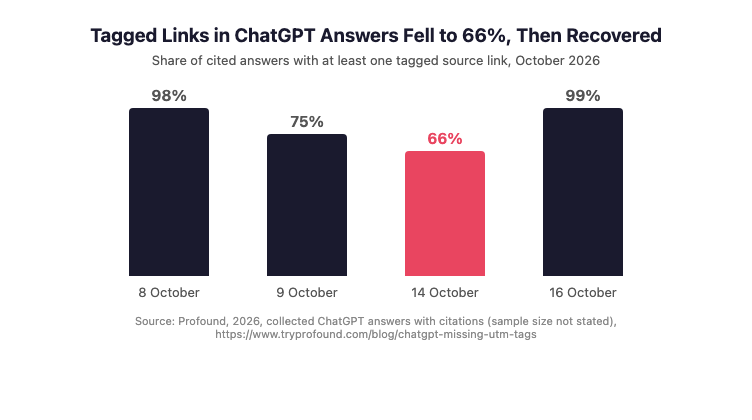
Figure 1 demonstrates that the share of ChatGPT answers carrying a tagged source link fell from about 98% to 66% in six days in October 2026 and recovered to about 99% by 16 October, showing that the dip in reported ChatGPT traffic matched a temporary loss of the tag GA4 uses to label the visit.
Two cautions apply. The OpenAI confirmation is secondhand, and several of these firms sell AI tracking tools. As of 20 October the evidence points to a temporary tracking change that has since been reversed, but it does not prove that no visitors were lost, and the visits from the affected days stay in the wrong rows of your reports.
Why This Matters for Your Business
A ChatGPT visit comes from someone who asked a question and clicked through to your site. When that visit is filed under Direct, three things go wrong.
You lose the signal that AI search is working. If a content series is earning citations, as described in the AEO and Google AI Overviews guide, its traffic should appear in the AI channel, and a relabelled row hides the payoff.
You risk acting on a false decline. A founder who sees ChatGPT sessions halve may pause the content that earned them. That is the opposite of what the data supports, and it ties directly to the pattern covered in impressions up, clicks down, where the numbers move and the cause sits elsewhere.
You also blur the conversion picture. Direct already mixes returning customers, typed addresses and untagged links. Adding AI visits makes Direct harder to read as a channel, which matters when you want to know why a website gets traffic but no sales.
Diagnostic Checklist
Your ChatGPT drop may be a labelling change rather than lost visitors if:
The fall in ChatGPT or AI Assistant sessions began on or around 8 or 9 October 2026 and eased from 15 or 16 October
Total sessions to the same pages stayed roughly level
Direct sessions rose on the same landing pages over the same days
Enquiries, orders or bookings did not fall in line with the ChatGPT row
The affected pages are deep content pages that you do not promote through ads, email or social
Your sales team or customers still mention finding you through ChatGPT
Fix Sequence
Annotate 8 to 15 October 2026 in GA4 and in any report, so nobody reads the dip as a trend
Compare total sessions by landing page for the two weeks before 8 October, the dip window and the days since, ignoring channels
Compare the ChatGPT or AI Assistant row against Direct on the same pages, side by side
Check whether Direct is up on pages that have no ads, email or social behind them
Look at conversions and enquiries for the same dates, because those are the outcome that matters
Add a “How did you hear about us?” field to enquiry forms, checkouts and booking flows, with ChatGPT as an option
Hold your content plan steady until the comparison is clear; Profound’s own advice is not to change strategy on the referral drop alone
Re-check after 15 October: if ChatGPT sessions return to their earlier level and Direct settles back, the dip was a relabel; if ChatGPT stays low while total sessions fall, the loss is real
What This Check Looks Like in Practice
Say ChatGPT sessions in GA4 halved around 9 October and you are wondering whether to change your content. Here is how the checklist above answers that in about twenty minutes.
Start with total sessions to your top ten content pages for the fortnight before 8 October, for 8 to 15 October, and for the days since. If the total is roughly level, visitors did not leave and their visits were filed under another row.
Next, open the same pages and compare the ChatGPT row with Direct. If Direct rose on pages that nothing else promotes, the extra visits are probably relabelled AI traffic. That is an inference the report cannot prove.
Then look at your enquiries and orders over the same dates. If they held up, the drop was reporting. If they fell, you have a real problem that the channel numbers were masking, and the next step is the page itself.
Finally, add the self-reported question to your forms so that next time you have a second source.
Where the ThriveX AI Audit Fits
Analytics tells you how many visitors arrived and, with limits, where they came from. It cannot tell you what they saw when they got there or why some left. A relabelled visit is still a visit that either converts or does not.
This is where the ThriveX AI Audit fits. It reviews the pages those visitors land on, whether the offer is clear, and where the path to enquiry or purchase leaks, so the traffic you are working to earn is not wasted once it arrives. The audit does not repair GA4 tracking. It covers the website that tracking is measuring.
If you are earning ChatGPT visitors and want to know whether your pages convert them, the ThriveX AI Audit is priced at $49 during beta, with standard pricing at $99.
FAQ
Why does ChatGPT traffic show as Direct in GA4?
GA4 identifies AI visits from the referrer or from campaign tags like utm_source. When a visit arrives with neither, it has nothing to match and records the visit as direct. In October, ChatGPT reportedly opened links in a way that withholds the referrer and dropped the utm_source tag, and visits like that end up there.
Did my ChatGPT traffic really drop in October 2026?
Possibly not. Graphite reported ChatGPT sessions falling 22% to 57% from 9 October, while LLM Pulse saw total traffic stay roughly constant, which points to relabelling rather than lost visits. Profound’s data shows link tagging back to about 99% by 16 October. Compare total sessions and conversions across the dip before deciding.
How can I track ChatGPT traffic in GA4?
Check the AI Assistant channel in the default channel group, which GA4 fills when the referrer matches a recognised assistant. Compare it with Direct on the same landing pages, and add a self-reported “How did you hear about us?” field. Some visits will still be invisible, because neither signal is guaranteed.
Should I change my content strategy because ChatGPT traffic fell?
Not on the traffic number alone. Profound advises against changing strategy based only on the referral drop, and says to review overall visits and conversions alongside citation trends. Check total sessions and enquiries first, because a labelling change and a real loss need different responses.
Has OpenAI fixed the missing UTM tags?
It appears so. Adobe’s Cedric Huesler said OpenAI told him it was a bug and that a fix began rolling out on 15 October, and Profound measured tagged links back at about 99% by 16 October. OpenAI had not commented publicly in the reports, so the confirmation is secondhand. The fix restores future tagging and does not recover the visits from 8 to 15 October.
Further Reading
Impressions Up, Clicks Down: Why Ranking #1 No Longer Means Traffic: https://www.thrivex.tech/blogs/marketing-visibility-problem
Why Is My Website Getting Traffic But No Sales? What Google Analytics Cannot Tell You: https://www.thrivex.tech/blogs/invisible-friction-ai-audit
Answer Engine Optimization and Google AI Overviews: The Complete Pillar Guide for 2026: https://www.thrivex.tech/blogs/aeo-google-ai-overviews-guide
What Entity Clarity Means and Why AI Search Cannot Find Unclear Businesses: https://www.thrivex.tech/blogs/entity-clarity-ai-search
The Website Conversion Audit Checklist to Run Before Increasing Ad Spend: https://www.thrivex.tech/blogs/website-conversion-audit-checklist