By Jetson, Head of CRO at ThriveX
Reading time: 5 minutes. Last updated: October 2026.
Author's Note
Ask ChatGPT for the best option in your category and you may see two competitors recommended while your brand gets one line at the end, or nothing at all. A mention only helps when the answer also gives the buyer a reason to choose you. This guide covers the three gaps that usually decide that, what the citation data shows, and a one-hour check you can run without paid tools. If you want a direct read on your own pages, the ThriveX AI Audit reviews exactly this.
Why Does ChatGPT Recommend Competitors? The Short Answer
ChatGPT recommends the brands it can describe best for the buyer's situation. When a competitor's pages, and other sources about that competitor, state the problem it solves, the facts behind it and who it suits, the answer has more to say about them than about you.
OpenAI does not publish how ChatGPT chooses, so this is a working model rather than a description of the algorithm. ThriveX checks for three gaps:
Situation: your pages do not describe the problem the buyer starts with
Proof: the facts a buyer asks about next are missing or only available on request
Comparison: your strengths are adjectives, not facts that can be compared
You cannot pay your way past these gaps. OpenAI states that ads in ChatGPT are clearly labelled, separate from its answers, and do not influence the answers ChatGPT provides.
Where Does ChatGPT Get Its Information About Brands?
Mostly from sources other than company websites. Profound's study of 11.8 billion AI citations found that 47% of ChatGPT's citations point to company-operated websites, compared with about 57% across all AI engines and 69% on Google Gemini. Most of the rest comes from editorial coverage, institutional sites, press releases and social platforms. Profound counts any company's site in that 47%, so your own website is only part of it.
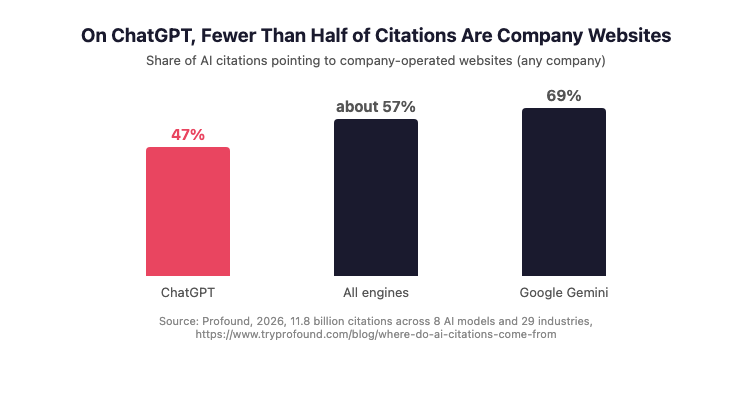
Figure 1 demonstrates that on ChatGPT, fewer than half of AI citations point to company-operated websites, compared with about 57% across all engines and 69% on Gemini, so the facts that support a recommendation need to exist beyond your own site.
Each engine also draws on different sources. In earlier Profound research across 100,000 prompts, only 11.0% of cited domains appeared in both ChatGPT and Perplexity answers. A strong showing on one engine says little about another.
What Are the Three Gaps That Favour Competitors?
1. Your Pages Do Not Describe the Buyer's Situation
Buyers usually start with a problem, not a brand name: "my online orders dropped after raya, what should I check?" If your pages only name your category, nothing connects you to that problem. Describe the situations your buyers are in, in their own words. The AEO and Google AI Overviews guide covers how to structure those pages.
2. The Proof Is Missing
On the shortlist, buyers ask what it costs, how long it takes and what results others have had. Google asks site owners to make important content available in textual form (Source: Google Search Central, 2025, https://developers.google.com/search/docs/appearance/ai-features). Put price ranges, process, timelines, policies and real case results on the page as text, and keep reviews and directory listings saying the same thing.
3. Your Strengths Cannot Be Compared
"Industry-leading" gives an answer nothing to compare. State who you suit, at what budget, under what conditions you work best, and who should look elsewhere. Naming who you are not for is practitioner judgement rather than a measured finding, but it also filters out enquiries that would never have closed.
Diagnostic Checklist
ChatGPT is likely to favour your competitors if:
Your pages describe your category but not the problems buyers arrive with
Prices, timelines or process are missing or "on request"
Case results live in sales decks, not on public pages
Your strengths are adjectives rather than comparable facts
Reviews and listings about you are few or out of date
Your robots.txt blocks OAI-SearchBot
You have checked only one AI engine, once
Fix Sequence
Confirm robots.txt allows OAI-SearchBot and your key pages are indexed
List ten questions buyers ask, from first problem to final choice
Run them in ChatGPT, Gemini and Perplexity and record who is recommended and how
Add the missing facts to your pages as plain text
Replace adjectives with comparable statements, including who you are not for
Update reviews, listings and profiles so outside sources match your site
Re-run the same questions every two to four weeks, engine by engine
What This Check Looks Like in Practice
Say ChatGPT keeps naming two competitors when you ask for the best option in your category. Ask three to five real buyer questions in fresh chats and save each answer.
For every answer, check four things. Is your brand recommended or only listed? Is what it says about you accurate and current? Do the strengths it gives match what the buyer asked for? Does each cited page actually support the sentence it is cited for?
Then compare how you and the recommended competitors are described. Every fact they have and you lack, such as a price range, a case result or a clear "best for", becomes one page fix. Citations change quickly, as covered in how long an AI citation lasts, so repeat the check on a schedule.
Where the ThriveX AI Audit Fits
All three gaps start on your own pages. The ThriveX AI Audit reviews whether your site states the situations you solve, the facts behind them and the reasons to choose you, in a form buyers, search engines and AI systems can read. The same signals sit behind a website that gets traffic but no sales.
If AI answers keep recommending your competitors, the ThriveX AI Audit is priced at $49 during beta, with standard pricing at $99.
FAQ
Why does ChatGPT recommend my competitors instead of me?
Often because their pages, and sources about them, give the answer more to work with: the buyer's situation, specific facts and clear reasons to choose them. OpenAI does not publish how recommendations are chosen, so test it by asking real buyer questions and comparing how each brand is described.
Can I pay to be recommended by ChatGPT?
No. OpenAI states that ads in ChatGPT are clearly labelled, separate from its answers, and do not influence the answers ChatGPT provides. An ad can appear beside the conversation, but being recommended inside the answer depends on what AI systems can find and confirm about you.
Is being mentioned by ChatGPT enough?
Rarely. Buyers act on the part of the answer that explains which option suits them. If your brand is listed for comparison while competitors get the detailed explanation, the mention is unlikely to bring enquiries. Check how you are described, not only whether you appear.
Does my website matter if ChatGPT cites other sources?
Yes. Profound found that 47% of ChatGPT's citations point to company-operated websites. Your site is where accurate facts should start, and outside sources confirm them. If your own pages do not state those facts clearly, reviews and articles have nothing consistent to repeat.
How often should I check what ChatGPT says about my business?
Every two to four weeks, using the same buyer questions, recorded engine by engine. Profound's research found that different AI engines cite largely different sources, so a single check on one engine gives an incomplete picture of how buyers see you.
Further Reading
What Entity Clarity Means and Why AI Search Cannot Find Unclear Businesses: https://www.thrivex.tech/blogs/entity-clarity-ai-search
How Long Does an AI Citation Last? What the Data Says: https://www.thrivex.tech/blogs/how-long-does-an-ai-citation-last
Should Small Businesses Advertise on ChatGPT?: https://www.thrivex.tech/blogs/should-small-businesses-advertise-on-chatgpt
Answer Engine Optimization and Google AI Overviews: The Complete Pillar Guide for 2026: https://www.thrivex.tech/blogs/aeo-google-ai-overviews-guide