By Jetson, Head of CRO at ThriveX
Reading time: 5 minutes. Last updated: October 2026.
Author's Note
Getting cited by ChatGPT or Perplexity feels like a result you can bank. The research says otherwise. Two large studies, from Profound and Scrunch, find that the typical AI citation fades within weeks, so AEO work needs a steady rhythm instead of a one-off push. This guide covers what the data shows, which pages last longest, and what to do about it. If you want a direct check on whether your pages are eligible to be cited at all, the ThriveX AI Audit covers that.
How Long Does an AI Citation Last? The Short Answer
Days to weeks, not months. Profound found that the median cited page loses half its citation share within 11 days of peaking. Scrunch found that half of a group of citations disappears in about 4.5 weeks on average.
What lasts longer:
Content that helps buyers choose: comparisons, reviews and how-tos outlast news
Pages cited by several engines: they hold on far longer than single-engine pages
A steady publishing rhythm: each new page replaces citations that fade
Why Don't AI Citations Last Like Rankings?
Because each AI answer is assembled when the question is asked, from sources the engine retrieves at that moment. A search ranking usually moves gradually, so a position you win keeps paying for a while. A page cited this week has no guaranteed place in next week's answer, and a citation earned in September does not keep sending buyers in November.
What Do the Studies Actually Measure?
Profound analysed 883,000 cited pages across seven answer engines from September 2025 to September 2026. Besides the 11-day median, 78% of cited pages fell to half their peak share within two weeks, and the remaining 22% had a median half-life of 27 to 29 days. Profound sampled 1 in 128 cited URLs and smoothed shares over a trailing 14-day window, so the 78% figure partly reflects that window.
Scrunch, working with Stacker, analysed 3.5 million citation events from September 2025 to March 2026 and measured how many weeks it takes for half of a cohort's citations to disappear: about 3.4 weeks on ChatGPT and 5.8 weeks on Perplexity.
The figures differ because Profound tracks how fast one page's share falls from its peak, while Scrunch tracks how long a group of citations takes to halve. Both companies sell citation tracking, so treat the numbers as benchmarks.
Which Pages Stay Cited Longest?
Profound points to three factors.
Content type. Among pages that kept being cited, the share still above half their peak at day 56 was 11.2% for comparisons, listicles and reviews, 10.2% for how-to and explainer content, 9.8% for product and company pages, and 7.0% for news and announcements. Content that helps a buyer choose lasts longest, though no type lasts for good. Profound classified pages with an AI model, so read this as a direction.
Number of engines. Of pages cited by one engine, 1.2% were still above half-peak at day 56, rising to 2.0% for two engines, 3.5% for three or four, and 6.8% for five or more.
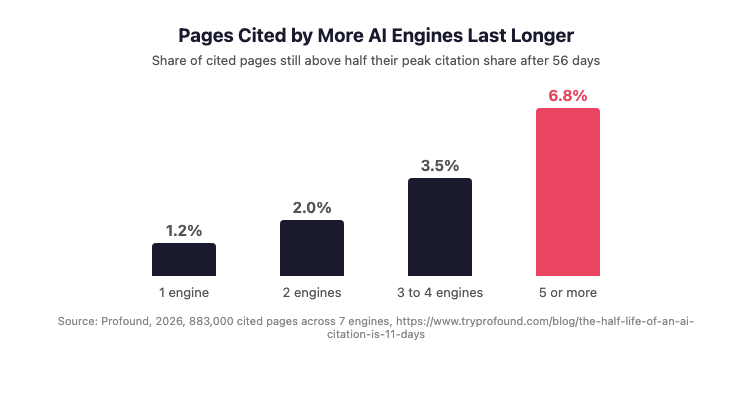
Figure 1 demonstrates that pages cited by five or more AI engines were about 5.5 times as likely as single-engine pages to still hold above half their peak citation share after 56 days, in Profound’s study of 883,000 cited pages.
Which engine. How long a page lasts on one engine says almost nothing about another, with correlations of only 0.03 to 0.09 for most engine pairs. Among pages that lasted past two weeks, a Claude citation was 2.8 times as likely as a ChatGPT citation to still be above half its peak share at two months. A page can fade on ChatGPT while holding on Claude or Perplexity, so check each engine separately.
What Should a Small Business Do About It?
Publish on a rhythm. Profound's conclusion is that authority in AI search has a half-life measured in days and does not accumulate, so brands need enough specificity to be chosen and enough consistency to be chosen again. A launch push followed by a quiet month hands the position back.
Fix the foundation first. A page that is not indexed or not clearly about one thing never gets cited long enough to fade. Entity clarity, indexation and the page structure in the AEO and Google AI Overviews guide come first.
Watch for silent loss. A fading citation sends no alert; it shows up as fewer mentions and clicks, the pattern in impressions up, clicks down. AI visits that do come through are often labelled Direct, as explained in why ChatGPT traffic shows as Direct in GA4.
Diagnostic Checklist
Your AI visibility rests on a one-off push if:
Your last new content went live more than a month ago
Most recent posts are announcements, not comparisons, how-tos or buying guides
You only ever test one AI engine
Nobody records which of your pages are cited, on which engine
Pages that were cited earlier have not been updated since
Your key pages are not indexed, or the business behind them is unclear
Fix Sequence
Confirm your important pages are indexed and say clearly who you are and what you do
List ten buyer questions and record which pages each engine cites
Re-check the same questions every one to two weeks
Set a publishing cadence you can keep, weekly or fortnightly
Weight the mix toward comparisons, buying guides, checklists and how-tos
Refresh cited pages that are fading, with updated facts and clearer answers
Track branded search and enquiries alongside citations
What This Check Looks Like in Practice
Say a page was cited by ChatGPT in September and the mention has gone by mid-October. Ask the same question on ChatGPT, Perplexity and Gemini and note which pages each cites. If a competitor now holds the spot and your page is still indexed and unchanged, this is the ordinary decay pattern.
Next, check in Search Console that the page is still indexed and that its answer sits near the top. If either fails, the loss is structural, so fix that first. Then look at your publishing record: if nothing new went live since the citation, the fix is a cadence.
Where the ThriveX AI Audit Fits
Publishing steadily on pages the engines cannot use only produces more pages they cannot use. The ThriveX AI Audit reviews whether your website is clear, indexable and answerable enough to be cited in the first place, the same diagnostic logic behind why a website gets traffic but no sales.
If you want to know whether your pages are ready to be cited, the ThriveX AI Audit is priced at $49 during beta, with standard pricing at $99.
FAQ
How long does an AI citation last?
Days to weeks. Profound found the median page loses half its citation share within 11 days of peaking, while Scrunch found half of a cohort's citations disappear in about 4.5 weeks. Figures vary by method and engine, but neither study supports expecting a citation to last for months.
Why did ChatGPT stop citing my page?
Most often because it assembled a different answer this time, which is the normal decay pattern. Check that the page is still indexed and unchanged before assuming a fault, then see which pages are cited now. A sudden loss across all your pages points to a technical problem instead.
Which content stays cited longest?
Content that helps buyers choose. Among pages Profound found kept being cited, 11.2% of comparisons, listicles and reviews were still above half their peak share at day 56, against 7.0% for news and announcements. No type is permanent, so plan to refresh pages.
How often should I publish for AI search?
At a rhythm you can sustain, such as weekly or fortnightly, rather than in bursts. Scrunch suggests teams targeting ChatGPT refresh content roughly every three weeks. Treat that as a vendor benchmark and set your own pace from a baseline of which pages are cited.
Further Reading
Answer Engine Optimization and Google AI Overviews: The Complete Pillar Guide for 2026: https://www.thrivex.tech/blogs/aeo-google-ai-overviews-guide
What Entity Clarity Means and Why AI Search Cannot Find Unclear Businesses: https://www.thrivex.tech/blogs/entity-clarity-ai-search
Why Does ChatGPT Traffic Show as Direct in GA4?: https://www.thrivex.tech/blogs/chatgpt-traffic-showing-as-direct-ga4
Impressions Up, Clicks Down: Why Ranking #1 No Longer Means Traffic: https://www.thrivex.tech/blogs/marketing-visibility-problem
Why Is My Website Getting Traffic But No Sales? What Google Analytics Cannot Tell You: https://www.thrivex.tech/blogs/invisible-friction-ai-audit