By Jetson, Head of CRO at ThriveX
Reading time: 5 minutes. Last updated: October 2026.
Author's Note
AI assistants are starting to shop on people's behalf. They compare products inside a conversation, and for US buyers some can now complete the purchase. The information an agent reads is the same information AI answers already use to describe your store: prices, stock, shipping terms and product details. If you want a direct read on your own pages, the ThriveX AI Audit reviews this specifically.
Is Your Website Ready for AI Shopping Agents? The Short Answer
It is ready if an agent can read your price, stock, shipping terms and product facts as text, find the same answer everywhere, and trust that it is current. Most store websites fall short through gradual drift, not missing technology.
Five checks decide it:
One answer per fact: price, delivery time and fees match on every page, language and listing
Facts in text: size charts, specifications and shipping terms are not locked in images or PDFs
Structured product data: markup that matches what the page shows
A reason to choose: each product says who it suits, for what use and at what budget
Current information: stock and prices on the page match checkout and your feeds
What Is an AI Shopping Agent?
An AI assistant that helps a shopper discover, compare and buy products within a conversation. Shopify names ChatGPT, Microsoft Copilot, and AI Mode in Google Search and the Gemini app among the AI channels its merchants can sell through.
Shopify says purchasing across all of them is currently available to US buyers only. For a Malaysian store, agent checkout is a change to prepare for, while AI answers that describe your products are already here.
What Do AI Shopping Agents Read?
Your product data. Shopify says agents read structured data such as product titles, descriptions, images, pricing, inventory and shipping speeds to decide what to recommend, and lists data completeness, structured formatting, real-time pricing and inventory, and engagement signals as key components. It also reports that in Q1 2026, AI-driven traffic to Shopify stores grew 8 times year over year, while orders from AI-powered searches increased nearly 13 times.
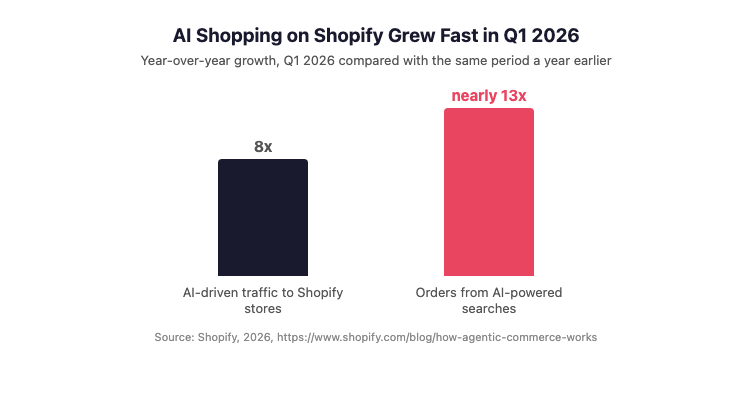
Figure 1 demonstrates that orders from AI-powered searches on Shopify grew nearly 13 times year over year in Q1 2026, faster than AI-driven traffic at 8 times, showing that AI-assisted shopping already produces orders as well as visits.
Google's guidance for its AI features points the same way. It says no special optimisations are needed for AI Overviews or AI Mode, and lists basics: make important content available in textual form, make sure structured data matches the visible text, and keep Merchant Center and Business Profile information up to date. For products, Google adds that structured data plus a Merchant Center feed maximises eligibility and helps it verify your data.
Where Do Store Websites Trip Up AI Agents?
1. The Same Fact Says Different Things
The product page says delivery takes three to five days, the FAQ says five to seven, and the Malay page still shows last year's price. A human may never notice. An agent comparing sources finds two answers and no way to tell which is current. Pick one source of truth for price, stock, shipping fee, delivery time and returns, and make every page, feed and language version match it.
2. Key Facts Are Locked in Images or PDFs
Size charts uploaded as images, specifications in a PDF and shipping terms inside a pop-up are common. Google asks for important content in textual form, so put dimensions, sizes, materials, price per variant and delivery fees on the page as text, and keep the image alongside if it helps people.
3. There Is No Structured Product Data
Many themes output some product markup, but variants, availability and shipping can be missing or stale. Check a few pages in Google's Rich Results Test; as covered in whether FAQ schema still works, markup helps only when it matches the page.
4. The Page Lists Features but Not Who It Is For
An agent finding the right option for a specific shopper needs a reason to pick yours: who the product suits, for what use and at what budget. This is judgement rather than a measured finding, but it costs little to test.
5. Information Is Out of Date
A product shown in stock on the page and sold out at checkout, or a price changed on the page but not in the feed, undermines everything else the page says. If the business behind the store is unclear too, product facts inherit that doubt, which is covered in entity clarity for AI search.
Diagnostic Checklist
Your website is not ready for AI shopping agents if:
Price, delivery time or shipping fee differ between product page, FAQ, language versions or marketplace listings
Size charts, specifications or shipping terms exist only as images, PDFs or pop-ups
Product pages have no structured data, or the markup shows a different price or stock status
Your Merchant Center feed has not been checked against the live site recently
Product descriptions never say who the product is for
Stock status on the page does not match checkout
Fix Sequence
List your top ten products by revenue and start there
Write down the true price, stock rule, delivery time, shipping fee and return terms for each
Make every page, language version, feed and marketplace listing match
Move key facts out of images, PDFs and pop-ups into text
Check structured data and correct any mismatch with the page
Add one or two sentences per product on who it suits and for what use
Re-check prices, stock and feeds monthly and after every promotion
What This Check Looks Like in Practice
Say you sell on Shopify in English and Malay and list bestsellers on Shopee. Open your best-selling product on all three and compare price, delivery time, shipping fee and returns; every difference is a conflict an agent could hit. Then note any fact that exists only as an image, and compare the Rich Results Test's price and stock with the page.
A real case shows what buried information costs with human shoppers too. Pretty Little Fit, a Malaysian activewear brand, had its size guide three taps deep, and exit surveys ranked sizing uncertainty the second most cited reason for not buying. After ThriveX moved the guide inline, 34% of product page visitors clicked it (Pretty Little Fit case study). That fixed friction for people, but an agent needs the same information.
Where the ThriveX AI Audit Fits
Inconsistent facts and image-only specifications produce no error message, the same blind spot behind a website that gets traffic but no sales. The ThriveX AI Audit reviews whether your pages are clear, consistent and readable enough for buyers, search engines and AI systems, and returns a prioritised fix list.
If you want to know whether your store is ready for AI shopping agents, the ThriveX AI Audit is priced at $49 during beta, with standard pricing at $99.
FAQ
Can AI agents buy from Malaysian online stores yet?
Not through the main channels Shopify lists. It says purchasing across ChatGPT, Copilot and Google's AI channels is currently available to US buyers only, and that merchants will be ready when AI partners expand to other regions. AI assistants that answer product questions are already used in Malaysia.
What information do AI shopping agents read?
Shopify says agents read product titles, descriptions, images, pricing, inventory and shipping speeds, and names data completeness, structured formatting, real-time pricing and inventory, and engagement signals as key components. In practice, the facts a buyer needs must be on the page as text, consistent everywhere and current.
Do I need special optimisation for AI agents?
Mostly no. Google says there are no special optimisations needed to appear in AI Overviews or AI Mode. Its basics are important content in text form, structured data that matches the visible page, and current Merchant Center and Business Profile information. Those basics are where most stores fall short.
How is this different from entity clarity?
Entity clarity is about whether AI systems understand who your business is: name, category and description. Agent readiness is about whether they can read what you sell and on what terms: price, stock, shipping and product facts. Both matter, and an unclear business weakens even accurate product data.
Further Reading
What Entity Clarity Means and Why AI Search Cannot Find Unclear Businesses: https://www.thrivex.tech/blogs/entity-clarity-ai-search
Answer Engine Optimization and Google AI Overviews: The Complete Pillar Guide for 2026: https://www.thrivex.tech/blogs/aeo-google-ai-overviews-guide
Does FAQ Schema Still Work in 2026?: https://www.thrivex.tech/blogs/faq-schema-still-work-2026
How to Increase Add-to-Cart Rate: 6 Product Page Fixes for Malaysian Stores: https://www.thrivex.tech/blogs/add-to-cart-bottleneck
Why Is My Website Getting Traffic But No Sales? What Google Analytics Cannot Tell You: https://www.thrivex.tech/blogs/invisible-friction-ai-audit