By Jetson, Head of CRO at ThriveX
Reading time: 5 minutes. Last updated: October 2026.
Author's Note
A conversion rate that slides from one month to the next usually sends founders straight to redesign ideas or new ad creative. Before changing anything, find out which part moved. Conversion rate is orders divided by sessions, so it falls when sales drop, when the traffic mix changes, or when the tracking changes, and each needs a different fix. This guide covers how to separate them in about an hour. If you want a direct read on where your site loses buyers, the ThriveX AI Audit checks that.
Why Is My Website Conversion Rate Dropping? The Short Answer
Usually because of one of five things: the tracking changed, the traffic mix changed, the season changed, something on the site broke, or the offer got worse. Check them in that order, because the first three can lower the rate without a single buyer being lost.
Tracking changed: a consent banner, a removed tag or a new analytics setup changes what gets counted
Traffic mix changed: more visitors from a channel that converts less pulls the average down
Season changed: a quiet month after a sale period looks like a drop
Something broke: a theme update, app, checkout error or slower pages
The offer got worse: a price rise, a new shipping fee or items out of stock
Is the Drop Real or Just a Tracking Change?
Check this first. Google says that when you add a consent banner, "Analytics will be missing data for users who decline consent". A new banner, a removed tag or a switch of analytics tools can change the reported rate overnight while real orders stay the same.
Compare orders in your store or booking system with the orders your analytics reports for the same weeks. If the store's numbers held and the analytics numbers fell, the problem is measurement. AI visits that arrive without a referrer are another measurement trap, covered in why ChatGPT traffic shows as Direct in GA4.
Did My Traffic Mix Change?
Often, yes. Conversion rate is an average across every channel, so a new campaign or a viral post that brings many low-intent visitors can lower the rate even when sales stay flat. Split conversion rate by channel and by device for this month and last. If each channel held steady but the share of a low-converting channel grew, the site did not get worse.
Seasonality works the same way. Compare against the same weeks last year, not just last month, especially after a big sale. The run-up to 11.11 and the weeks after it behave differently, as covered in is your website ready for 11.11.
Did Something on the Site Break?
If tracking and traffic mix both check out, look for a change on the site. In Baymard Institute's research, 17% of shoppers who abandoned an order, excluding those just browsing, said the website had errors or crashed, and 40% named extra costs such as shipping, tax and fees.
Speed counts too. A study commissioned by Google and run by 55 and Deloitte across 37 brand sites found that a 0.1 second improvement in mobile site speed increased conversion rates by 8.4% for retail sites. A theme update or new app that slows mobile pages can work in the opposite direction.
List every change made in the week the drop started: theme, apps, prices, shipping rules, payment methods, stock. The drop usually lines up with one of them.
What Does Fixing the Leak Look Like?
Pretty Little Fit, a Malaysian activewear brand on Shopify, had steady social traffic but a 1.2% conversion rate. With 84% of visitors on mobile, the mobile conversion rate was 0.8% and pages took 4.8 seconds to load. ThriveX diagnosed seven friction points, including a size guide buried three taps deep and forced account creation at checkout, and tested each fix before rollout. After 90 days, conversion rate reached 3.7%, mobile conversion 3.1%, and load time 1.9 seconds (Pretty Little Fit case study).
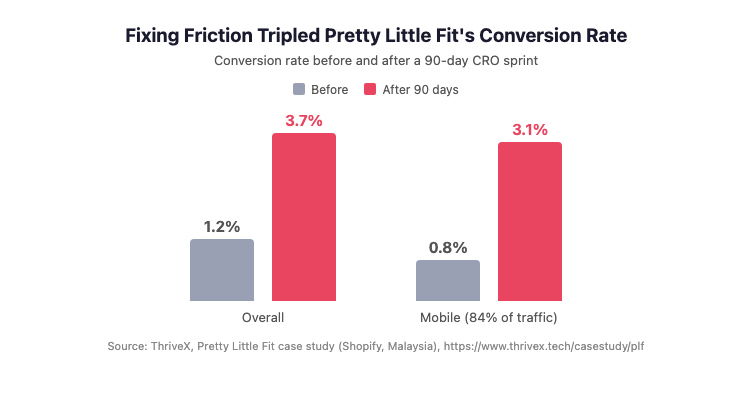
Figure 1 demonstrates that fixing diagnosed friction raised Pretty Little Fit’s overall conversion rate from 1.2% to 3.7% and its mobile conversion rate from 0.8% to 3.1% in 90 days, showing how much of a conversion rate sits in the site rather than the traffic.
Diagnostic Checklist
Your conversion rate drop needs a site fix, not more traffic, if:
Orders in your store fell, not just the rate in analytics
The rate fell within the same channel and device, not only overall
The drop is still there when compared with the same weeks last year
A theme, app, price, shipping or payment change went live in the week it started
Mobile conversion fell further than desktop
Add-to-cart held steady but checkout completion fell
Fix Sequence
Check measurement: compare store orders with analytics orders for the same weeks
Split the rate: by channel, device and landing page, this month against last month and last year
Find the step: compare sessions, add-to-cart, checkout and purchase to see where the drop sits
List recent changes: theme, apps, prices, shipping, payments and stock, with dates
Test the path yourself: buy something on a phone, from an ad link and from search
Fix and watch: reverse or repair the change that lines up with the drop, then track the same split for two to four weeks
What This Check Looks Like in Practice
Say your conversion rate fell from 2% to 1.4% in a month. Start with orders: if the store recorded about the same number of orders while sessions rose, the extra visitors are diluting the rate, so look at which channel grew.
If orders fell, split the funnel. When add-to-cart holds but completed checkouts fall, the problem sits in checkout: a new shipping fee, a payment method that failed, or an app that slowed the page. The fixes for that step are in how to reduce cart abandonment. When add-to-cart itself fell, look at product pages, stock and prices first.
Where the ThriveX AI Audit Fits
Analytics tells you the rate fell and roughly where. It does not show what visitors saw on the page that made them leave. The ThriveX AI Audit reviews the pages and path buyers take, so the fix targets the step that changed. If your site gets visits but has never converted well, start with why your website gets traffic but no sales instead.
If your conversion rate has dropped and you want to know where buyers are leaving, the ThriveX AI Audit is priced at $49 during beta, with standard pricing at $99.
FAQ
Why is my website conversion rate dropping?
Usually because tracking changed, the traffic mix shifted toward lower-intent visitors, the season changed, something on the site broke, or the offer got worse. Check orders in your store against analytics first, then split the rate by channel and device before changing anything on the site.
Can my conversion rate drop while sales stay the same?
Yes. Conversion rate is orders divided by sessions, so extra low-intent visitors from a new campaign, a viral post or bots lower the rate while orders stay flat. Compare the number of orders, not just the percentage, and split the rate by channel to see which traffic grew.
How do I find what caused a sudden conversion drop?
Note the week it started and list every change made around then: theme, apps, prices, shipping fees, payment methods and stock. Then compare each funnel step, from sessions to purchase, before and after. The step that fell and the change that lines up with it usually point to the cause.
Does page speed affect conversion rate?
Yes. A Google-commissioned study by 55 and Deloitte found that a 0.1 second improvement in mobile site speed increased retail conversion rates by 8.4%. If the drop began after a theme or app change, test mobile page speed before and after it, since slower pages work in the opposite direction.
Further Reading
Why Is My Website Getting Traffic But No Sales? What Google Analytics Cannot Tell You: https://www.thrivex.tech/blogs/invisible-friction-ai-audit
How to Increase Add-to-Cart Rate: 6 Product Page Fixes for Malaysian Stores: https://www.thrivex.tech/blogs/add-to-cart-bottleneck
How to Reduce Cart Abandonment in Malaysia: 3 Checkout Fixes That Actually Work: https://www.thrivex.tech/blogs/cart-abandonment-checkout-fixes
The 7 Signals Your Website Is Leaking Revenue Right Now: https://www.thrivex.tech/blogs/7-signals-website-leaking-revenue
How to Increase ROAS Without Increasing Ad Spend: Fix Conversion Before You Scale: https://www.thrivex.tech/blogs/cro-before-ads