By Jetson, Head of CRO at ThriveX
Reading time: 5 minutes. Last updated: October 2026.
Author's Note
llms.txt is often sold to business owners as the file that gets a website into ChatGPT and Google's AI answers. It is quick to add, which makes it tempting. Before spending time on it, it helps to know what Google has said about it and whether AI systems even request it. This guide covers both, where the file can still be useful, and what moves AI visibility instead. If you want a direct read on whether AI systems can understand your site, the ThriveX AI Audit checks that.
Does llms.txt Work? The Short Answer
Not for AI search visibility, on current evidence. Google says you do not need new machine-readable files or AI text files to appear in its AI features. In Ahrefs' study of 137,210 sites, 97% of llms.txt files received no requests at all in May 2026.
What this means for a business website:
It will not get you cited: Google says it is not needed, and AI tools rarely even request it
It is not harmful: it is low effort, but it is not a lever
It can help developer documentation: coding agents are among the few tools that fetch it
Your pages matter more: crawler access, readable text and clear facts decide what AI systems use
What Is llms.txt?
A Markdown file placed at /llms.txt that gives a short summary of a website and links to its most useful pages, written for large language models to read. Jeremy Howard proposed it in September 2024, and the proposal says it was expected to be useful mainly when an AI system answers a question at the moment it is asked, rather than for training. The proposal's site notes that OpenAI, Anthropic and Google publish llms.txt files for their own developer documentation, which is different from reading other sites' files.
What Does Google Say About llms.txt?
That it is not needed. Google's guidance for AI Overviews and AI Mode says "You don't need to create new machine readable files, AI text files, or markup to appear in these features."
Google's John Mueller has gone further. In April 2025 he said none of the AI services had said they use the file, that server logs show they do not even check for it, and that he saw it as "comparable to the keywords meta tag", a tag search engines stopped trusting because site owners write it about themselves. On Google's Search Off the Record podcast in 2026, he added that an AI system cannot trust a file a site writes about itself to tell sites apart, though it might help an automated agent that is already on your site.
Do AI Crawlers Actually Read llms.txt?
Rarely. Ahrefs found that about 28% of the 137,210 sites in its study had an llms.txt file, an upper bound because its customers lean technical. Of those files, 97% were never requested in May 2026, and named AI tools made up 19.5% of the fetches to the files that were requested, led by OpenAI's GPTBot.
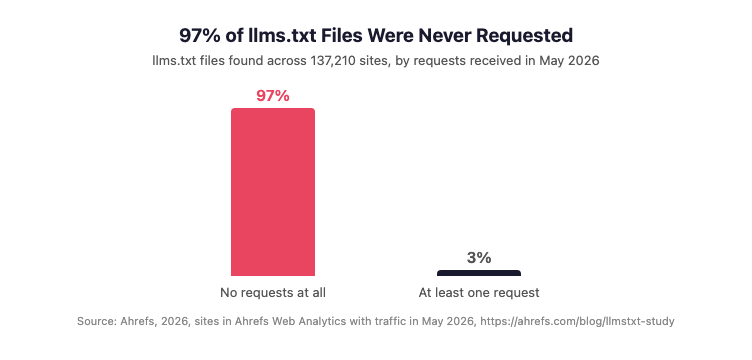
Figure 1 demonstrates that 97% of llms.txt files in Ahrefs' study of 137,210 sites were never requested in May 2026, which is why the file is not a lever for AI search visibility.
Having the file does not appear to change citations either. SE Ranking's study of about 300,000 domains found llms.txt on 10.13% of them and no relationship between having the file and how often a domain is cited in AI answers. Both studies describe current conditions and do not rule out future use.
When Is llms.txt Worth Adding?
When your site has developer documentation, an API or technical guides that coding assistants read. Ahrefs found coding agents among the few tools that fetch the file. For a shop, clinic, agency or service business, it is optional: add it if it takes ten minutes, keep it accurate, and spend the real effort elsewhere.
What Helps AI Visibility Instead?
The pages AI systems already read. Make sure ChatGPT's search crawler is allowed, your key pages are indexed, and the facts a buyer asks about are on the page as plain text. Google's own list for its AI features is the ordinary basics: textual content, structured data that matches the visible page, and current Merchant Center and Business Profile details. Indexing problems are covered in crawled, currently not indexed, and the same "does it still work" test applied to markup is in does FAQ schema still work.
Diagnostic Checklist
Your AI visibility work is aimed at the wrong lever if:
You added llms.txt but never checked whether your robots.txt allows AI search crawlers
Key pages are not indexed in Google Search Console
Prices, services or specifications appear only in images, PDFs or JavaScript widgets
Your business name and description differ across your site and listings
You are paying for llms.txt setup as an AI visibility service
Fix Sequence
Check crawler access: confirm robots.txt and your firewall allow search crawlers such as OAI-SearchBot and Googlebot
Check indexing: fix any key page marked "Crawled, currently not indexed"
Put facts in text: prices, services, areas served and specifications as plain HTML
Keep facts consistent: the same details on your site, Google Business Profile and directories
Decide on llms.txt last: add it only if it is quick and you can keep it current
What This Check Looks Like in Practice
If you already have an llms.txt file, ask whoever manages your hosting for the last 30 days of server logs and search them for "/llms.txt". Note how many requests there were and which user agents made them. Then search the same logs for OAI-SearchBot and Googlebot, and compare how often they requested your actual pages.
Next, open Search Console's Pages report and list any important page that is not indexed. Google's AI features cannot use those pages, whatever llms.txt says about them. The gap between what crawlers read and what you hoped they would read is your fix list. The page-level basics are covered in entity clarity and the AEO and Google AI Overviews guide.
Where the ThriveX AI Audit Fits
AI systems use the pages they can reach, read and trust. The ThriveX AI Audit reviews whether your site is crawlable, indexable and clear about what you do, for whom and at what price, and returns a prioritised fix list, so effort goes into the pages instead of a file nobody requests.
If you want to know what AI systems can actually read on your website, the ThriveX AI Audit is priced at $49 during beta, with standard pricing at $99.
FAQ
Does llms.txt work?
Not for AI search visibility, on current evidence. Google says no AI text files are needed for its AI features, Ahrefs found 97% of llms.txt files were never requested in May 2026, and SE Ranking found no link between having the file and AI citations. It can help developer documentation.
Does Google use llms.txt?
Google's guidance says you do not need machine-readable files or AI text files to appear in AI Overviews or AI Mode. Google's John Mueller compared llms.txt to the keywords meta tag and said AI services do not appear to check for it, because a site's description of itself cannot be trusted to rank it.
Should I add llms.txt to my website?
It is optional. If your site has developer documentation, it can help coding assistants find the right pages. For most business websites it has no measured effect, so add it only if it is quick, keep it accurate, and put the real effort into crawl access, indexing and clear page content.
Is llms.txt the same as robots.txt?
No. robots.txt tells crawlers which pages they may access, and AI companies such as OpenAI document how their crawlers follow it. llms.txt is a proposed summary file a site writes about itself, and Google says files like it are not needed for its AI features.
Further Reading
Does FAQ Schema Still Work in 2026?: https://www.thrivex.tech/blogs/faq-schema-still-work-2026
Answer Engine Optimization and Google AI Overviews: The Complete Pillar Guide for 2026: https://www.thrivex.tech/blogs/aeo-google-ai-overviews-guide
"Crawled – Currently Not Indexed": Why It Happens and How to Fix It: https://www.thrivex.tech/blogs/crawled-currently-not-indexed
What Entity Clarity Means and Why AI Search Cannot Find Unclear Businesses: https://www.thrivex.tech/blogs/entity-clarity-ai-search
Why Does ChatGPT Traffic Show as Direct in GA4?: https://www.thrivex.tech/blogs/chatgpt-traffic-showing-as-direct-ga4