By Jetson, Head of CRO at ThriveX
Reading time: 5 minutes. Last updated: October 2026.
Author's Note
When a buyer asks ChatGPT about your category, it may read your website and still cite a review site, a directory or a competitor. Much of the advice on this guesses at ranking factors nobody outside OpenAI can see. This guide sticks to what can be checked: what OpenAI says about how ChatGPT searches, and what two independent studies of its behaviour found. If you want a direct read on whether your own pages give AI systems clear facts to cite, the ThriveX AI Audit reviews that.
How Does ChatGPT Choose Its Sources? The Short Answer
ChatGPT first decides whether to search the web at all. When it does, it rewrites the question into search queries, reads a set of pages, and cites the pages that best support specific sentences in its answer. OpenAI says it ranks results "using multiple factors intended to help users find relevant, reliable information" and that placement is not guaranteed.
Four things follow for a business:
Be reachable: ChatGPT's search crawler has to be allowed onto your site
Be readable: key facts such as prices must be in the page text, not loaded later by JavaScript
Be the best support for one claim: one clear page per question beats many thin pages
Be confirmed elsewhere: answers about which option is best tend to cite third parties
Beyond OpenAI's help pages, the most detailed public account comes from Suganthan Mohanadasan, co-founder of Snippet Digital, who read ChatGPT's network traffic across a few dozen searches. He found no visible ranking score, and because his data comes from one account and mostly software topics, he treats his figures as directional.
Does ChatGPT Always Search the Web?
No. OpenAI says ChatGPT "may search the web automatically" when a question would benefit from current information. Otherwise it answers from training data, which runs only up to a cutoff date, and on the training cutoff. Mohanadasan found that wording decides the route more than topic: three of the ten deliberately current questions he tested got no search.
Search-based answers can change once better pages are found. Answers from training reflect what was published consistently over time, one reason a steady publishing rhythm matters, as covered in how long an AI citation lasts.
Why Does ChatGPT Read a Page but Not Cite It?
Because reading and citing are separate steps: many pages are fetched into the model's context, and only some become the source of a sentence. Mohanadasan's traffic shows three reasons:
Citations attach to sentences: a page is cited when it is the best support for one precise claim
Results are grouped by domain: duplicates from one domain are removed, so 20 thin pages from one site count as one
Some formats are read but rarely cited: YouTube pages were fetched 201 times and cited zero times, which he puts down to the model seeing only the title and description. Reddit was fetched 278 times and cited 11 times
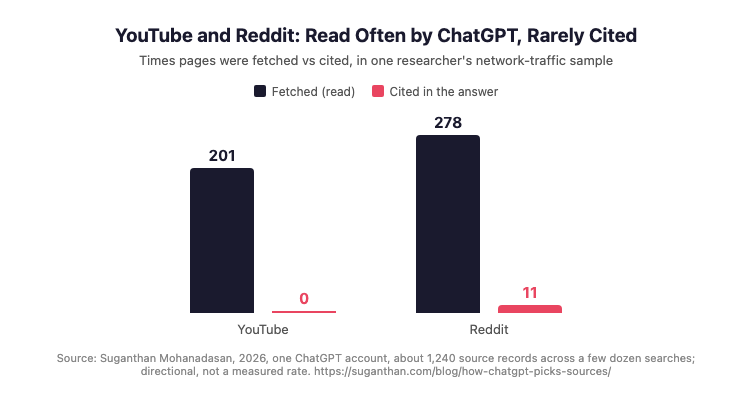
Figure 1 demonstrates that ChatGPT read YouTube pages 201 times without citing one, and cited Reddit only 11 times in 278 reads, in one researcher's directional sample, so being read by ChatGPT does not mean being cited.
Ahrefs' much larger study of 1.4 million ChatGPT prompts points the same way: about half the URLs ChatGPT retrieved were cited, but Reddit results only 1.93% of the time and YouTube results 0.51%. Cited pages also had titles closer in meaning to the question.
So publish one strong page per buyer question, with the key sentence plain enough to quote, and put facts that live in videos into text.
Why Does ChatGPT Quote Someone Else's Price for Your Business?
Often because it cannot read yours. When Mohanadasan asked about pricing for two AI visibility tools, ChatGPT's reasoning noted that the prices were possibly loaded with JavaScript and turned to third-party sources, with G2 as the suggested citation. Vercel and MERJ found the same limit in crawler data: none of the major AI crawlers they monitored, including OpenAI's, rendered JavaScript at the time.
His traffic also showed a split. Facts such as price went to the official page first, while verdicts on which product is best were cited to third parties. That is one reason ChatGPT can recommend a competitor even when your own pages are accurate.
How Does ChatGPT Pick Local Businesses?
Through a separate local route. OpenAI says ChatGPT can use the searcher's approximate location, rewrite "good restaurants near me" into a search like "top restaurants San Francisco", and draw on unnamed third-party providers for nearby business listings. Mohanadasan saw "near me" questions capped by a setting, local_results_limit, of 2: "For local you're in the top 2 or you aren't there." That is one observation and may change.
Since the listing sources are not public, keep your business name, category, address, hours and services identical on your website, your Google Business Profile and the main directories.
Diagnostic Checklist
ChatGPT is likely to read past your website if:
Your robots.txt, firewall or CDN blocks OAI-SearchBot
Prices or key specifications appear only after JavaScript runs, or only in images and PDFs
Several thin pages cover one topic instead of one clear page per question
Your business details differ across your website, Google Business Profile and directories
Reviews and third-party coverage of you are thin or out of date
Fix Sequence
Open the door: allow OAI-SearchBot in robots.txt and make sure your host or CDN allows OpenAI's published IP addresses. OpenAI says robots.txt changes take about 24 hours to apply
Check indexing of key pages, as covered in crawled, currently not indexed
Move facts into text that loads without JavaScript: prices, packages, service areas, specifications
Merge thin pages so each buyer question has one page that answers it first, with a title and URL slug in the buyer's own words, which Ahrefs found are cited more often
Align listings across your website, Google Business Profile and directories
Re-test the same buyer questions every two to four weeks
What This Check Looks Like in Practice
Open your pricing page and view the source (Ctrl+U on Windows, Option+Command+U on a Mac). Search it for one of your prices. If the number is missing, it is most likely loaded by JavaScript or held in an image, and AI crawlers that do not run scripts will miss it.
Next, check yourdomain.com/robots.txt for a block on OAI-SearchBot, and check that any firewall or CDN bot protection lets it through.
Then ask ChatGPT, with search on, what your business charges. Open every cited source. Where it quotes a directory or an old article instead of your page, compare the two; each difference becomes one fix, in the order set out in why ChatGPT has wrong information about your business.
Where the ThriveX AI Audit Fits
The ThriveX AI Audit reviews whether your site says what you offer, who it is for and what it costs in a form buyers, search engines and AI systems can read.
If ChatGPT keeps citing other sites when buyers ask about you, the ThriveX AI Audit is priced at $49 during beta, with standard pricing at $99.
FAQ
How does ChatGPT choose its sources?
It first decides whether a question needs a web search. If so, it rewrites the question into search queries, reads a set of results and cites the pages that best support specific sentences. OpenAI says it ranks results using multiple factors aimed at relevant, reliable information.
Can ChatGPT see my website?
It can if its search crawler is allowed in. OpenAI says sites that block OAI-SearchBot are not shown in ChatGPT search answers. Your host or CDN also has to allow OpenAI's published IP addresses, and content that appears only after JavaScript runs may be missed.
Does ChatGPT use Bing or Google to search?
OpenAI does not publish a full list. Its help page says ChatGPT search sometimes partners with other search providers and points to Microsoft's and Shopify's privacy policies for those searches; Google is not named there. What you control is crawler access, readable facts and consistent business listings.
Why does ChatGPT cite review sites instead of my website?
For opinion questions, such as which option is best, ChatGPT tends to cite third parties, while facts such as price come from official pages first. If your facts are hard to read, it may cite a review site for those too.
Further Reading
How Long Does an AI Citation Last? What the Data Says: https://www.thrivex.tech/blogs/how-long-does-an-ai-citation-last
Why Does ChatGPT Recommend My Competitors Instead of Me?: https://www.thrivex.tech/blogs/why-chatgpt-recommends-competitors
"Crawled – Currently Not Indexed": Why It Happens and How to Fix It: https://www.thrivex.tech/blogs/crawled-currently-not-indexed
What Entity Clarity Means and Why AI Search Cannot Find Unclear Businesses: https://www.thrivex.tech/blogs/entity-clarity-ai-search
Why Does ChatGPT Have Wrong Information About My Business?: https://www.thrivex.tech/blogs/chatgpt-wrong-information-about-my-business
Answer Engine Optimization and Google AI Overviews: The Complete Pillar Guide for 2026: https://www.thrivex.tech/blogs/aeo-google-ai-overviews-guide