Why Your AI UGC Ads Aren't Converting
By Jetson, Head of CRO at ThriveX
Reading time: 6 minutes. Last updated: August 2026.
Author's Note
AI-generated UGC ads are cheap to produce at volume, which is exactly why so many brands are running them without a clear read on why some convert and most don't. This is the first diagnostic guide in ThriveX's AIGC and video content series. It covers the specific, researched reason AI ad creative underperforms, separate from why AI marketing tools broadly fail to move revenue, and where a conversion-focused audit fits before you produce more creative.
The Ad Isn't the Problem. Looking Artificial Is.
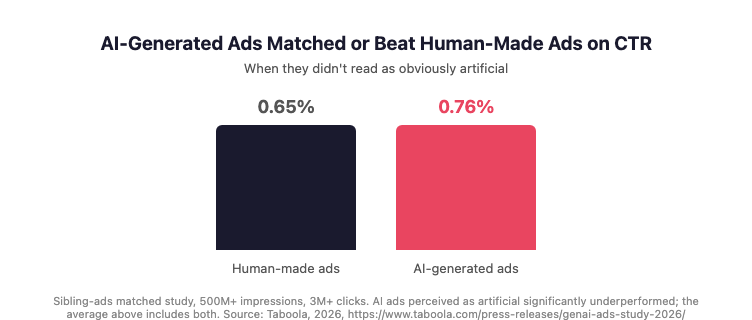
Figure 1 demonstrates that AI-generated ads matched or slightly outperformed human-made ads on click-through rate, contradicting the assumption that AI-generated creative underperforms by default.
A joint study by Taboola with researchers from Columbia, Harvard, the Technical University of Munich, and Carnegie Mellon analyzed over 500 million ad impressions and 3 million clicks on live campaigns, using a matched "sibling ads" method that compared AI-generated and human-made ads from the same advertiser, same campaign, same date. AI-generated ads achieved a 0.76% average click-through rate against 0.65% for human-made ads, and did not sacrifice downstream conversion performance to get there.
The finding that actually explains underperforming AI UGC ads sits inside that headline number: AI ads that were perceived as obviously artificial significantly underperformed, while ads that appeared authentically human, indistinguishable from a real person filming real footage, performed on par with or better than human-made ads. The study also found a large, clear human face in the ad was one of the strongest trust signals driving that performance gap.
In plain terms: AI-generated UGC does not fail because it's AI-generated. It fails when it looks like it.
This tracks with separate research from the Nuremberg Institute for Market Decisions, which surveyed 3,000 respondents across the US, UK, and Germany plus a follow-up experiment testing identical ads labeled as AI-generated versus human-made. Ads labeled AI-generated were rated significantly lower on emotional appeal and usefulness than the exact same ad labeled human-made, even though nothing about the ad itself had changed. The penalty is attached to the perception of artificiality, not to AI-generated content on principle.
Where AI UGC Ads Actually Break Down
Three patterns account for most underperforming AI UGC ad creative.
The Face or Voice Reads as Synthetic
Uncanny mouth movement, inconsistent lighting on a face, or a voice that doesn't match natural speech cadence are the fastest way to trigger the "this is fake" reaction the Taboola research identified as the core performance divider. Once a viewer consciously registers "AI," trust drops and the scroll continues.
The Script Sounds Like an Ad, Not a Person
Real UGC works because it mimics how someone actually talks about a product to a friend. AI-generated scripts that lean on marketing language, feature lists, or a suspiciously perfect testimonial structure break the illusion even when the visuals are convincing.
The Ad Is Disconnected From What Happens After the Click
A highly convincing AI UGC ad still fails commercially if the landing page it points to doesn't continue the same claim, tone, or offer. The click is a promise. The page has to keep it, the same mechanism CRO before ads describes for any paid traffic, AI-generated or not.
Diagnostic Checklist
Run this against your current AI UGC ad creative.
Would a stranger scrolling past immediately clock this as AI-generated?
Does the script sound like something a real person would actually say out loud?
Is there a large, clear human face on screen for most of the ad, not just a voiceover?
Does the landing page the ad points to continue the exact claim made in the first three seconds?
Are you tracking click-through rate and conversion rate separately, or only judging the ad by views?
Has this exact creative been running past the point where fatigue typically sets in?
Fix Sequence
Watch your current top-spend AI UGC ad with sound off, then sound on, and note the first moment it feels synthetic
Rewrite the script to remove any phrase that sounds like ad copy rather than a real recommendation
Prioritize a clear, well-lit human face over B-roll or product-only shots
Confirm the landing page continues the specific claim made in the ad, not a generic homepage
Separate click-through rate from conversion rate in reporting so a "good-looking" ad that isn't converting gets caught early
How This Plays Out for a Malaysian SME
Before: A Klang Valley skincare brand produced a batch of AI UGC ads at low cost and saw strong click-through rates but a conversion rate roughly a third of their previous influencer-shot content.
Diagnosis: The AI-generated actor's voice had a slightly uneven cadence during product claims, and the ad linked to the brand's generic homepage instead of the specific product page the ad referenced.
Fix: The team re-generated the voice track with more natural pacing, added a clear human face for the full duration instead of cutting to product shots, and pointed the ad directly to the matching product page.
After: Conversion rate on the same ad spend recovered to within range of the original influencer-shot benchmark, while production cost per ad variant stayed a fraction of what commissioning new influencer content would have cost.
This example is illustrative, not drawn from a documented ThriveX case study. Real case study data is available here.
Where the ThriveX AI Audit Fits
A brand cannot always tell, from ad-platform metrics alone, whether an underperforming AI UGC ad is a creative authenticity problem or a landing page continuity problem. Both produce the same flat conversion number.
This is where the invisible friction AI audit fits. ThriveX reviews whether the constraint sits in the ad creative itself or in what happens after the click, so budget goes toward the actual fix instead of another round of creative variants.
If your AI UGC ads are getting clicks but not conversions, the audit is priced at $49 during beta, with standard pricing at $99, and built to find which side of the click is actually losing you the sale.
FAQ
Why do AI-generated UGC ads get clicks but not conversions?
Usually because the ad itself is convincing enough to earn the click, but the landing page it points to doesn't continue the same claim or tone, breaking the promise the viewer clicked on. This is a continuity failure, not a creative failure.
Do AI UGC ads actually perform worse than human-made ads?
Research analyzing over 500 million impressions found AI-generated ads matched or slightly outperformed human-made ads in click-through rate, with no loss in downstream conversion, as long as the ad didn't read as obviously artificial. The determining factor was perceived authenticity, not whether the ad was AI-generated.
What's the single biggest fix for an underperforming AI UGC ad?
Removing anything that makes the ad register as synthetic to a viewer, unnatural voice cadence, inconsistent facial lighting, or ad-copy-style scripting, since that perception is what the research identified as the primary driver separating high and low performing AI-generated creative.
How long can I run the same AI UGC ad before performance drops?
Track click-through and conversion rate separately and watch for decline rather than assuming a fixed timeline. Fatigue patterns vary by audience size and creative style, so the data on a specific ad is a more reliable signal than a general rule of thumb.
Further Reading
Why Is My AI Marketing Not Working?: https://www.thrivex.tech/blogs/why-ai-marketing-not-working
CRO Before Ads: Why Malaysian DTC Brands Burn Marketing Budget at the Wrong End of the Funnel: https://www.thrivex.tech/blogs/cro-before-ads
The Invisible Friction AI Audit: What Google Analytics Cannot Tell You: https://www.thrivex.tech/blogs/invisible-friction-ai-audit
The 6 AI Marketing Trends That Actually Matter for 2025-2026: https://www.thrivex.tech/blogs/ai-marketing-trends-2025-2026