Why Did My Google Ads Performance Drop After the AI Max Switch?
By Susan, Head of Paid Ads at ThriveX
Reading time: 6 minutes. Last updated: September 2026.
Author's Note
Every time Google changes how campaigns run, I get the same message from clients: performance dropped, it must be the new thing. Sometimes it is. Often the account was never switched over at all, and the real cause was sitting somewhere else the whole time. This guide shows you how to confirm whether AI Max is actually running on your account before you spend a week trying to undo it, and what to check if it turns out not to be the cause. If you want a direct read on where your paid performance is actually leaking, the ThriveX AI Audit checks this specifically.
Confirm the Switch Happened Before You Blame It
The most common mistake I see right now is an account owner attributing a performance drop to AI Max without checking whether their campaigns were migrated in the first place.
Google's automatic upgrade of Dynamic Search Ads campaigns to AI Max was originally scheduled for September 2026. It was pushed back to February 2027, a five month extension, and Google restored the ability to create new DSA campaigns from June 15, 2026. Google Ads Liaison Ginny Marvin attributed the delay to advertiser feedback, saying "We've heard your feedback loud and clear: you need more time to transition.‘’
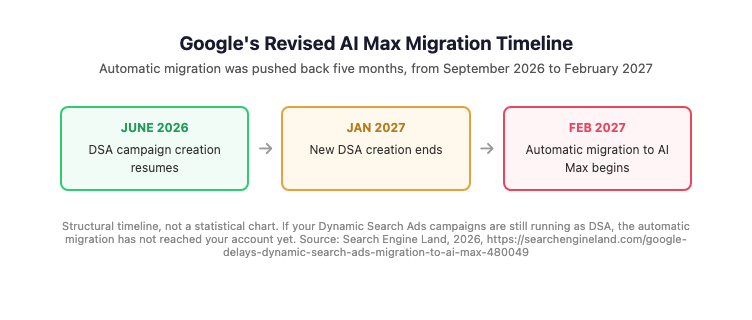
Figure 1 demonstrates Google's revised AI Max migration timeline, showing that automatic migration does not begin until February 2027, five months later than originally scheduled.
If your DSA campaigns are still running as DSA campaigns, the automatic migration has not reached you yet. A performance drop in that window came from something else, and treating it as an AI Max problem sends you looking in the wrong place while the actual cause keeps costing money.
What AI Max Actually Changes
AI Max is Google's automated layer for Search campaigns, expanding how queries are matched and how creative is assembled rather than leaving those decisions to manually defined keywords and ads. Google's own testing claim is narrow and worth reading precisely: campaigns achieved their first conversion faster during the first two weeks after launch.
Faster first conversion is not the same claim as better sustained cost per conversion, and it is not a claim about ROAS at all. Reading a narrow claim as a broad one is how advertisers end up surprised three weeks later.
That distinction matters commercially because the automation changes what traffic arrives, and traffic composition is exactly the variable that determines whether your existing landing page still converts at the rate it used to.
The Diagnostic That Settles It
Before touching campaign settings, check whether budget is even the constraint on your account.
Look at your Lost impression share due to budget metric. If it reads 0%, raising your budget is unlikely to have any impact, because there is no additional impression inventory your current budget is missing out on. An account at 0% that responds to a performance drop by adding budget is buying the same impressions at the same conversion rate, which is the same mistake as more ad spend not meaning more conversions.
Where Post-Migration Drops Actually Come From
Four causes account for most of what gets blamed on AI Max.
The Campaign Was Never Migrated
Covered above, and worth checking first because it costs thirty seconds and rules out the entire theory. Open the campaign and confirm what type it actually is.
Query Composition Changed, So the Landing Page Now Mismatches
Broader automated matching brings in queries your ad copy and landing page were never written for. The click still costs the same, but the visitor arrives with a different intent, and the page answers a question they did not ask. This is a message match failure created by a targeting change rather than a copy change.
Conversion Tracking Broke and Nobody Noticed
Campaign type changes are a common moment for conversion actions to stop firing correctly. Performance that looks like it collapsed is sometimes performance that stopped being counted. Verify the conversion action is still recording before diagnosing anything else.
The Drop Predates the Change
Pull the date range wider than the incident. If conversion rate was already declining for six weeks before the switch, the switch is not the cause, it is the moment someone finally looked at the account.
Diagnostic Checklist
Your performance drop is probably not an AI Max problem if:
Your campaigns are still listed as their original type in the campaign table
Conversion rate was already trending down before the change date
Lost impression share due to budget reads 0%, meaning budget was never the constraint
Your conversion action last recorded a conversion before the change but not after, which points at tracking rather than delivery
Impressions held steady or rose while conversions fell, which points past the click
The landing page has not been reviewed against the queries actually arriving now
Fix Sequence
Confirm the campaign type in the account rather than assuming the migration reached you
Verify conversion tracking is still firing before interpreting any performance number
Pull a date range wide enough to see whether the decline predates the change
Review the search terms report against your landing page copy, since automated matching changes what arrives
Fix the post-click mismatch before adjusting bids or budget
Only after those four, test campaign settings changes, one at a time
What This Check Looks Like in Practice
Say enquiries from Google Ads dropped in late August and the obvious suspect is the AI Max news. Here's how the checklist above settles it in about fifteen minutes.
Open the campaign table first. If the campaigns still show as Search or Dynamic Search Ads, AI Max isn't running, and that rules out the theory before anything else.
Next, widen the date range to 90 days. A decline that started in June is not an August platform change, whatever the timing of the headlines.
Then check what changed on the landing page in that window: an edited enquiry form, a new pop-up, a slower load, a rewritten headline. Changes after the click are the most common thing mistaken for a platform problem, because they don't show up anywhere in the ad account.
If all three come back clean and impressions fell along with conversions, the cause is more likely on the delivery side, and that's when campaign settings are worth investigating.
Where the ThriveX AI Audit Fits
A platform change is a convenient explanation for a performance drop, which is exactly why it is worth ruling out properly. Accounts that spend weeks fighting a migration that never happened lose more than accounts that check first.
This is where the invisible friction AI audit fits. ThriveX reviews whether the constraint sits in the ad account, in tracking, or in the page receiving the click, so the fix goes where the loss actually is.
If your paid performance dropped and you are not certain why, the audit is priced at $49 during beta, with standard pricing at $99.
FAQ
Has Google already switched my campaigns to AI Max?
Not automatically, if you are running Dynamic Search Ads. Google delayed the automatic DSA to AI Max migration from September 2026 to February 2027. Open your campaign table and confirm the campaign type directly rather than assuming, since the answer changes what you should be fixing.
When does the AI Max migration actually happen?
Google's published timeline resumed DSA campaign creation in June 2026, ends new DSA creation in January 2027, and begins automatic migration in February 2027. That leaves a testing window in between, which Google has encouraged advertisers to use for side by side comparison.
How do I tell a targeting problem from a landing page problem?
Compare impressions against conversions across the same period. If impressions held steady or grew while conversions fell, the loss is happening after the click, which points at the landing page or tracking rather than delivery. If impressions themselves collapsed, the cause sits in delivery or budget.
Should I increase budget to recover a drop?
Check Lost impression share due to budget first. At 0%, extra budget buys no additional impressions and simply spends more at your existing conversion rate. Recovering a drop by raising spend without diagnosing it multiplies the loss rather than reversing it.
Further Reading
Why More Ad Spend Doesn't Mean More Conversions Without CRO First: https://www.thrivex.tech/blogs/why-more-ad-spend-doesnt-mean-more-conversions
Why Meta Ads Underperform When the Landing Page Breaks Message Match: https://www.thrivex.tech/blogs/message-match-meta-ads-landing-page
The Website Conversion Audit Checklist to Run Before Increasing Ad Spend: https://www.thrivex.tech/blogs/website-conversion-audit-checklist
The Invisible Friction AI Audit: What Google Analytics Cannot Tell You: https://www.thrivex.tech/blogs/invisible-friction-ai-audit