Why Is My AI Marketing Not Working?
By Jetson, Head of CRO at ThriveX
Reading time: 6 minutes. Last updated: August 2026.

Author's Note
Founders come to us after buying two or three AI marketing tools and seeing no real movement in revenue. The tools work exactly as advertised. The problem sits somewhere else. This guide explains the actual mechanism behind AI marketing underperformance, using the 6 AI Marketing Trends that actually matter as the starting reference point, and where the ThriveX AI Audit fits if you need a direct answer for your own stack.
The Tools Aren't the Problem
MIT's Project NANDA studied 300 public AI deployments, 52 executive interviews, and survey responses from 153 senior leaders, and found that 95% of generative AI pilots deliver no measurable impact on profit and loss. The report's own framing matters here: the core issue is not model quality. It is what MIT calls a learning gap, tools that don't adapt to how a specific business actually works.
The same research found that sales and marketing receive over half of enterprise AI budget allocation, despite back-office automation showing stronger measurable ROI. Marketing is where the most AI money goes and where the failure rate is least visible, because a content tool can look productive without ever being tied to a revenue number.
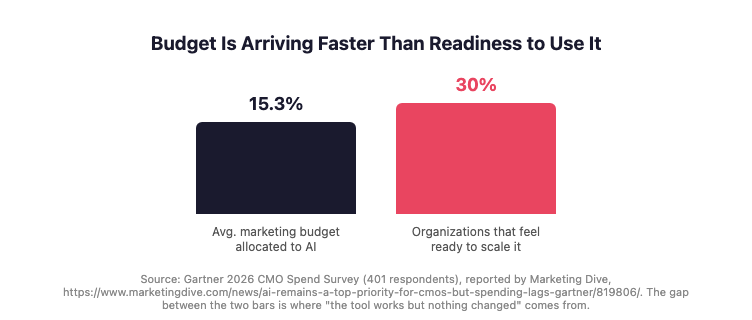
Figure 1 demonstrates the gap between AI budget allocation (15.3%) and organizational readiness to scale it (30%), based on Gartner's 2026 CMO Spend Survey of 401 marketing leaders.
Gartner's 2026 CMO Spend Survey, covering 401 marketing leaders across North America, Europe, and the UK, found CMOs now allocate an average 15.3% of marketing budget to AI, yet only 30% of organizations report being genuinely ready to scale their AI capabilities. Budget is arriving faster than the operational readiness needed to use it well, the same gap that shows up as "the tool works but nothing changed."
That combination, heaviest spend and weakest measurement, explains why "my AI marketing isn't working" is such a common complaint despite near-universal tool adoption.
What "Not Working" Actually Means
When founders say AI marketing isn't working, they usually mean one of three different things, and the fix is different for each.
The Tool Produces Output, But Nothing Changes Downstream
Content generation, ad copy variants, email drafts. The tool works. Nobody measures whether the output changed a conversion rate, a reply rate, or a close rate. This isn't a tool failure. It's a measurement gap.
The Tool Was Layered Onto a Broken Process
An AI chatbot answering leads that a slow, unclear website already lost. A personalization engine optimizing an offer nobody understands. AI cannot fix upstream structural problems. It can only accelerate whatever process it's plugged into, for better or worse. This is the same pattern the 2026 Efficiency Gap describes: AI compounds an existing advantage, it does not create one from nothing.
The Tool Was Never Integrated Into a Real Workflow
The MIT research found purchased, vendor-built AI tools succeeded roughly twice as often as tools built or stitched together internally without a clear operating process around them. A tool used ad hoc, outside any defined workflow, rarely survives past the trial period.
Diagnostic Checklist
Before concluding the tool itself is the problem, check these six things.
Is there a specific, named metric this tool is supposed to move, and is anyone tracking it weekly?
Is the tool plugged into an existing workflow, or does someone have to remember to use it?
Does the tool's output ever get reviewed by a human before it reaches a customer?
Is the upstream process (the page, the funnel, the offer) actually sound, or is the tool compensating for something broken further back?
Was this tool purchased for a defined use case, or adopted because it seemed important to "have AI"?
If the tool disappeared tomorrow, would anyone notice a number change, or just notice the workflow feels slower?
Fix Sequence
Pick one AI tool currently in use and name the single business metric it's meant to move
Check that metric against a baseline from before the tool was introduced
If the metric hasn't moved, trace the workflow the tool sits inside and find where a human still has to manually intervene
Fix the upstream process issue before adding a second tool to compensate for the first one's lack of results
Only then evaluate whether the tool itself, not the process around it, is the actual constraint
This is the same sequencing discipline behind CRO before ads: fix the structure the spend or the tool depends on before adding more of either.
How This Plays Out for a Malaysian SME
Before: A KL-based skincare DTC brand adopted an AI product description generator and an AI email personalization tool within the same quarter, expecting a lift in both organic conversion and email revenue.
Diagnosis: The email tool personalized subject lines against a list that hadn't been segmented in over a year, and the product description generator was producing copy for pages that weren't ranking or converting to begin with. Neither tool had a workflow around it beyond "turn it on."
Fix: The team paused the AI tools for two weeks, fixed list segmentation manually, and rewrote the three highest-traffic product pages using the diagnostic process from the existing conversion audit. Only then did they re-enable the AI tools against the now-cleaner foundation.
After: Email revenue per send increased on the same list size, and the product description tool's output started reflecting the page structure that was actually converting.
This example is illustrative, not drawn from a documented ThriveX case study.
Where the ThriveX AI Audit Fits
Most founders cannot tell, from the outside, whether an underperforming AI tool is genuinely misconfigured or whether it's compensating for a structural problem further back in the funnel. Both look identical: flat numbers, no clear reason why.
This is where the invisible friction AI audit fits. ThriveX reviews the actual workflow an AI tool sits inside, not just the tool's own settings, to identify whether the constraint is the tool, the process around it, or the page and funnel it's plugged into.
If your AI marketing stack isn't moving the numbers you expected, the audit is priced at $49 during beta, with standard pricing at $99, and built to find the real constraint before you add another tool.
FAQ
Why isn't my AI marketing tool improving my results?
Usually because it's producing output without being tied to a tracked business metric, or because it was layered onto a process that was already broken upstream. MIT's Project NANDA found that 95% of generative AI pilots deliver no measurable P&L impact, and named workflow integration, not model quality, as the primary cause.
How do I know if the problem is the AI tool or something else in my funnel?
Trace the workflow the tool sits inside. If the tool depends on an earlier step, a page, a list, an offer, that isn't working, the tool inherits that failure regardless of how well it performs its own task. Fixing the upstream step first is the faster diagnostic path.
Should I stop using AI marketing tools if they're not showing results?
Not necessarily. Pause and check whether the tool has a defined metric and a real workflow around it before deciding it doesn't work. A tool without either of those is unlikely to show results no matter how capable the underlying model is.
Is buying more AI tools the fix for slow results?
Usually not. Adding tools without fixing the process they operate inside compounds the same gap rather than closing it. The research on this is consistent: purchased tools plugged into a defined workflow succeed at a much higher rate than tools added on top of an undefined one.
Further Reading
The 6 AI Marketing Trends That Actually Matter for 2025-2026: https://www.thrivex.tech/blogs/ai-marketing-trends-2025-2026
How Modern Brands Operationalize AI Across Their Marketing Stack: https://www.thrivex.tech/blogs/operationalize-ai-marketing-stack
AI for Small Business: A Practical 30-Day Starter Guide: https://www.thrivex.tech/blogs/ai-tools-small-business-30-day-guide
The Invisible Friction AI Audit: https://www.thrivex.tech/blogs/invisible-friction-ai-audit