By Susan, Head of Paid Ads at ThriveX
Reading time: 5 minutes. Last updated: October 2026.
Author's Note
A lead campaign with a low cost per lead and a pile of contacts who never answer looks like a success in Ads Manager and a failure in the sales team's inbox. Meta's default settings explain much of it. The default form, the default goal and slow follow-up all push toward more submissions, and none of them asks whether the person is likely to buy. If you want a direct read on what happens after the click, the ThriveX AI Audit checks that side.
Why Are My Facebook Leads Low Quality? The Short Answer
Usually because the campaign is doing what it was set up to do. Meta describes its default instant form type, More volume, as designed to generate a larger number of leads. Optimised for submissions, the campaign finds people who submit easily, and some were never going to buy. Those leads still use up sales time, which is part of why cost per lead keeps rising while the dashboard looks fine.
The five usual causes:
The form makes submitting too easy: prefilled fields and no review screen
The form does not qualify anyone: only name, phone and email
The goal is submissions, not sales: Meta never learns who bought
The ad does not filter: price, commitment or eligibility left out
Follow-up is slow or weak: the lead moves on before anyone calls
What Counts as a Low-Quality Lead?
A contact who cannot be reached, is not a fit, or is not serious enough to buy. Unreachable leads point to the form, poor-fit leads to the ad and the form questions, and leads that go cold to what happens after submission, which Ads Manager cannot show.
What Does Meta Say About Lead Quality?
Meta says fewer multiple choice questions on an instant form produce more submissions, while more multiple choice questions typically produce more quality leads. It also recommends building lookalike audiences from existing customers rather than from form submitters.
Meta's second form type, Higher intent, adds a review screen where people confirm their details and a note that the business may follow up. Meta says these help prevent submissions from people who are only marginally interested. Higher intent forms run only in Facebook Feed and Instagram feed on mobile.
Where Do Low-Quality Facebook Leads Come From?
1. The Form Makes Submitting Too Easy
Prefilled fields let a person submit before deciding much. If your form is still on More volume and quality is the complaint, test Higher intent on part of the budget. Expect fewer leads, and judge the test on cost per qualified lead.
2. The Form Does Not Qualify Anyone
Name, phone and email collect contacts, not information. Add one to three multiple choice questions that sort leads the way your sales team already does: budget range, timeline, which service. Keep it short: in checkout research, Baymard Institute found the average 2024 checkout had 11.3 form fields when 8 were needed.
3. The Goal Is Submissions, Not Sales
By default Meta learns to find more people who submit. Its Conversion Leads goal learns from your CRM's lead outcomes instead, and Meta says it may yield higher quality leads. Meta's developer documentation recommends at least 200 leads a month, a lead stage reached within 28 days, a stage conversion rate between 1% and 40%, and the Meta Lead ID stored in your CRM.
Many Malaysian SMEs do not reach 200 leads a month. Below that, build lookalikes from customers and review lead quality by ad and by form answer every week.
4. The Ad Does Not Filter
An ad that stresses free, fast and easy attracts people who want free, fast and easy. State the price range, minimum commitment or eligibility in the ad, so the filtering happens before the click and not on your sales team's time. This is practitioner judgement, and the same principle as message match between the ad and the landing page.
5. Follow-Up Is Slow or Weak
On ThriveX accounts, some of the clearest results sit after the lead arrives. A KL and Johor wellness and spa brand held a phone number conversion rate above 30% on Messenger campaigns, and the deciding factor was the quality of the human follow-up more than the ad creative. Meta notes that a burst of leads can overwhelm a sales team and suggests ad scheduling to keep volume within what the team can answer.
Diagnostic Checklist
Your Facebook leads are low quality because of how the campaign is built if:
The instant form is still on More volume
The form asks only name, phone and email
Cost per lead is low, but fewer than half of leads answer a first call
The campaign optimises for submissions and nobody records who bought
Lookalike audiences are built from form submitters, not customers
The ad leaves out price, commitment or eligibility
First contact with a new lead takes more than a day
Fix Sequence
Mark the last thirty leads as reached, qualified or bought
Add one to three qualifying multiple choice questions
Test Higher intent on part of the budget and compare cost per qualified lead
Put the price range, commitment or eligibility in the ad
Set a first-contact target and use ad scheduling so volume never outruns your team
Record outcomes by ad and by form answer, and rebuild lookalikes from customers
At about 200 leads a month, connect your CRM and test Conversion Leads
What This Check Looks Like in Practice
Say a campaign brings fifty leads a week at a low cost per lead, and sales reaches fewer than half. Mark the last thirty leads as reached, qualified or bought. If most failed at the first call, check the form type and prefilled fields.
Next, compare the form answers of buyers against everyone else; a question that separates them, such as timeline or budget, becomes required. Then compare hours to first contact with who answered. The step where most leads fall out is the fix for the month.
What Does Good Lead Quality Look Like?
A Penang dental clinic that ThriveX ran Meta messaging and engagement campaigns for spent about RM2,000 a month, and four dental implant cases worth RM20,000 in total came through, roughly 10 times the spend. It was a messaging campaign, not an instant form, but the lesson carries over: for high-value services, lead quality and follow-up matter more than lead count.
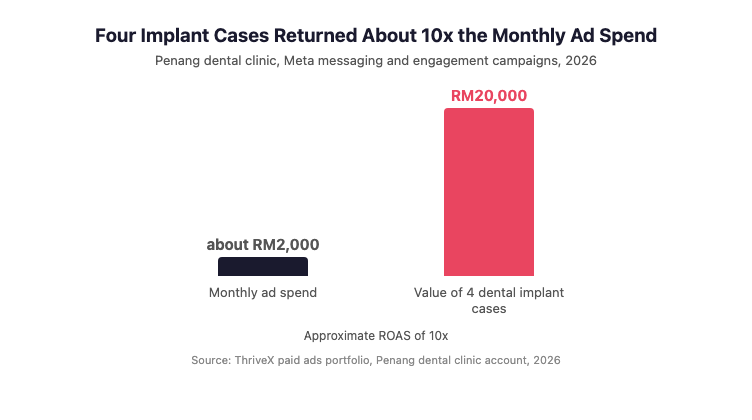
Figure 1 demonstrates that a Penang dental clinic's Meta messaging campaigns turned about RM2,000 of monthly spend into four implant cases worth RM20,000, showing that lead quality and conversion journey outweigh lead volume for high-value services.
Where the ThriveX AI Audit Fits
Meta's reports show how many leads you got and what each cost, but not how your form and landing page set expectations. The ThriveX AI Audit reviews that destination side, and the same checks apply to your contact form.
If your leads arrive cheaply but do not become customers, the ThriveX AI Audit is priced at $49 during beta, with standard pricing at $99.
FAQ
Why are my Facebook leads fake or never answer?
Often they are real people who submitted on impulse or mistyped a detail, which the default More volume form with prefilled fields makes easy. Add a qualifying question, test the Higher intent type with its review screen, and contact new leads quickly. Check a sample before assuming they are fake.
What is the difference between More volume and Higher intent forms?
More volume is the default and is designed to generate a larger number of leads. Higher intent adds a review screen and a note that the business may follow up, which Meta says helps prevent submissions from marginally interested people. Higher intent forms appear only in mobile Facebook and Instagram feeds.
How many questions should a Facebook lead form have?
There is no fixed number. Meta says fewer multiple choice questions produce more submissions, and more typically produce more quality leads. Start with the one to three questions your sales team uses to sort leads, then test form length against cost per qualified lead.
Can Facebook optimise for leads that actually buy?
Yes, through the Conversion Leads goal, which learns from lead outcomes sent from your CRM. Meta's documentation recommends at least 200 leads a month, a lead stage within 28 days and the Meta Lead ID stored in your CRM. Below that volume, manual tracking by ad and form answer is more practical.
Further Reading
Why Are My Facebook Ads Not Converting?: https://www.thrivex.tech/blogs/why-are-my-facebook-ads-not-converting
Why Your Cost Per Lead Keeps Rising: https://www.thrivex.tech/blogs/cost-per-lead-keeps-rising
Why Meta Ads Underperform When the Landing Page Breaks Message Match: https://www.thrivex.tech/blogs/message-match-meta-ads-landing-page
Why Your Contact Form Is Losing You Leads: https://www.thrivex.tech/blogs/contact-form-losing-leads
Why Is My Website Getting Traffic But No Sales? What Google Analytics Cannot Tell You: https://www.thrivex.tech/blogs/invisible-friction-ai-audit