By Susan Wong, Head of Paid Ads at ThriveX
Reading time: 5 minutes. Last updated: October 2026.

Author's Note
Many Google Ads accounts saw returns fall in late August 2026, and the first reaction is usually to rebuild the campaign or switch bid strategy. Google changed how target-based bidding behaves for campaigns limited by budget, and the target that used to sit in the background now steers spend. This guide explains the change, how to tell whether it hit your campaigns, and what to adjust. If you want a direct read on the page side of your paid traffic, the ThriveX AI Audit checks what happens after the click.
Why Did My Google Ads Sales Drop After the Target ROAS Change? The Short Answer
Because your campaign now aims at the target you set instead of beating it. Since 17 August 2026, campaigns that are limited by budget and use Target ROAS or Target CPA move toward their target, and Google says it will not change your targets or budgets for you. If your target was looser than your real results, the campaign now buys more expensive traffic to reach the looser number.
Check three things:
Status: the campaign shows "Limited by budget"
Strategy: it uses Target ROAS or Target CPA
Gap: before mid-August it was clearly beating its target
If all three are true, reset the target to the return you actually want, or move to a Maximize strategy.
What Did Google Change on 17 August 2026?
How budget-limited campaigns treat the target. Google's example: a campaign with a $10 Target CPA that has been achieving $5 "now delivers more closely to a $10 USD actual CPA", and to keep the $5 result you would set the target to $5. The change covers Search, Shopping, Performance Max, Demand Gen, Display, Hotel and Travel campaigns; Display and Hotel already worked this way, and App and Video reach and view campaigns are not affected.
Google's options: keep the target, adjust it to recent performance, switch to a Maximize strategy, or raise the budget carefully.
How Do I Know If the Change Hit My Campaigns?
Compare the weeks before and after 17 August for campaigns that meet all three checks above. Amsive compared the first week after the change with the three weeks before across hundreds of campaigns: Target CPA Search campaigns stayed close to baseline, while Target ROAS Search campaigns got more clicks at a lower cost per click but ROAS fell 32%. Amsive calls this an early signal from a smaller Target ROAS group.
The pattern is easy to see in one public case. An advertiser on Reddit reported that a Shopping campaign with a 300% Target ROAS had been returning about 3,000% to 4,000% while limited by budget, and that sales fell after 17 August. A 300% target told Google that a much lower return was acceptable, and after the change it began bidding toward it.
If the drop started earlier, or the campaign is not limited by budget, check the AI Max switch, tracking and landing pages first.
Why Does a Loose Target Cost Money?
Because Google treats the target as permission. Pasar Mart UK, an online grocery store whose Google Ads ThriveX reviewed, shows it, from before the August change. In March 2026 its main campaign moved from a 1,000% Target ROAS to a Target CPA of £8, while its sales were actually costing about £4.30 each. Over the next four weeks, against the four before, cost per sale rose from £4.32 to £6.13 (up 42%), ROAS fell from 10.6x to 7.0x, and sales fell from 180 to 124.
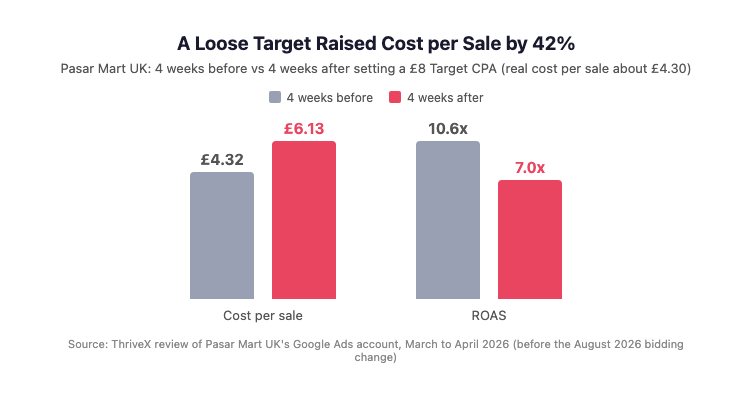
Figure 1 demonstrates that setting a Target CPA of £8 when sales actually cost about £4.30 raised cost per sale by 42% and cut ROAS from 10.6x to 7.0x within four weeks, showing that Google spends toward the target it is given.
The account told Google it could pay nearly twice its real cost per sale, and Google spent accordingly.
Since 17 August, budget-limited campaigns follow the target even more closely.
How Do I Set the Right Target?
Start from what you have actually achieved. Google advises setting Target ROAS from your business goals with historical ROAS as the reference: add the Conv. value / cost column and multiply by 100. It also warns that a target set too high may limit the traffic your ads get, so a stricter target trades volume for return.
Diagnostic Checklist
The 17 August change is the likely cause of your drop if:
The decline started on or soon after 17 August 2026
The affected campaigns show "Limited by budget"
They use Target ROAS or Target CPA, not a Maximize strategy without a target
Before August, actual ROAS was well above the target, or actual CPA well below it
Clicks or spend rose while return per click fell
Tracking and landing pages did not change in the same week
Fix Sequence
Confirm the cause: check the start date, budget status and target gap for each campaign
Find your real number: read the last eight weeks of ROAS or cost per sale, allowing for conversion delay
Decide the trade-off: a stricter target for return, or a looser one or a Maximize strategy for volume
Change one thing: set the target close to the real number, not far below or above it
Leave it alone: judge after two conversion cycles or two weeks, whichever is longer
Raise budget only when the target holds: in steps, keeping the budget comfortably above average daily spend
What This Check Looks Like in Practice
Open Campaigns, add the Bid strategy type and Status columns, and filter for target-based campaigns marked "Limited by budget". Compare each target with what the campaign achieved in the eight weeks before 17 August, and mark large gaps, such as a 300% target on a campaign returning over 1,000%.
For those, compare the four weeks after the change with the four before. If clicks rose and ROAS fell, set the target near the return you need and note the date. If nothing changed, the drop has another cause, and the post-click checks in why more ad spend does not mean more conversions are the next step.
Where the ThriveX AI Audit Fits
Bidding decides which clicks you buy and at what price; the landing page decides what they are worth. When targets push spend toward pricier traffic, a page that converts poorly turns a small bidding change into a large drop in return. The ThriveX AI Audit reviews that page side, as in fixing conversion before you scale.
If your Google Ads return fell and you want to know whether the page is part of it, the ThriveX AI Audit is priced at $49 during beta, with standard pricing at $99.
FAQ
What changed in Google Ads on 17 August 2026?
Campaigns limited by budget that use Target CPA or Target ROAS now aim to perform toward the target you set, instead of beating it. Google's example is a $10 Target CPA campaign achieving $5 that now delivers closer to $10. Google does not change targets or budgets for you.
Why did my ROAS drop after the Google Ads update?
Usually because the target was looser than the campaign's real results. A budget-limited campaign that returned far more than its Target ROAS now bids toward the lower target, often buying more expensive clicks. Check whether the campaign is limited by budget and how far its target sat from its actual ROAS.
Should I switch from Target ROAS to Target CPA or Maximize Conversion Value?
Not as a first step. Setting the existing target near your real return is usually the smaller change. Maximize Conversion Value without a target keeps volume but lets return move with budget. Target CPA treats every sale as equal value, which suits leads better than shop orders of different sizes.
How long should I wait after changing my target?
Google says target changes do not restart the learning period, but results can take one to two conversion cycles to settle. Judge the change over two conversion cycles or two weeks, whichever is longer, and avoid changing the target again within one cycle unless the business needs it.
Further Reading
Why Did My Google Ads Performance Drop After the AI Max Switch?: https://www.thrivex.tech/blogs/google-ads-ai-max-performance-drop
Why More Ad Spend Doesn't Mean More Conversions Without CRO First: https://www.thrivex.tech/blogs/why-more-ad-spend-doesnt-mean-more-conversions
How to Increase ROAS Without Increasing Ad Spend: Fix Conversion Before You Scale: https://www.thrivex.tech/blogs/cro-before-ads
Why Are My Facebook Ads Not Converting?: https://www.thrivex.tech/blogs/why-are-my-facebook-ads-not-converting
The Website Conversion Audit Checklist to Run Before Increasing Ad Spend: https://www.thrivex.tech/blogs/website-conversion-audit-checklist