Why Your Landing Page Is Not Converting
By Jetson, Head of CRO at ThriveX
Reading time: 6 minutes. Last updated: August 2026.
Author's Note
A landing page with real traffic and a flat conversion rate is one of the most expensive problems in a funnel, because the ad spend already did its job. This is the exact failure point CRO before ads warns against: more traffic cannot fix a page that already loses the visitors it has. This guide walks through why landing pages fail to convert specifically, using the real Pretty Little Fit case study as the anchor, and where the ThriveX AI Audit fits if you need a direct read on your own page.
The Median Landing Page Converts Worse Than You Think
Unbounce's Conversion Benchmark Report, analyzing over 41,000 landing pages and 464 million visitors, found the median conversion rate across all industries sits at 6.6%, with industry-specific medians ranging as high as 12.3% for the strongest-converting sectors. That gap, between the all-industry median and what the best-performing sectors achieve, is explained largely by structural clarity, not traffic quality or ad targeting.
Load time compounds the problem before a visitor ever reaches the offer. Google's own analysis found that as mobile page load time increases from 1 to 3 seconds, the probability of a visitor bouncing increases by 32%. A slow page loses visitors before the message even has a chance to land.
Where Landing Pages Actually Break
Four patterns account for most underperforming landing pages.
The Page Doesn't Continue the Ad's Promise
A visitor who clicked a specific claim expects the landing page to open with that same claim. When the landing page pivots to a generic homepage message instead, the visitor has to re-decide whether this is still relevant, and many don't.
The Offer Isn't Clear in the First Five Seconds
If a visitor cannot state what's being offered and why it matters to them within the first few seconds on the page, they won't invest the effort to figure it out. Clarity has to arrive before persuasion.
Trust Signals Are Missing or Buried
Reviews, guarantees, real photos, and credibility markers need to be visible near the point of decision, not scrolled past or relegated to a footer. A visitor deciding whether to convert is looking for reassurance at the exact moment they're asked to commit.
The Page Asks for Commitment Before Building Confidence
Pages that push straight to a hard CTA without addressing likely objections first lose visitors who had real intent but weren't ready to commit yet. The page needs to answer the objection before the visitor has to ask it.
Diagnostic Checklist
Does your landing page open with the exact claim the ad made, or a generic message?
Can a first-time visitor state your offer within five seconds of landing?
Are trust signals (reviews, guarantees, credibility markers) visible without scrolling past the main CTA?
Does the page load in under 3 seconds on mobile?
Does the page address the most common objection before asking for commitment?
Have you tested this page against a real conversion benchmark, or only against your own past performance?
Fix Sequence
Audit message match between your top ad and its landing page first, before anything else
Rewrite the opening section so the offer is unmistakable within five seconds
Move trust signals up, near the primary CTA, not buried in a footer
Check mobile load time and fix anything pushing past 3 seconds
Address the single most common objection directly on the page before the final CTA
Re-test against the Unbounce benchmark (6.6% median across industries) to gauge where the page actually stands
The Pretty Little Fit Case Study
Before: Pretty Little Fit, a DTC apparel brand, was converting at 1.2% on its primary landing page despite steady, well-targeted traffic.
Diagnosis: The page buried the core offer below unrelated brand content, delayed trust signals until far down the page, and didn't clearly continue the promise made in the ads driving traffic to it.
Fix: The page was restructured to lead with the specific offer, move trust signals and social proof above the fold, and tighten message match with the ad creative driving traffic.
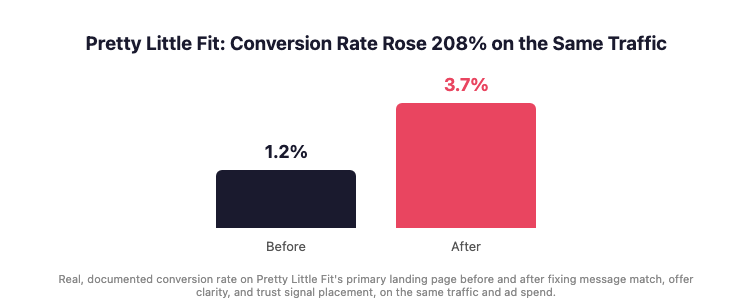
Figure 1 demonstrates Pretty Little Fit's real, documented conversion rate increase after fixing message match, offer clarity, and trust signal placement, without any change in traffic or ad spend.
After: Conversion rate rose from 1.2% to 3.7%, a 208% increase, on the same traffic and the same ad spend. That is the difference fixing the page makes before increasing ad budget instead of after.
This is a real, documented case study, not an illustrative example.
Where the ThriveX AI Audit Fits
A landing page can look fine on a quick scan and still be losing the majority of qualified traffic to friction that isn't obvious without a structured review. Most founders don't have a reliable way to separate a genuine offer problem from a page-clarity problem.
This is where the invisible friction AI audit fits. As a CRO and AEO diagnostic consultancy, ThriveX reviews your landing page against the specific friction points covered here, message match, offer clarity, trust signal placement, and objection handling, before you spend more on traffic to send to it.
If your landing page has real traffic and a flat conversion rate, the audit is priced at $49 during beta, with standard pricing at $99, and built to find the specific fix.
FAQ
What's a good landing page conversion rate?
The median across industries is 6.6%, based on an analysis of over 41,000 landing pages and 464 million visitors. The strongest-converting industries reach medians as high as 12.3%. If your page sits well below 6.6%, structural friction is a more likely explanation than traffic quality.
Why does my landing page get traffic but not convert?
The most common causes are a mismatch between what the ad promised and what the page delivers, an offer that isn't clear within the first few seconds, missing or buried trust signals, and asking for commitment before addressing the visitor's likely objection.
Does page load speed really affect conversion that much?
Yes. Google's own data found bounce probability increases 32% as mobile load time goes from 1 to 3 seconds. A visitor who bounces before the page finishes loading never gets the chance to evaluate your offer at all.
Should I add more content to my landing page to build trust?
Not necessarily more content, more clarity. Trust signals need to be positioned where the visitor is actually deciding, near the primary CTA, not simply added in volume elsewhere on the page. A shorter page with well-placed trust signals often outperforms a longer one with them buried.
Further Reading
CRO Before Ads: Why Malaysian DTC Brands Burn Marketing Budget at the Wrong End of the Funnel: https://www.thrivex.tech/blogs/cro-before-ads
Why Meta Ads Underperform When the Landing Page Breaks Message Match: https://www.thrivex.tech/blogs/message-match-meta-ads-landing-page
The Invisible Friction AI Audit: What Google Analytics Cannot Tell You: https://www.thrivex.tech/blogs/invisible-friction-ai-audit
The Add-to-Cart Bottleneck: Why High-Traffic Product Pages Fail to Convert in Malaysia: https://www.thrivex.tech/blogs/add-to-cart-bottleneck
How to Reduce Cart Abandonment in Malaysia: 3 Checkout Fixes That Actually Work: https://www.thrivex.tech/blogs/cart-abandonment-checkout-fixes